
Card-to-Crypto Payments Let Customers Pay With Their Credit Card While Merchants Receive USDC
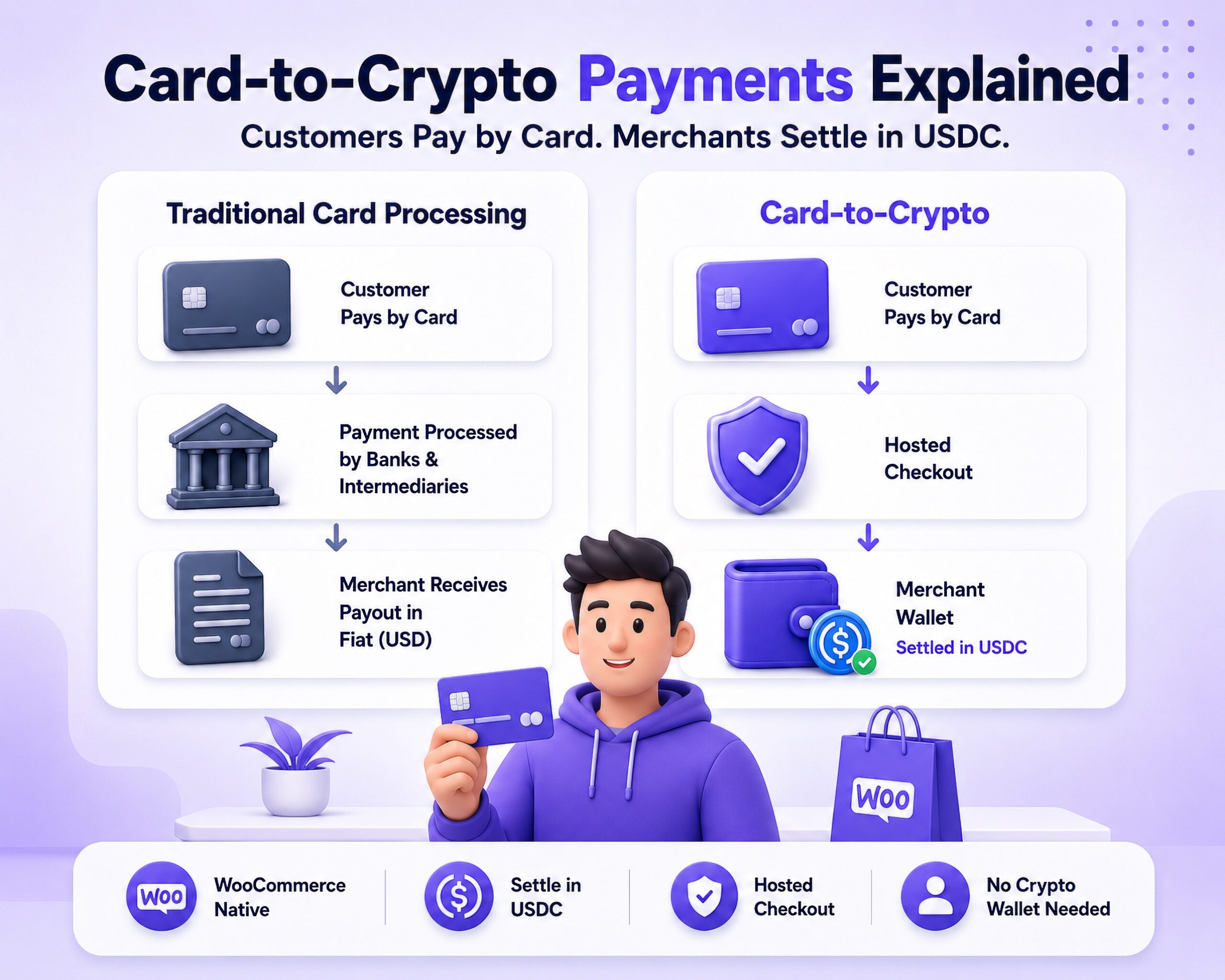
Card-to-crypto payments are a checkout architecture that allows customers to pay using traditional payment methods while merchants receive settlement in cryptocurrency, typically a stablecoin such as USDC. The customer experiences a familiar card payment, while the WooCommerce merchant receives blockchain-based settlement through a hosted checkout provider.
In practice, that means a customer pays using a normal debit card, credit card, Apple Pay, Google Pay, or supported local payment method. Behind the scenes, a hosted checkout provider converts the customer’s fiat payment into cryptocurrency and settles USDC directly to the merchant’s wallet. The WooCommerce store does not require a traditional merchant account dedicated to crypto settlement and does not need to build blockchain infrastructure from scratch.
Last updated: July 14, 2026
Key Highlights
- Customers pay with familiar payment methods.
- WooCommerce merchants receive USDC directly to their wallet.
- WooCommerce continues managing orders.
- VERIFIED provides checkout infrastructure — not payment processing.
- Hosted providers handle payment execution, compliance, and customer verification.
- No blockchain development is required.
- Supports classic WooCommerce, Blocks, and headless storefronts.
Direct Answer: What Are Card-to-Crypto Payments?
Card-to-crypto payments let a customer pay with a normal debit card, credit card, Apple Pay, Google Pay, or another supported payment method while the WooCommerce merchant receives settlement in cryptocurrency — typically USDC — in a wallet the merchant controls. A hosted checkout provider collects the fiat payment, performs required compliance and verification, converts the payment value to USDC, and settles it on-chain to the merchant’s wallet.
In simple terms, customers continue paying exactly as they normally would. The difference happens behind the scenes: instead of settling to a traditional merchant bank account, the hosted checkout provider converts the payment into USDC and settles it directly to the merchant’s wallet.
VERIFIED Crypto Checkout charges a 4% infrastructure fee on completed checkout transactions. Hosted provider fees, conversion costs, spread, network fees, and other provider-controlled charges are separate. According to the official WordPress.org plugin listing, on-chain settlement typically occurs within minutes, although actual timing depends on the provider, payment method, verification requirements, blockchain network conditions, and transaction approval. Traditional card-processing payouts commonly take two to three business days.
Card-to-crypto payments are a checkout architecture where customers pay with traditional payment methods while merchants receive cryptocurrency settlement through a hosted checkout provider.
What Are Card-to-Crypto Payments?
Card-to-crypto payments describe a specific arrangement: the customer pays in fiat using an everyday payment method, and the WooCommerce merchant receives cryptocurrency — commonly a stablecoin such as USDC — as settlement. The two sides of the transaction are denominated differently, and a hosted provider sits in the middle to bridge them.
That arrangement represents a meaningful shift in how online payments are structured. To understand why the category exists, it helps to separate the customer experience from the settlement mechanism. Card-to-crypto deliberately keeps the first familiar while changing the second.
The Customer Side Stays Ordinary
From the customer’s point of view, nothing unusual needs to happen. The customer reaches checkout, chooses to pay by card, enters payment details or uses Apple Pay or Google Pay, and completes the purchase. There is no wallet to install, no seed phrase to protect, no token to acquire in advance, and no blockchain transaction to manually send.
This removes the largest barrier to direct crypto commerce: the requirement that the customer already hold and understand cryptocurrency. By keeping the buyer experience conventional, card-to-crypto opens wallet settlement to ordinary card-paying customers rather than limiting the merchant to shoppers who already own digital assets.
The Merchant Side Receives Crypto Settlement
On the merchant’s side, the payment value arrives as USDC in a wallet the merchant controls — the settlement model described in the WooCommerce USDC payment gateway guide. Instead of receiving a traditional bank deposit from an acquiring processor, the merchant receives a stablecoin transfer on-chain.
USDC is commonly used because it is designed to track the value of the U.S. dollar, making it more practical for settlement than volatile crypto assets. Circle describes USDC as redeemable 1:1 for U.S. dollars and backed by highly liquid reserves.
Card-to-Crypto Payments vs Accepting Cryptocurrency
Accepting cryptocurrency and using card-to-crypto checkout are different payment models.
Accepting cryptocurrency means the customer already owns crypto and sends it directly to the merchant. The customer needs a funded wallet, must choose the correct network, may need to account for network fees, and bears responsibility for sending the transaction correctly.
Card-to-crypto payments reverse that requirement. The customer does not need crypto or a wallet. The customer pays in fiat through a hosted checkout, and the provider handles the conversion to crypto on the back end.
A WooCommerce store using card-to-crypto checkout is therefore not simply asking customers to pay in cryptocurrency. It is accepting familiar payment methods while choosing crypto settlement at the merchant layer.
Why the Category Is Growing
Several forces are pushing merchants toward this model. Stablecoins have become more practical as settlement rails, a development examined in the guide to USDC payments for ecommerce. Global ecommerce has outpaced the reach of traditional acquiring in some regions and merchant categories. Hosted providers have also industrialized the difficult parts of payment execution, customer verification, conversion, and wallet settlement.
The result is a category that sits between two systems: normal card acceptance for the customer and crypto settlement for the merchant.
Why This Category Exists
Card-to-crypto payments exist because traditional ecommerce and blockchain settlement were built on different assumptions.
Traditional ecommerce was built around banks. Card networks, acquiring banks, underwriting, rolling reserves, chargebacks, settlement windows, and bank payouts assume a bank account at the destination and a regulated merchant relationship behind the transaction.
Blockchain settlement was built around wallets. Crypto networks move value between wallet addresses rather than bank accounts. That structure can be global and wallet-native, but it assumes that participants already know how to use wallets and blockchain networks.
These systems do not connect naturally. A customer with a payment card cannot independently route value into a merchant’s USDC wallet, and a merchant with a wallet cannot independently pull funds from a card network.
Hosted checkout providers bridge the systems. They accept the customer’s payment, perform required verification, execute the payment through traditional rails, convert the payment value into crypto, and deliver settlement to the merchant’s wallet.
Card-to-crypto payments are therefore the meeting point between familiar customer payment methods and wallet-native merchant settlement.
How Card-to-Crypto Payments Actually Work
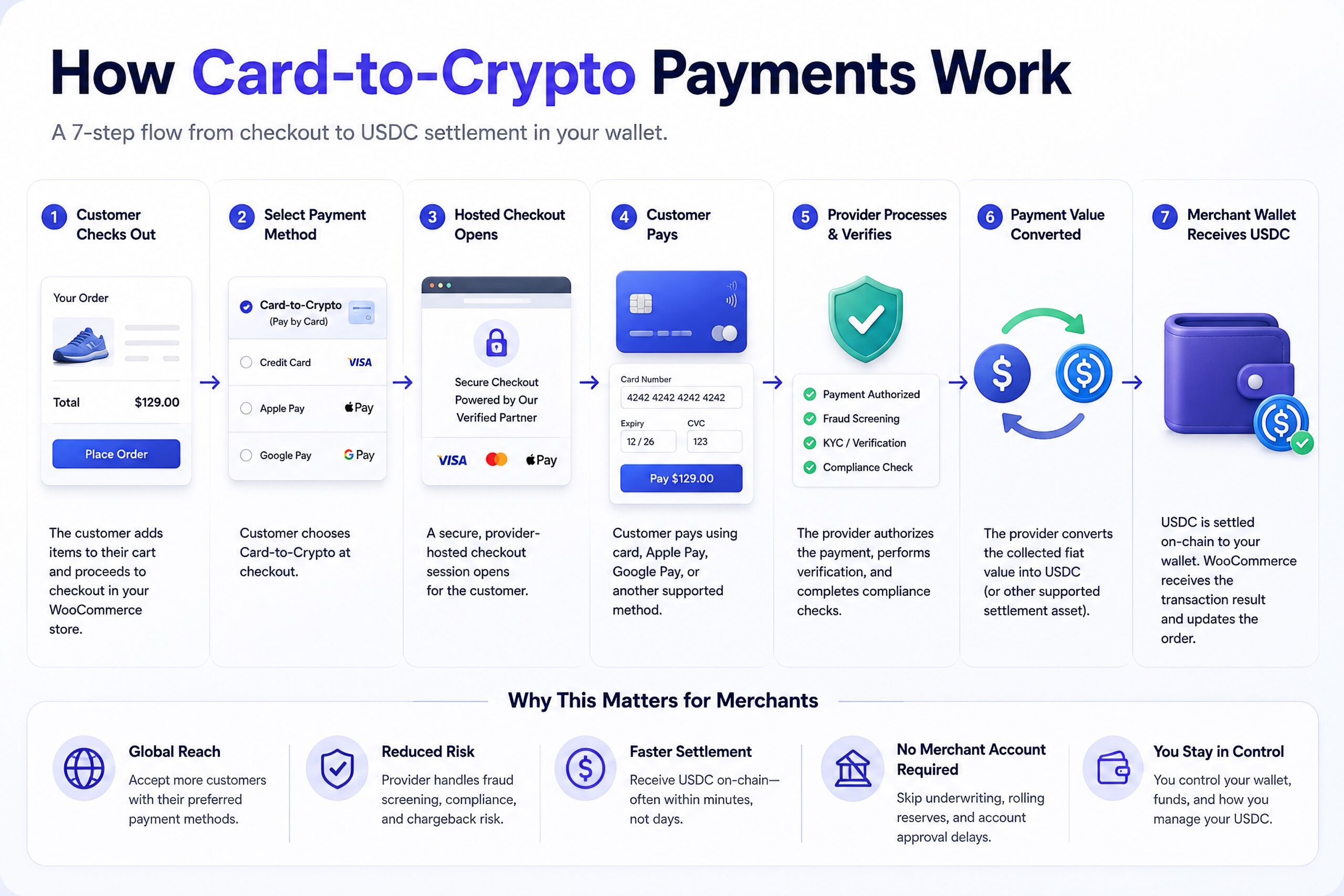
The customer-to-settlement flow can be explained in seven steps.
- Customer checks out — the customer reaches checkout in the WooCommerce store.
- Customer selects the payment option — the card-to-crypto gateway is chosen.
- Hosted checkout opens — a secure provider-hosted checkout session is created.
- Customer pays — the customer uses a card, Apple Pay, Google Pay, or another supported method.
- Hosted provider processes the payment — the provider executes the fiat transaction and performs any required verification.
- Provider converts the payment value — the provider converts the collected value into USDC or another supported settlement asset.
- Merchant wallet receives settlement — the provider sends settlement to the merchant-controlled wallet and WooCommerce receives the transaction result.
Although the customer experiences a familiar card checkout, the WooCommerce merchant ultimately receives settlement in USDC.
The Full Routing Architecture
Every layer performs a specialized job. WooCommerce manages commerce operations. VERIFIED manages checkout routing and synchronization. The hosted provider manages payment execution, customer verification, conversion, and settlement. The merchant controls the store and wallet.
Why Hosted Checkout Matters
Hosted checkout is not merely another payment page. It is the architecture that makes the card-to-crypto model possible.
When a provider hosts checkout, the sensitive payment activity occurs in the provider’s controlled environment rather than inside the merchant’s WordPress installation. That lets the provider manage responsibilities that most WooCommerce merchants should not build themselves:
- Payment methods — available cards, digital wallets, and local methods.
- Compliance — provider-controlled regulatory obligations connected to payment execution.
- Regional availability — which countries, currencies, and methods are supported.
- Customer verification — KYC, identity checks, and payment authentication.
- Fraud screening — provider-controlled risk analysis and transaction review.
- Conversion and settlement — converting payment value and delivering settlement to the merchant wallet.
The WooCommerce merchant receives these capabilities without collecting raw card data, building KYC systems, operating a conversion engine, or maintaining direct payment-method integrations.
Hosted checkout is therefore not just a convenience. It is the containment boundary that keeps payment execution, verification, fraud controls, and settlement on the provider’s side of the system.
Why Merchants Are Moving Toward Card-to-Crypto Checkout
This model addresses practical operating problems rather than crypto hype.
Traditional processing can involve:
- Banking and processor relationship friction.
- Underwriting delays, merchant account denials, or loss of an existing processing relationship.
- Rolling reserves.
- Chargeback exposure and account risk.
- Geographic restrictions.
- Delayed or conditional bank payouts.
Card-to-crypto changes the structure:
- Settlement goes to a merchant-controlled wallet.
- The card-to-crypto settlement flow can operate without a traditional merchant account dedicated to that payment path.
- The hosted provider manages available regions and payment methods.
- The merchant does not build the hosted payment experience.
- The merchant-side infrastructure is simpler than a direct provider integration.
Neither model is universally better. They distribute responsibility, access, settlement, and risk differently. The comparison is especially important for businesses evaluating the operational risk of traditional processing versus card-to-crypto settlement. Merchants should evaluate which structure fits their operating requirements. The VERIFIED Crypto Checkout Fees Transparency Guide explains how infrastructure and provider-controlled costs are separated.
Card-to-Crypto Payments Are Not Payment Processing
Payment processing is the execution of financial transactions. The party executing the payment authorizes or facilitates the customer payment, collects fiat, performs required verification, and manages conversion and settlement.
Checkout infrastructure routes customers into payment execution. It creates checkout sessions, connects those sessions to WooCommerce orders, records provider responses, manages order state, supports recovery, and exposes additional payment workflows without executing the financial transaction itself.
VERIFIED Crypto Checkout is checkout infrastructure. It does not process payments, custody customer funds, hold merchant funds, perform customer KYC, or execute conversion. Hosted providers perform those functions.
This distinction determines responsibility. The merchant operates the store and controls the wallet. VERIFIED provides the WooCommerce routing and operational layer. The hosted provider executes the payment and settlement.
Who Handles What?
| Component | Responsible Party |
|---|---|
| WooCommerce Store | Merchant |
| Checkout Infrastructure | VERIFIED Crypto Checkout |
| Hosted Checkout Session | Hosted Provider |
| Payment Execution | Hosted Provider |
| Customer Verification | Hosted Provider |
| Fiat Collection | Hosted Provider |
| Crypto Conversion | Hosted Provider |
| Settlement | Hosted Provider |
| Merchant Wallet | Merchant |
The merchant runs the store and controls the wallet. The hosted provider executes the payment. VERIFIED is the infrastructure layer connecting the two inside WooCommerce.
VERIFIED Is a Checkout Infrastructure Layer for WooCommerce
VERIFIED is not another hosted checkout provider. It is the WooCommerce infrastructure layer that sits between the store and the hosted providers that execute payment.
The layer performs several jobs:
- Routing layer — routes WooCommerce orders into hosted checkout sessions.
- Commerce layer — supports payment links, invoice requests, QR payments, and subscription renewal workflows.
- Operational layer — manages callbacks, order synchronization, recovery, and WooCommerce compatibility.
- Integration layer — supports classic checkout, Blocks, APIs, and headless storefronts.
The WordPress plugin is how a WooCommerce merchant installs the infrastructure into the store. The plugin is the delivery mechanism; the infrastructure layer is the operational product.
For a full entity-level overview, see What Is VERIFIED Crypto Checkout?
| Capability | Basic Hosted Checkout | VERIFIED |
|---|---|---|
| WooCommerce Gateway | Sometimes | Yes |
| Hosted Checkout Routing | Yes | Yes |
| Merchant Wallet Settlement | Provider dependent | Provider dependent |
| Payment Links | Sometimes | Yes |
| Invoice Requests | Rare | Yes |
| QR Payments | Rare | Yes |
| Subscription Renewal Links | Rare | Yes |
| Smart Recovery | Rare | Yes |
| Headless Support | Varies | Yes |
| API | Varies | Yes |
The VERIFIED Checkout Ecosystem
The capabilities are different interfaces into the same underlying WooCommerce infrastructure.
Beyond the Checkout Session
Recover Abandoned Payments
Hosted checkouts have a specific abandonment pattern: the customer opens the provider session, gets interrupted, closes the page, fails verification, or lets the session expire. Smart Recovery addresses that gap by giving the merchant an infrastructure-level way to re-engage incomplete payment attempts.
Smart Recovery preserves order continuity by helping the customer return to the incomplete payment flow through a secure link. The merchant can recover revenue without storing card credentials or manually recreating the transaction.
Accept Remote Payments
Payment links let a WooCommerce merchant send a hosted payment request through email, chat, support, or another channel. Invoice requests extend the same infrastructure into a formal billing workflow.
Accept In-Person Payments
In-person QR checkout lets a customer scan a code and complete the hosted payment on their phone. This can support trade shows, retail counters, events, consultations, and pop-up locations without requiring a dedicated card terminal for the card-to-crypto flow.
Support Subscription Renewals
VERIFIED can support subscription renewal payments through hosted renewal links. Instead of storing payment credentials and automatically charging the customer, the customer receives a hosted checkout for the renewal. This creates a recurring payment workflow without storing raw card credentials.
Build Headless Commerce
Headless commerce separates the storefront from the WooCommerce backend. The frontend may be built in React, Next.js, Vue, Nuxt, or another framework while WooCommerce continues managing products, carts, orders, and customers.
VERIFIED supports headless checkout through the WooCommerce Store API and API-oriented workflows. The custom frontend creates the order, submits the VERIFIED payment method, receives the hosted checkout destination, redirects the customer, and relies on WooCommerce to retain the operational order record.
For architecture guidance, see Headless WooCommerce Payments. For implementation details, see the Headless WooCommerce Integration Guide.
Why Developers Do Not Usually Build This Themselves
A direct provider integration can look simple at first: call an API, receive a checkout URL, and wait for a callback. A production integration requires much more.
- Checkout-session creation and lifecycle management.
- Provider-specific API authentication.
- Callback and webhook endpoints.
- Duplicate and out-of-order callback handling.
- WooCommerce order-state synchronization.
- Failed, cancelled, and expired payment logic.
- Wallet validation and configuration.
- Provider and network selection.
- Settlement confirmation.
- Refund handling.
- Classic WooCommerce checkout compatibility.
- WooCommerce Blocks compatibility.
- Store API support.
- Headless redirect and state management.
- Payment links and invoice requests.
- QR payment workflows.
- Subscription renewal logic.
- Recovery flows.
- Ongoing maintenance as WooCommerce and provider APIs change.
VERIFIED packages these operational requirements into one WooCommerce-native infrastructure layer. Developers integrate with a maintained system rather than building and permanently maintaining the entire payment stack themselves.
Example Checkout Flow
Card-to-Crypto vs Traditional Crypto Payments
| Traditional Crypto Checkout | Card-to-Crypto Checkout |
|---|---|
| Customer already owns crypto. | Customer pays with a familiar payment method. |
| Customer wallet required. | No customer crypto wallet required before checkout. |
| Customer sends crypto directly. | Provider converts the customer payment. |
| Audience limited to crypto holders. | Audience includes ordinary card-paying customers. |
| Requires more blockchain knowledge. | Uses a familiar hosted checkout experience. |
Who Should Use Card-to-Crypto Payments?
WooCommerce stores. A store already using WooCommerce can add hosted card-to-crypto checkout while continuing to manage products, customers, orders, fulfillment, and reporting in WooCommerce.
International ecommerce merchants. Hosted providers may offer access to payment methods and customer regions that differ from a merchant’s traditional acquiring coverage. Availability still depends on the provider, customer location, and payment method.
Underwriting-restricted ecommerce businesses. Merchants that cannot secure or maintain an appropriate traditional merchant account may evaluate card-to-crypto as a different checkout and settlement model. Provider restrictions still apply.
Digital goods sellers. Software, downloads, memberships, and other remote-delivery products can benefit from hosted checkout and wallet settlement without requiring the customer to own crypto.
Subscription businesses. Hosted renewal links provide an alternative to storing payment credentials for automatic recurring charges.
Custom and headless storefronts. Teams building React, Next.js, Vue, Nuxt, or other decoupled storefronts can connect WooCommerce orders to hosted checkout through Store API workflows.
Agencies and developers. A maintained WooCommerce infrastructure layer can reduce the amount of custom payment logic that must be built and supported separately for each client.
Merchants that want wallet settlement. The model is built for businesses that want the payment value to settle to a merchant-controlled wallet rather than exclusively to a traditional bank account.
When Card-to-Crypto Is Not the Right Fit
Card-to-crypto is generally not the right choice when:
- An existing merchant account already fits the business well. A stable, affordable acquiring relationship may already solve the merchant’s payment needs.
- The merchant requires fiat bank deposits as the primary settlement method. USDC settlement introduces wallet management and possible conversion steps.
- The business does not want to hold or manage digital assets. Wallet settlement requires operational and security discipline.
- The business depends on processor-specific features not available through hosted providers.
- No supported provider accepts the merchant category or customer region. VERIFIED does not guarantee provider approval or availability.
- The payment must happen completely offline. Hosted checkout requires an internet connection.
Card-to-crypto checkout is a strong fit when the merchant needs hosted payment execution, WooCommerce-native routing, wallet settlement, and less custom infrastructure. It should not be presented as a universal replacement for every merchant account.
Need Traditional Card Processing Instead?
If a business qualifies for a conventional merchant account with bank settlement, VERIFIED Credit Card Processing focuses on underwriting, merchant account placement, and processor selection.
VERIFIED Crypto Checkout focuses on hosted card-to-crypto checkout and wallet settlement. The two models solve different operating requirements. Some merchants may use one; others may maintain both.
Where Card-to-Crypto Payments Are Heading
Stablecoins are becoming settlement infrastructure. Dollar-denominated stablecoins are increasingly used as rails for moving value rather than solely as speculative assets. The broader operational case is covered in USDC Payments for Ecommerce.
Hosted checkout is becoming more common. Moving sensitive payment execution to provider-controlled surfaces concentrates verification, risk controls, and settlement responsibilities with the party executing the payment.
Commerce is becoming more wallet-native. More businesses are becoming capable of receiving, holding, and managing value in wallets.
Checkout is becoming composable and API-first. Payment links, invoices, QR codes, subscription renewal flows, classic checkout, Blocks, and headless storefronts can operate as different interfaces into one infrastructure layer.
Headless commerce continues to expand. Decoupled storefronts require payment systems that can work through APIs rather than relying only on traditional checkout templates.
Card-to-crypto payments sit directly at the intersection of these trends: familiar customer payment methods, hosted payment execution, and wallet-native merchant settlement.
Add Card-to-Crypto Payments to WooCommerce
VERIFIED Crypto Checkout lets WooCommerce merchants route customer card payments through hosted checkout providers while receiving settlement in USDC directly to merchant-controlled wallets.
The same infrastructure supports payment links, invoice requests, subscription renewal payments, Smart Recovery, in-person QR payments, headless storefronts, and API integrations.
Whether a merchant is launching a WooCommerce store, adding another checkout option, or building a custom storefront, VERIFIED provides the infrastructure required to connect WooCommerce orders to hosted card-to-crypto providers without building the payment stack from scratch.
Download VERIFIED Crypto Checkout from the WordPress plugin repository, configure the merchant wallet, and review the Documentation Hub before going live.
Frequently Asked Questions
What are card-to-crypto payments?
Card-to-crypto payments are a checkout architecture where customers pay with traditional payment methods while merchants receive cryptocurrency settlement through a hosted checkout provider.
Does the customer need cryptocurrency?
No. The customer pays with a normal card or another supported payment method and does not need to own cryptocurrency or use a crypto wallet before checkout.
Does the merchant receive crypto?
Yes. The merchant can receive settlement in USDC or another provider-supported settlement asset in a merchant-controlled wallet.
Does VERIFIED Crypto Checkout process payments?
No. VERIFIED Crypto Checkout is checkout infrastructure. Hosted providers execute payments, perform customer verification, convert payment value, and settle funds.
Who performs KYC?
The hosted checkout provider performs any required customer verification or KYC under its own policies and regulatory obligations.
Who controls the merchant wallet?
The merchant controls the settlement wallet. VERIFIED does not hold the merchant’s private keys or custody the merchant’s funds.
Can customers use Apple Pay or Google Pay?
Availability depends on the hosted provider, customer region, device, payment method eligibility, and provider configuration.
Can I use card-to-crypto payments with WooCommerce?
Yes. VERIFIED Crypto Checkout is built as WooCommerce-native checkout infrastructure.
Does this support WooCommerce Blocks?
Yes. VERIFIED supports both classic WooCommerce checkout and WooCommerce Blocks workflows.
Does this work with headless WooCommerce storefronts?
Yes. Headless storefronts can use WooCommerce Store API and VERIFIED API-oriented workflows to route customers into hosted checkout.
Can merchants use payment links and QR payments?
Yes. VERIFIED supports payment links, invoice requests, and QR-initiated hosted checkout workflows.
Can card-to-crypto checkout support subscriptions?
Yes. VERIFIED can support subscription renewal workflows through hosted renewal payment links without storing raw payment credentials.
Can merchants accept international customers?
Potentially. Customer regions and payment methods depend on the selected hosted provider and its availability rules.
Is card-to-crypto a replacement for every merchant account?
No. It is a different checkout and settlement model. Merchants with a strong traditional acquiring relationship may continue using bank-settled processing, while others may use card-to-crypto as an additional or alternative payment path.
When is card-to-crypto not the right fit?
It may not fit merchants that require only fiat bank deposits, do not want to manage a wallet, need fully offline payment acceptance, or cannot use any supported hosted provider.
How much does VERIFIED Crypto Checkout cost and how quickly does settlement occur?
VERIFIED Crypto Checkout charges a 4% infrastructure fee on completed checkout transactions. Hosted provider fees and other provider-controlled costs are separate. On-chain settlement typically occurs within minutes, but actual timing depends on the provider, payment method, verification requirements, network conditions, and transaction approval.
About the Author: Brad Ungar
