
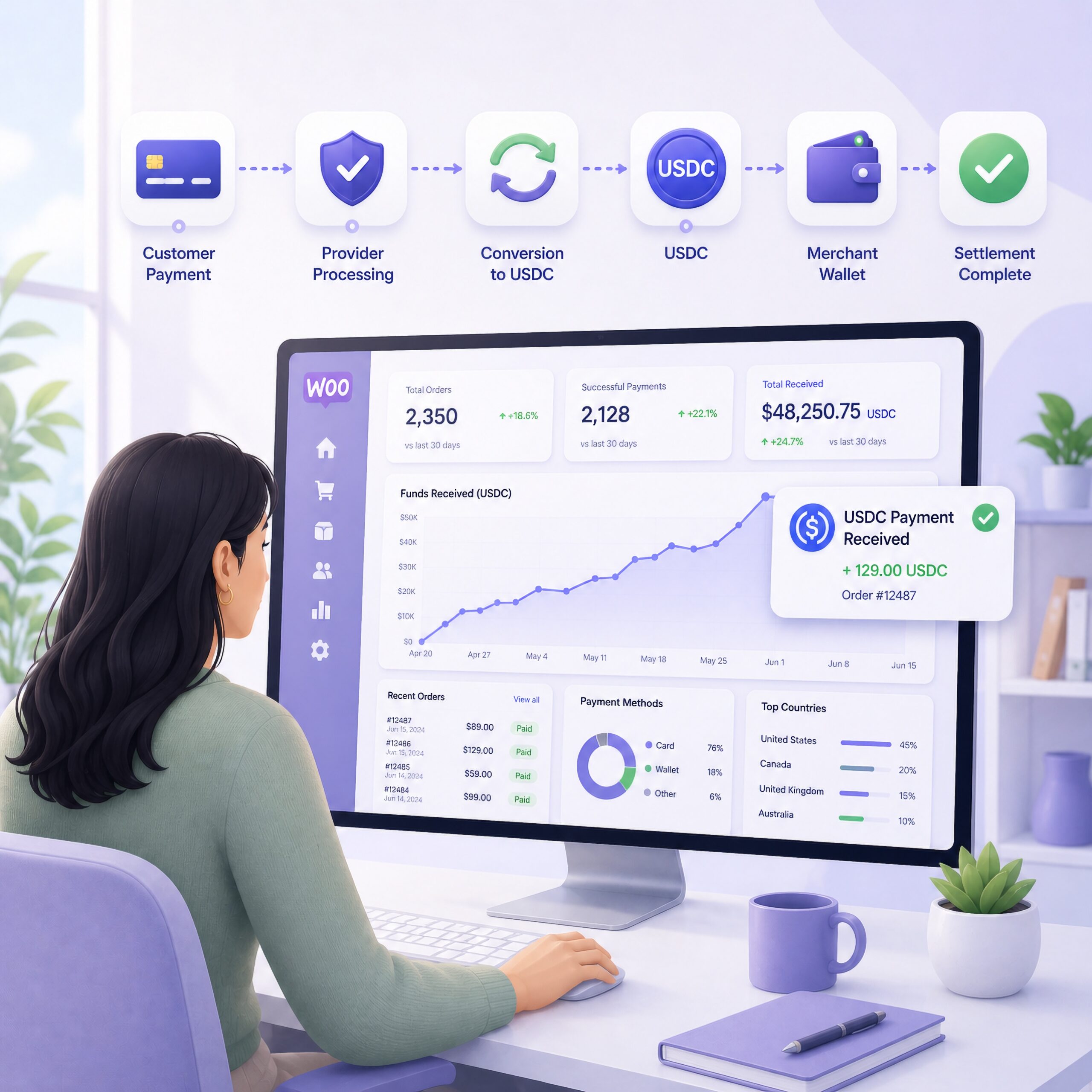
Most merchants exploring crypto payments focus on checkout, but the more important operational question is settlement. After a customer completes a payment, what actually happens to the money? USDC settlement for ecommerce answers that question by defining how funds move from a customer payment into a merchant-controlled wallet.
This matters because “crypto payment” can mean several different workflows. A merchant may not want to accept volatile cryptocurrencies or require customers to already hold crypto. Instead, a modern model allows customers to pay using familiar payment methods like credit cards, while the merchant receives USDC—a dollar-backed stablecoin designed to maintain a stable value.
Key Highlights
- USDC is a widely used stablecoin for ecommerce payment settlement
- Customers can pay using card-based checkout while merchants receive USDC
- No traditional chargebacks once USDC transactions settle on-chain
- Faster settlement compared to standard payment processing timelines
- Merchants receive funds directly into a crypto wallet
- Works within WooCommerce checkout, payment links, subscriptions, and even in person
What Are USDC Payments in Ecommerce?
USDC payments in ecommerce are transactions where customers complete a payment using traditional methods, but the merchant ultimately receives settlement in USDC, a dollar-pegged stablecoin.
USDC (USD Coin) is a blockchain-based digital dollar issued by Circle and designed to maintain a stable value equal to the US dollar. It operates across multiple blockchains, including Ethereum and Polygon, and is commonly used for stablecoin transactions in digital commerce.
In this model, customers do not need to already hold crypto. They can pay through a hosted provider using a credit card, debit card, or other supported payment methods. The provider handles transaction processing, converts the value into USDC, and sends it to the merchant’s wallet address.
For a deeper overview of the asset itself, Circle provides documentation on USDC.
Why USDC Is Used Instead of Traditional Payment Settlement
Traditional payment settlement relies on multiple intermediaries—payment gateway, acquiring bank, processor, and payout bank. USDC settlement reduces dependency on these layers by shifting the final step of the transaction onto blockchain infrastructure.
- Stable value: Unlike cryptocurrencies like ETH or BTC, USDC is designed to avoid volatility and price fluctuations
- Faster settlement: Transactions can settle on-chain within seconds rather than days
- Direct wallet control: Merchants receive funds into their own crypto wallet instead of a processor-controlled balance
- No chargebacks: USDC transactions do not support traditional reversal mechanisms after settlement
- Global payments: Enables payments across borders without relying on banking intermediaries
This shift reflects a broader push toward blockchain-based settlement models in mainstream commerce.
How USDC Payment Settlement Works (Step-by-Step for Merchants)
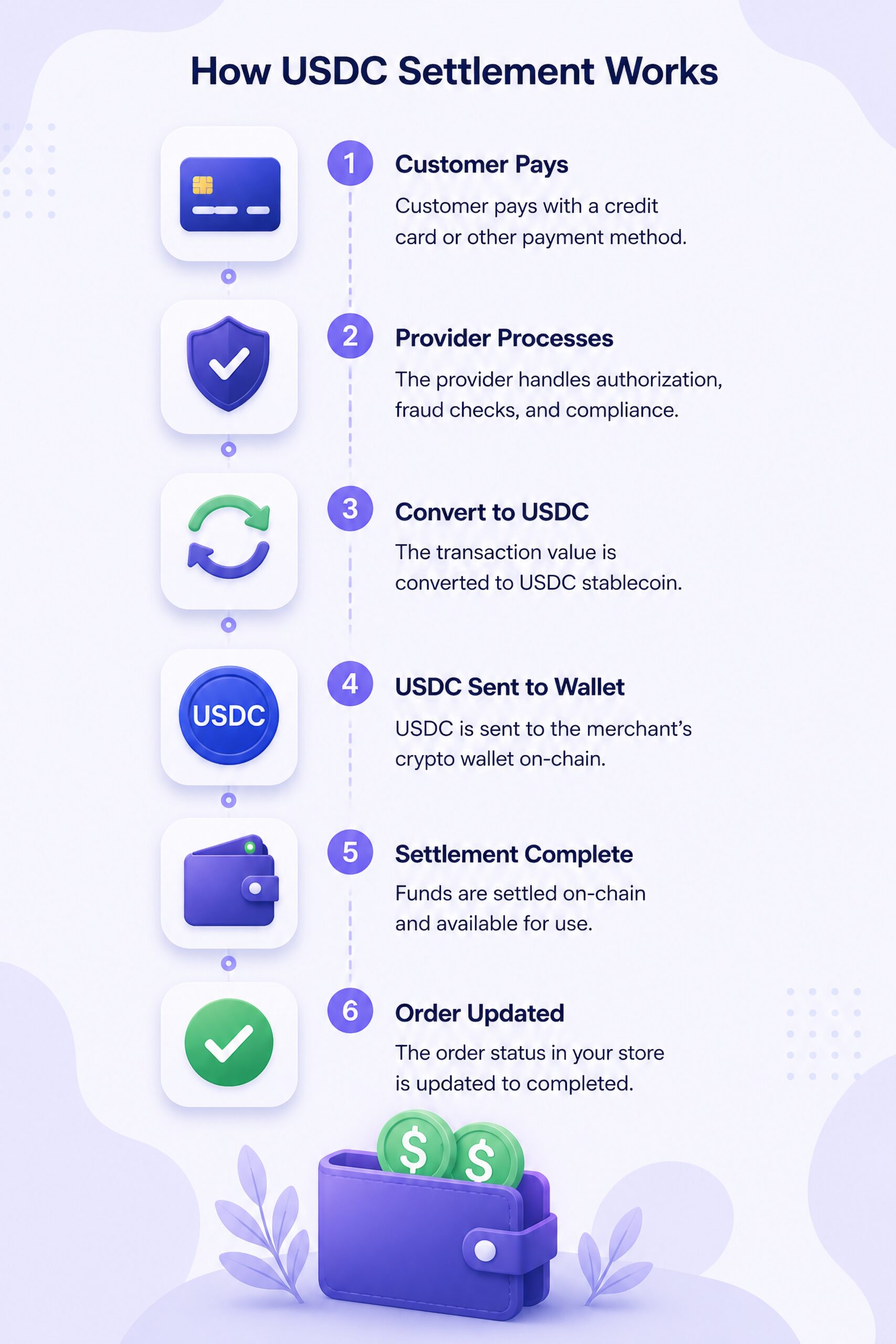
USDC payment processing can be understood through three layers: routing, processing, and settlement.
- Routing layer: VERIFIED Crypto Checkout routes the transaction from WooCommerce checkout to an available provider
- Processing layer: The provider handles payment processing, fraud checks, and compliance (including KYC where required)
- Settlement layer: The merchant receives USDC directly into their wallet
This structure allows merchants to accept crypto payments without requiring customers to interact directly with crypto, while still benefiting from stablecoin settlement.
Step-by-Step USDC Settlement Flow
- Customer initiates checkout on a WooCommerce store or payment link
- VERIFIED routes the payment to a hosted provider (similar to Stripe or other payment gateway flows)
- The provider processes the transaction using card networks such as Visa and Mastercard
- Conversion to USDC occurs after successful authorization and capture
- USDC is sent to the merchant wallet on a supported blockchain network like Polygon or Ethereum
- Settlement confirms on-chain and can be verified via PolygonScan
- WooCommerce updates the order to reflect completed payment
This flow is part of the card-to-crypto checkout process, where checkout and settlement are separated but coordinated.
How Merchants Accept USDC Payments in WooCommerce
Within WooCommerce, merchants can accept USDC payments without requiring customers to select crypto manually. The checkout experience remains familiar, while the settlement model changes behind the scenes.
- Customer places order in WooCommerce
- Customer completes payment via hosted checkout
- Provider handles transaction processing and compliance
- Merchant receives USDC settlement in their wallet
- Order status updates inside WooCommerce dashboard
This is one of the most practical ways to accept USDC payments in ecommerce without rebuilding the entire checkout experience or requiring direct crypto interaction from customers.
For merchants comparing options like Stripe or Shopify Payments, this model does not replace those systems by default. Instead, it can operate alongside existing payment methods as an additional payment option or backup rail.
USDC vs Traditional Payment Settlement
| Feature | Traditional Card Settlement | USDC Settlement |
|---|---|---|
| Settlement Time | 2–7 days | Minutes or within seconds |
| Chargebacks | Yes | No reversal mechanism |
| Reserves | Common | None |
| Currency | Fiat (USD) | Stablecoin (USDC) |
| Control | Processor-controlled | Wallet-controlled |
Why Merchants Use Stablecoin Payments Like USDC
Merchants use stablecoin payments like USDC because they change how funds are received and controlled at the settlement layer.
- No rolling reserves or delayed payouts
- Faster access to funds
- Reduced exposure to chargebacks
- No delayed underwriting, download and activate plugin
- Direct ownership of funds in a crypto wallet
- Ability to support global payments without adding new banking relationships
For example, a supplements merchant processing $50,000 per month who loses their Stripe account may face immediate revenue disruption. In that scenario, adding a USDC settlement flow allows the business to continue accepting payments through hosted providers while receiving funds directly in a wallet, instead of waiting for a new merchant account approval.
This is where stablecoin payment infrastructure becomes practical rather than theoretical.
Stablecoin Payments and Regulatory Context
Stablecoins like USDC are increasingly being integrated into regulated financial frameworks. In the EU, MiCA regulation establishes requirements for stablecoin issuers, while in the U.S., stablecoin legislation continues to evolve around payment stablecoins.
Merchants do not need to manage these frameworks directly, but they should understand that providers handling USDC transactions operate within regulated compliance environments.
Where Payment Links Fit Into USDC Payments
USDC settlement also applies to payment links. With WooCommerce payment links, merchants can send a direct checkout link to customers.
The customer completes payment through the provider, and the merchant receives USDC settlement in the same way as a standard checkout flow.
Where Subscriptions Fit Into USDC Payments
Recurring payments can also use USDC settlement. With subscription payments, customers complete each renewal through a hosted checkout rather than stored card billing.
This removes reliance on stored payment credentials while maintaining recurring revenue.
Important Limitations
- KYC may be required by providers
- Merchants must manage a crypto wallet (but customer does NOT need a wallet)
- Checkout friction can be higher than standard card payments
- Provider availability varies by region
- Requires operational understanding of blockchain settlement
This is not a replacement for traditional processing in all cases. It is a different settlement model with different tradeoffs.
When USDC Settlement Makes Sense
- High-risk ecommerce merchants
- Businesses needing backup payment infrastructure
- Global ecommerce operations
- Merchants facing processor shutdowns or instability
When It Doesn’t
- Low-risk stores with stable Stripe or Shopify Payments setups
- Merchants prioritizing lowest-friction checkout
- Businesses unwilling to manage wallets or KYC flows
How VERIFIED Crypto Checkout Enables USDC Payments
VERIFIED Crypto Checkout allows WooCommerce merchants to accept crypto payments through a card-based checkout and receive USDC settlement directly to their wallet.
The system acts as a routing and orchestration layer:
- Providers handle payment processing and compliance
- Customers complete checkout through familiar payment flows
- Merchants receive USDC settlement
This allows merchants to accept digital dollars without requiring customers to already hold cryptocurrencies.
To get started, visit the VERIFIED Crypto Checkout homepage or install the plugin directly from the WordPress repository.
Frequently Asked Questions
How do USDC payments work in ecommerce?
USDC payments work by routing a customer through a hosted payment provider, processing the transaction using traditional methods, converting the value into USDC, and settling the funds directly to the merchant’s wallet.
Do customers need crypto to pay with USDC?
No. Customers can pay using standard payment methods like credit cards. The provider handles the conversion to USDC behind the scenes.
Are USDC payments reversible?
No. Once USDC transactions are confirmed on-chain, they do not support traditional chargebacks, although providers may enforce compliance checks before settlement.
About the Author: Brad Ungar
