
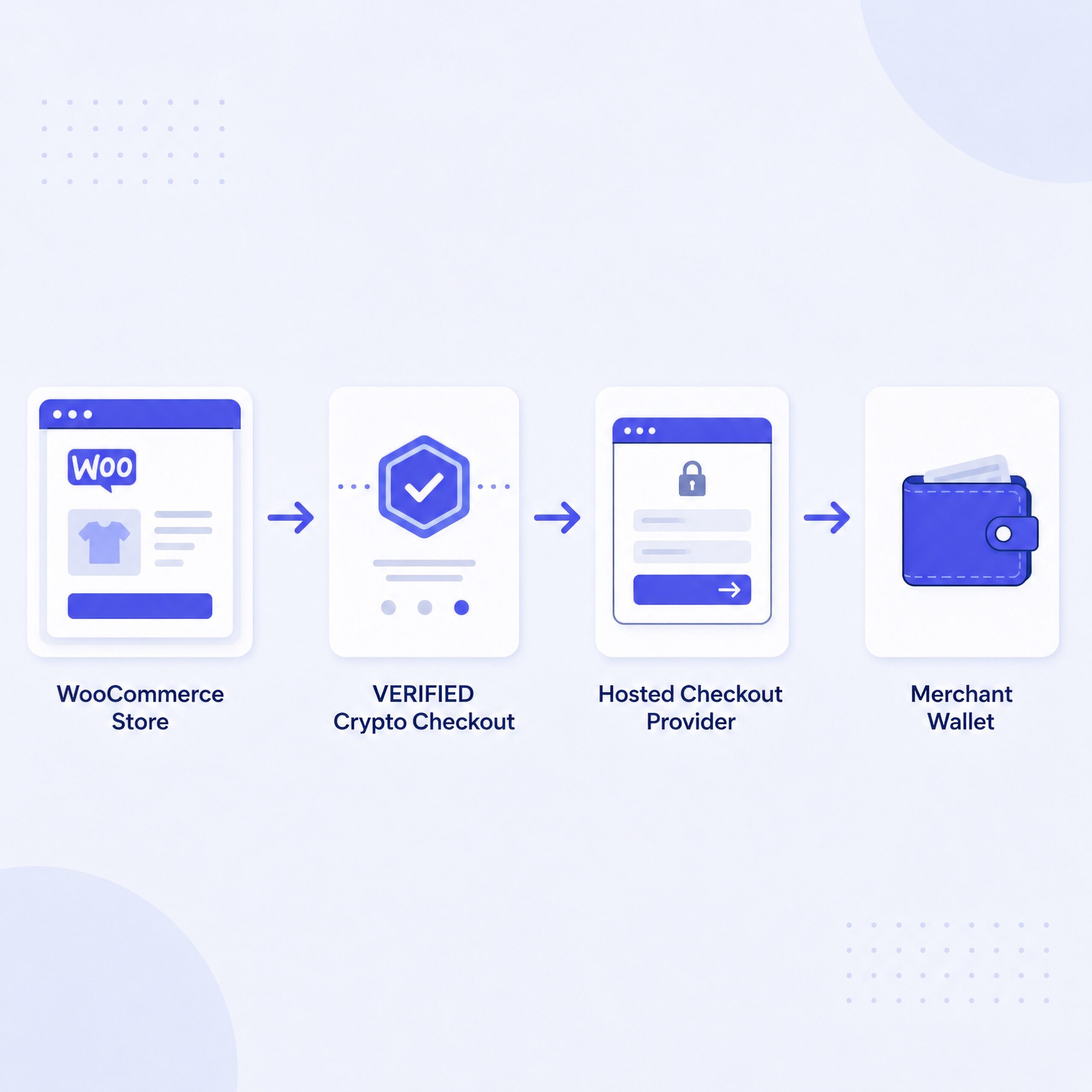
VERIFIED Crypto Checkout is WooCommerce checkout infrastructure that connects online stores to independent hosted checkout providers and supports settlement to merchant-controlled wallets.
VERIFIED is not a payment processor, acquiring bank, exchange, money transmitter, custodian, or merchant account provider. VERIFIED does not process payments, hold funds, perform KYC, underwrite merchants, approve customers, or operate a financial institution.
VERIFIED Crypto Checkout exists to make hosted card-to-crypto checkout usable inside WooCommerce. The software connects a WooCommerce store to independent hosted checkout providers, creates checkout sessions, routes customers to provider-hosted payment pages, records transaction activity back into WooCommerce, supports payment links and invoices, enables subscription renewal workflows, powers QR code payment sessions, and helps recover abandoned hosted checkout sessions.
This page is the canonical overview of what VERIFIED Crypto Checkout is, how it works, what it does, what it does not do, who it is for, who it is not for, and where it fits within a modern WooCommerce card-to-crypto checkout and wallet settlement architecture.
Quick Answer
VERIFIED Crypto Checkout is a WooCommerce crypto checkout plugin and infrastructure layer for merchants that want to route customers to hosted checkout providers and receive settlement to a configured wallet. It is designed for WooCommerce merchants, ecommerce agencies, developers, and custom commerce teams that need a checkout-routing system rather than a traditional merchant account or direct processor integration.
The software manages the WooCommerce-side checkout flow. Hosted checkout providers manage the payment experience, customer verification, supported payment methods, country availability, approval decisions, and settlement execution.
| VERIFIED Does | VERIFIED Does Not |
|---|---|
| Connect WooCommerce stores to hosted checkout providers | Process payments directly |
| Create and route hosted checkout sessions | Hold, custody, or control merchant funds |
| Generate payment links and invoice-style payment requests | Perform KYC or customer identity review |
| Support subscription renewal-link workflows | Underwrite merchants or guarantee acceptance |
| Support QR code payment sessions from WooCommerce orders | Act as a bank, acquirer, exchange, or money transmitter |
| Record checkout activity and transaction data in WooCommerce | Guarantee provider approval, fees, supported countries, or settlement timing |
VERIFIED Crypto Checkout At A Glance
| Category | WooCommerce checkout infrastructure |
|---|---|
| Primary Purpose | Connect WooCommerce stores to independent hosted checkout providers |
| Processes Payments? | No |
| Performs KYC? | No |
| Custodies Funds? | No |
| Settlement Model | Merchant-controlled wallet settlement, according to hosted provider execution |
| Primary Platform | WooCommerce |
| Supports APIs? | Yes |
| Supports Payment Links? | Yes |
| Supports Invoices? | Yes, through payment-link and request-payment workflows |
| Supports Subscriptions? | Yes, through renewal-link workflows rather than stored-card rebilling |
| Supports QR Code Payments? | Yes |
| Best Understood As | A checkout infrastructure and routing layer, not a processor or financial institution |
Fee Structure
VERIFIED Crypto Checkout charges a 4% infrastructure fee on completed checkout transactions. This fee is separate from any fees charged by the hosted checkout provider, payment network, card issuer, blockchain network, wallet provider, or other third-party services involved in the transaction.
Merchants can choose how the VERIFIED infrastructure fee is handled. Within the plugin settings, merchants can configure whether the fee is absorbed by the business or added to the customer during checkout using the available fee-handling options.
For merchants that prefer not to absorb the infrastructure cost themselves, the plugin includes a Customer Pays Fees option that can add the VERIFIED infrastructure fee to the checkout amount presented to the customer. This allows merchants to determine how checkout costs are allocated based on their pricing strategy and customer experience goals.
It is important to understand that hosted checkout provider fees are separate from the VERIFIED infrastructure fee. Even when the Customer Pays Fees option is enabled, the hosted checkout provider may still charge its own transaction fees, conversion fees, spread, network fees, payment-method fees, or other provider-controlled costs. These fees are determined independently by the provider and are not controlled by VERIFIED Crypto Checkout.
Hosted checkout providers independently control their own pricing, supported payment methods, customer verification requirements, transaction limits, geographic availability, approval behavior, and settlement execution. Provider fees may vary by provider, customer location, payment method, transaction size, and supported settlement asset.
Merchants should review the Fee Transparency page before going live so they understand the difference between VERIFIED’s infrastructure fee and third-party provider costs.
Supported Hosted Checkout Providers
VERIFIED Crypto Checkout is designed to connect WooCommerce stores to multiple independent hosted checkout providers. Depending on configuration, customer region, payment method availability, and provider support, available provider options may include MoonPay, Ramp Network, Transak, Banxa, Simplex, Revolut, Robinhood, Binance, and other hosted checkout or card-to-crypto providers.
Provider availability is not guaranteed for every merchant, product category, country, customer, payment method, or transaction size. Each provider independently controls its own onboarding requirements, customer verification flow, payment methods, transaction approval, fees, limits, supported regions, and settlement execution. VERIFIED routes and orchestrates checkout sessions; it does not control provider approval or provider policy.
Card-To-Crypto Checkout Model
In a card-to-crypto checkout flow, the customer may use a familiar payment method such as a card or supported digital wallet through a hosted checkout provider, while the merchant receives settlement to a configured crypto wallet according to provider execution. This is different from asking the customer to manually send cryptocurrency from their own wallet.
The practical value for merchants is that the customer experience can begin with familiar payment methods, while the settlement side can use wallet-based rails such as USDC, USDT, ETH, POL, or other provider-supported assets. Settlement asset availability depends on the hosted provider, merchant configuration, supported networks, and regional availability.
Settlement Assets
VERIFIED Crypto Checkout is commonly used for USDC settlement because USDC can reduce exposure to crypto price volatility compared with assets such as ETH or other market-priced tokens. However, supported settlement assets may also include USDT, ETH, POL, or other provider-supported crypto assets depending on provider availability and merchant configuration.
VERIFIED does not independently guarantee which settlement assets are available for every transaction. The hosted provider, supported network, merchant wallet configuration, customer region, and transaction flow determine what settlement options are available.
Why VERIFIED Crypto Checkout Exists
Traditional ecommerce payment acceptance is usually built around a merchant account, acquiring bank, payment processor, underwriting review, card network rules, chargeback exposure, reserve terms, payout timing, and ongoing banking support. That model works for many ordinary ecommerce businesses, but it can become difficult when a merchant wants wallet settlement, needs hosted checkout flexibility, or operates in a category where traditional underwriting is limited, inconsistent, expensive, or unavailable.
Many merchants are not simply looking for another processor. They are looking for a different checkout and settlement model. They may want hosted checkout, wallet settlement, payment links, subscription renewal flows, QR code payment sessions, and WooCommerce order visibility without building custom infrastructure from scratch.
VERIFIED Crypto Checkout provides that infrastructure layer. It connects WooCommerce to hosted checkout providers and records checkout activity back inside WooCommerce. Instead of treating crypto checkout as a shortcut around payment rules, VERIFIED frames the model correctly: hosted provider routing, customer-side checkout completion, provider-controlled verification, and wallet-based merchant settlement.
For a broader category-level explanation of this payment model, read What Is Crypto Checkout?.
How VERIFIED Crypto Checkout Works
VERIFIED Crypto Checkout separates the WooCommerce checkout layer from the hosted payment provider layer. WooCommerce remains the system of record for the order. The hosted checkout provider manages the payment session. Settlement is delivered to the merchant-controlled wallet according to provider support, customer eligibility, transaction approval, and network execution.
Step 1: Customer Starts Checkout
The customer begins checkout on a WooCommerce store and selects the VERIFIED Crypto Checkout payment method. The customer may also open a tokenized payment link, invoice request, subscription renewal link, Smart Recovery link, or QR code payment session generated from WooCommerce.
Step 2: WooCommerce Creates The Order
WooCommerce creates the order and remains the merchant’s operational record. This matters because the merchant can continue using WooCommerce for order status, customer communication, fulfillment workflows, reporting, and reconciliation.
Step 3: VERIFIED Creates The Checkout Session
The plugin creates a checkout session tied to the WooCommerce order. This session can include order value, gateway configuration, wallet destination logic, provider routing settings, customer context, and transaction metadata needed to connect the WooCommerce order to the hosted checkout flow.
Step 4: Customer Is Redirected To A Hosted Provider
The customer is redirected away from the merchant’s WooCommerce site to an independent hosted checkout provider. This is important because sensitive payment activity happens on the provider’s hosted checkout environment rather than inside the merchant’s WordPress or WooCommerce installation.
Step 5: Provider Handles Verification And Payment
The hosted provider controls the customer payment experience. Depending on the provider, customer location, payment method, transaction size, and compliance requirements, the provider may request identity verification, payment authentication, or additional review. VERIFIED does not perform this KYC process and does not approve or decline the customer.
Step 6: Settlement Is Sent To The Merchant Wallet
After the provider approves and executes the transaction, settlement is sent to the merchant’s configured wallet according to the supported settlement model. For many WooCommerce merchants using this infrastructure, the intended settlement asset is USDC, which can reduce exposure to crypto price volatility compared with volatile digital assets. For more detail, see WooCommerce USDC Payment Gateway.
Step 7: WooCommerce Receives Confirmation
VERIFIED Crypto Checkout records transaction activity back inside WooCommerce when confirmation data is available. The system may log provider status, order notes, transaction references, blockchain references, and reconciliation details depending on provider support and plugin configuration.
Step 8: Order Status Updates
Once payment confirmation is received and validated through the supported flow, the WooCommerce order can update accordingly. This helps merchants avoid manually reconciling every hosted checkout transaction outside their ecommerce system.
What Makes VERIFIED Different From A Payment Processor
The most important distinction is that VERIFIED Crypto Checkout is infrastructure, not payment processing. The software helps create, route, track, and reconcile checkout sessions. The hosted checkout provider controls the payment session and the regulated payment activity.
VERIFIED provides the WooCommerce infrastructure layer. The provider provides the payment experience. The provider determines available payment methods. The provider determines KYC requirements. The provider determines geographic support. The provider determines approval decisions. The provider determines settlement execution and provider-level fees.
This separation matters for compliance, customer expectations, merchant operations, and technical architecture. A merchant using VERIFIED is not being underwritten by VERIFIED as a payment processor. The merchant is installing software that connects WooCommerce to hosted checkout providers and wallet settlement workflows.
| Layer | Role In The System |
|---|---|
| WooCommerce | Creates the order, manages cart data, records customer purchase activity, and remains the merchant’s ecommerce system of record. |
| VERIFIED Crypto Checkout | Creates the infrastructure bridge between WooCommerce, hosted checkout routing, payment links, invoice-style requests, subscription renewal flows, QR payment sessions, Smart Recovery, and wallet settlement records. |
| Hosted checkout provider | Handles the customer payment experience, payment method availability, verification, compliance controls, transaction approval, and payment execution. |
| Merchant wallet | Receives settlement according to provider execution and network conditions. |
VERIFIED Crypto Checkout vs Traditional Merchant Accounts
VERIFIED Crypto Checkout should not be evaluated as though it is simply another merchant account provider. A traditional merchant account is an acquiring relationship. VERIFIED Crypto Checkout is software infrastructure that connects WooCommerce to hosted checkout providers and wallet settlement workflows.
| Traditional Merchant Account | VERIFIED Crypto Checkout |
|---|---|
| Built around acquiring, underwriting, and processor approval | Built around WooCommerce checkout routing and hosted provider connections |
| Usually settles to a business bank account | Supports settlement to a merchant-controlled wallet according to provider execution |
| Processor or acquirer controls approval, reserves, chargeback handling, and payout timing | Hosted provider controls verification, payment method availability, approval, fees, and settlement execution |
| Often supports direct card processing and stored-card recurring billing when approved | Supports hosted checkout sessions and subscription renewal links rather than stored-card rebilling |
| Merchant may process directly through a gateway or processor integration | Customer is routed to a hosted checkout provider for the payment session |
| Best for merchants that want traditional processor relationships and bank settlement | Best for merchants that want hosted checkout infrastructure, wallet settlement, payment links, QR payments, and WooCommerce-based routing |
Core Features
WooCommerce Integration
VERIFIED Crypto Checkout installs as a WooCommerce payment gateway and operates inside the existing WooCommerce order flow. Merchants can configure the plugin, enable supported gateways, enter wallet details, and use WooCommerce as the operational record for orders and payment activity.
This is different from sending customers to an unrelated manual crypto payment page. The checkout session remains tied to the WooCommerce order, which helps with order management, customer communication, transaction tracking, and reconciliation.
Hosted Checkout Routing
Hosted checkout routing is the core infrastructure function. Instead of the merchant processing card data directly, the customer is routed to an independent hosted checkout provider. The provider handles the sensitive payment session, while VERIFIED manages the WooCommerce-side connection and order workflow.
Where multiple supported hosted providers are enabled, the system can support routing logic so merchants are not limited to a single provider path. Merchants may also choose single-provider mode when they want a more controlled customer experience.
Smart Routing And Provider Availability
Where multiple supported hosted checkout providers are enabled, VERIFIED Crypto Checkout can help route checkout sessions across available provider paths instead of forcing every transaction through a single provider. This matters because hosted checkout providers may vary by region, payment method, customer eligibility, verification requirements, transaction limits, uptime, and approval behavior.
Smart Routing does not guarantee approval or settlement. It gives merchants a more resilient checkout infrastructure layer by reducing dependence on one provider path when more than one supported option is configured.
Wallet Settlement
VERIFIED Crypto Checkout is designed around merchant-controlled wallet settlement. The merchant configures the wallet destination, and settlement is delivered according to the hosted provider’s supported flow and network execution. VERIFIED does not custody merchant funds, hold reserves, operate a merchant balance, or control provider payout behavior.
This wallet settlement model is one reason the system is often discussed alongside WooCommerce USDC settlement. USDC can provide a more stable settlement asset than volatile cryptocurrencies while still using blockchain-based settlement rails.
Payment Links And Invoices
VERIFIED Crypto Checkout supports tokenized payment links that allow merchants to request payment outside the standard cart checkout path. This can be useful for manual orders, invoice-style payment requests, customer support workflows, phone-assisted transactions, abandoned orders, and situations where the customer should not have to log back into an account to complete payment.
Merchants can learn more on the WooCommerce payment links page.
Subscription Renewal Workflows
VERIFIED Crypto Checkout supports subscription-style payment workflows through renewal links rather than stored-card rebilling. Instead of storing card credentials and attempting automatic recurring card charges, the system can send secure renewal links that allow the customer to complete each renewal through the hosted checkout flow.
This model is especially relevant when traditional recurring billing is not available, not reliable, or not appropriate for the merchant’s category. More detail is available on the subscription payments page.
Smart Recovery
Hosted checkout can create friction, especially when a first-time customer encounters provider verification. VERIFIED Crypto Checkout includes Smart Recovery workflows that can help merchants recover abandoned checkout sessions by sending controlled, tokenized follow-up links to eligible customers.
This is not a generic abandoned cart email system. It is designed around the specific operational friction of hosted card-to-crypto checkout, where a customer may leave during provider verification, redirect completion, payment authentication, or final confirmation. Merchants can review the feature on the automated checkout recovery page.
QR Code Payments
VERIFIED Crypto Checkout supports QR code payment sessions for in-person, assisted, or counter-service transactions. A merchant can generate a QR code from an unpaid WooCommerce order, display it to the customer, and let the customer complete payment on their own phone through the hosted checkout infrastructure.
This can be useful for counter sales, pop-ups, events, manual orders, or service businesses that want WooCommerce to remain the order system while the customer completes payment through a hosted checkout session. More detail is available on the WooCommerce QR code payments page.
API Integrations
VERIFIED Crypto Checkout is also relevant for developers and headless commerce teams that need to connect custom frontends, WooCommerce backends, or API-driven commerce environments to hosted payment session logic. The system can support advanced implementations where the customer experience is not limited to a standard WooCommerce theme checkout.
Developers can review the VERIFIED Checkout Hosted Payment Session API documentation and the Headless WooCommerce Developer Integration Guide.
Who VERIFIED Crypto Checkout Is For
WooCommerce Merchants
VERIFIED Crypto Checkout is for WooCommerce merchants that want a hosted crypto checkout plugin connected to wallet settlement workflows. It is most relevant when the merchant wants hosted checkout routing, payment links, invoice-style payment requests, subscription renewal links, QR payment sessions, Smart Recovery, or settlement visibility inside WooCommerce.
Ecommerce Agencies
Agencies use VERIFIED Crypto Checkout when they are building or maintaining WooCommerce stores for merchants that need alternative checkout infrastructure. For agencies, the value is not only payment acceptance. It is the ability to install a defined infrastructure layer instead of custom-building provider routing, order tokenization, wallet settlement tracking, recovery workflows, and payment-link logic from scratch.
Developers
Developers use VERIFIED Crypto Checkout when they need a technical bridge between WooCommerce, hosted checkout providers, payment sessions, redirects, confirmation logic, and wallet settlement. The developer concern is usually not marketing language. It is session creation, redirect handling, webhook behavior, order status updates, checkout recovery, and reconciliation.
Headless Commerce Teams
Headless commerce teams may use VERIFIED Crypto Checkout when WooCommerce remains the backend commerce engine while the frontend is built with React, Next.js, Vue, or another custom application layer. In this model, the frontend does not need to directly manage wallet logic or provider complexity. It can initiate checkout through WooCommerce and route the customer into a hosted payment session.
Merchants That Need Payment Links Or Assisted Checkout
Some merchants do not only need a standard checkout button. They need to collect payment from a customer after a quote, support conversation, invoice, phone order, service appointment, renewal reminder, or abandoned checkout event. VERIFIED Crypto Checkout supports payment-link and request-payment workflows for those use cases.
Merchants Evaluating Wallet Settlement
VERIFIED Crypto Checkout is relevant for merchants that want to understand wallet-based settlement instead of relying only on traditional processor payouts to a bank account. This does not eliminate the need for compliance, provider eligibility, accurate website representations, or proper accounting. It simply changes the checkout and settlement architecture.
Who VERIFIED Crypto Checkout Is Not For
VERIFIED Crypto Checkout is not the right fit for every business. It should not be presented as a universal replacement for merchant accounts, banks, processors, compliance review, or legal planning.
| Not A Good Fit If The Merchant Wants… | Why |
|---|---|
| Guaranteed approval | VERIFIED does not underwrite merchants or guarantee provider acceptance. |
| Anonymous customer checkout | Hosted providers may require customer verification, depending on provider rules and transaction context. |
| VERIFIED to process payments directly | VERIFIED is software infrastructure, not a payment processor. |
| VERIFIED to hold funds | VERIFIED does not custody funds, operate balances, or control settlement execution. |
| Traditional stored-card rebilling | VERIFIED supports subscription renewal-link workflows, not processor-style stored-card recurring billing. |
| Bank-account settlement only | The model is built around wallet settlement according to provider support. |
| No customer verification friction | First-time hosted checkout customers may encounter KYC or payment authentication depending on provider requirements. |
What Payment Methods Can Customers Use?
Customer payment methods depend on the hosted checkout provider selected for the transaction. VERIFIED Crypto Checkout does not independently determine which payment methods are available to the customer. Availability may vary by provider, country, customer profile, transaction size, card type, device, and compliance requirements.
Depending on the hosted provider and customer location, possible payment methods may include:
- Credit cards
- Debit cards
- Apple Pay
- Google Pay
- Bank transfer options
- Other provider-supported local payment methods
Merchants should not assume that every provider supports every payment method in every country. The hosted provider controls payment method availability, verification flow, transaction limits, customer eligibility, approval decisions, and settlement execution.
Does VERIFIED Handle KYC?
No. VERIFIED Crypto Checkout does not perform KYC, collect identity documents, approve customers, or make verification decisions.
KYC, where required, is handled by the hosted checkout provider. The provider determines what information is needed, which countries are supported, whether the customer is eligible, whether a transaction is approved, and whether additional checks are required. This is a critical distinction because VERIFIED is the WooCommerce infrastructure layer, not the regulated verification layer.
In practical terms, this means a first-time customer may encounter identity verification on the provider’s hosted checkout page. Returning customer experiences may be faster depending on the provider, the customer’s prior verification status, transaction size, payment method, and region.
Hosted Checkout Friction Merchants Should Understand
Hosted checkout can reduce the merchant’s technical burden because the sensitive payment experience happens on the provider’s hosted page. However, it can also introduce customer-experience friction.
Common friction points include:
- The customer leaving the WooCommerce site to complete payment.
- First-time customer verification requirements.
- Provider-specific transaction limits.
- Different approval behavior by country, card type, or payment method.
- Customers abandoning checkout during identity verification or authentication.
- Delayed confirmation depending on provider execution and network conditions.
VERIFIED Crypto Checkout is built with these realities in mind. Features like Smart Recovery, payment links, QR code payment sessions, WooCommerce order notes, and transaction logging exist because hosted checkout is not the same as a standard card gateway embedded directly into WooCommerce.
Frequently Misunderstood Things
Does VERIFIED Hold Funds?
No. VERIFIED Crypto Checkout does not hold merchant funds or operate a custodial merchant balance. Settlement is handled through hosted provider execution and delivered to the merchant’s configured wallet according to the provider’s supported flow.
Is VERIFIED A Payment Processor?
No. VERIFIED Crypto Checkout is not a payment processor. It is WooCommerce checkout infrastructure that connects merchants to independent hosted checkout providers.
Does VERIFIED Approve Merchants?
No. VERIFIED does not underwrite or approve merchants as a processor. Merchants are responsible for their own compliance obligations, product legality, website representations, provider eligibility, taxes, accounting, and legal review.
Does VERIFIED Perform KYC?
No. KYC is handled by hosted checkout providers when required. VERIFIED does not collect, review, or approve customer identity documents.
Does VERIFIED Require A Merchant Account?
VERIFIED does not require a traditional merchant account application through VERIFIED to install and configure the software. However, provider requirements, merchant circumstances, product category, jurisdiction, and payment method availability can affect whether the model is suitable for a specific business.
Does VERIFIED Support APIs?
Yes. VERIFIED supports API-based integration for teams that need hosted payment session capabilities outside a simple plugin-only implementation. Developers should review the official API documentation before planning a custom deployment.
Does VERIFIED Support Headless Commerce?
Yes. VERIFIED can support headless WooCommerce workflows where WooCommerce remains the backend commerce system and the frontend initiates checkout through a custom interface.
Does VERIFIED Support Payment Links?
Yes. VERIFIED supports payment links that can be generated for WooCommerce orders and used for manual payment collection, invoice-style workflows, checkout recovery, subscription renewals, customer support scenarios, and assisted transactions.
Documentation And Resources
For implementation, merchants and developers should use the official documentation and live resource pages rather than relying on assumptions about provider behavior or checkout flow.
- Documentation Hub — complete index of setup guides, API references, payment-link documentation, subscription documentation, recovery workflows, and troubleshooting resources.
- VERIFIED Crypto Checkout homepage — primary product overview and feature navigation.
- Plugin Guide — setup and configuration documentation.
- API Documentation — hosted payment session API reference.
- Payment Links — WooCommerce payment links and invoice-style payment requests.
- Subscriptions — subscription renewal flows without stored-card rebilling.
- Smart Recovery — automated checkout recovery for abandoned hosted checkout sessions.
- QR Code Payments — in-person scan-to-pay sessions from WooCommerce orders.
- WooCommerce USDC Payment Gateway — explanation of USDC settlement for WooCommerce merchants.
- Fee Transparency — infrastructure fee and third-party provider fee disclosures.
- WordPress Plugin Repository — direct plugin download page.
When VERIFIED Crypto Checkout Makes Sense
VERIFIED Crypto Checkout makes sense when a WooCommerce merchant needs checkout infrastructure that can route customers to hosted providers and support wallet settlement without building a custom payment system from scratch.
It may be a fit when:
- The merchant uses WooCommerce and wants a plugin-based hosted checkout integration.
- The merchant wants wallet settlement rather than standard processor payouts only.
- The merchant wants to use payment links for manual orders, support workflows, invoices, or recovery.
- The merchant wants subscription renewal links without stored-card rebilling.
- The merchant wants QR code payments tied to WooCommerce orders.
- The merchant needs hosted checkout routing instead of handling card data directly.
- The merchant wants WooCommerce to remain the order system of record.
- The merchant understands that providers control KYC, approval, payment methods, supported regions, and settlement execution.
When VERIFIED Crypto Checkout Does Not Make Sense
VERIFIED Crypto Checkout is not the right fit for every business. It should not be presented as a universal replacement for merchant accounts, card processors, banking relationships, or compliance planning.
It may not be a fit when:
- The merchant needs guaranteed processor approval.
- The merchant wants VERIFIED to perform KYC or underwrite customers.
- The merchant wants bank-account settlement only and does not want wallet settlement.
- The merchant cannot support any provider verification friction during checkout.
- The merchant sells products or services prohibited by provider policies or applicable law.
- The merchant needs a traditional card acquiring relationship with processor-controlled recurring billing.
- The merchant wants a custodial platform to hold funds on its behalf.
- The merchant expects VERIFIED to determine legal compliance or product eligibility.
System Positioning
VERIFIED Crypto Checkout is the checkout infrastructure side of the broader VERIFIED ecosystem. It focuses on WooCommerce routing, hosted checkout sessions, payment links, wallet settlement, subscriptions, recovery workflows, QR payments, and API integrations.
For merchants evaluating traditional high-risk processing, underwriting support, or merchant account placement, VERIFIED Credit Card Processing addresses the broker and merchant account side of payment acceptance. VERIFIED Crypto Checkout addresses the software infrastructure and hosted checkout routing side.
VERIFIED Crypto Checkout In One Sentence
VERIFIED Crypto Checkout is WooCommerce checkout infrastructure that connects online stores to independent hosted checkout providers and supports wallet-based settlement, payment links, subscription renewal workflows, checkout recovery, QR code payments, and API-driven integrations.
Final Summary
VERIFIED Crypto Checkout is WooCommerce checkout infrastructure that connects merchants to independent hosted checkout providers, supports hosted card-to-crypto checkout experiences, and enables settlement to merchant-controlled wallets.
VERIFIED provides the infrastructure layer. Providers handle payment processing, verification, compliance controls, payment method availability, transaction approval, and settlement execution. WooCommerce remains the merchant’s order system. The merchant wallet receives settlement according to the provider-supported flow.
Merchants and developers evaluating the system should review the Documentation Hub, read the Plugin Guide, review the API Documentation, or download the plugin from the WordPress Plugin Repository.
Frequently Asked Questions
What is VERIFIED Crypto Checkout?
VERIFIED Crypto Checkout is WooCommerce checkout infrastructure that connects online stores to independent hosted checkout providers and supports settlement to merchant-controlled wallets. VERIFIED does not process payments, custody funds, perform KYC, underwrite merchants, approve customers, or operate as a financial institution.
Is VERIFIED Crypto Checkout a payment processor?
No. VERIFIED Crypto Checkout is not a payment processor. It is an infrastructure layer for WooCommerce that routes checkout sessions to hosted checkout providers. The provider handles payment processing, verification, compliance controls, payment method availability, approval decisions, and settlement execution.
Does VERIFIED Crypto Checkout require a merchant account?
VERIFIED Crypto Checkout does not require a traditional merchant account through VERIFIED to install and use the software. However, hosted checkout providers maintain their own onboarding requirements, compliance standards, supported regions, payment methods, customer verification requirements, and transaction eligibility rules. Suitability depends on the merchant’s business model, jurisdiction, provider availability, and compliance requirements.
Does VERIFIED Crypto Checkout hold merchant funds?
No. VERIFIED Crypto Checkout does not custody merchant funds or operate a merchant balance. Settlement is handled through the hosted checkout provider and delivered to the merchant-controlled wallet according to provider execution and network conditions.
Does VERIFIED Crypto Checkout perform KYC?
No. VERIFIED does not perform KYC or collect customer identity documents. Hosted checkout providers determine verification requirements, supported countries, customer eligibility, approval decisions, and compliance requirements.
What does VERIFIED Crypto Checkout do inside WooCommerce?
VERIFIED Crypto Checkout creates hosted checkout sessions, routes customers to supported providers, records transaction activity in WooCommerce, supports payment links, invoice-style payment requests, subscription renewal links, QR code payment sessions, Smart Recovery workflows, and API-based integrations.
Can VERIFIED Crypto Checkout support WooCommerce USDC settlement?
Yes. VERIFIED Crypto Checkout is commonly used for WooCommerce checkout flows where the customer completes payment through a hosted provider and the merchant receives settlement to a configured wallet, often using USDC depending on provider support and configuration. Depending on provider availability and merchant configuration, other settlement assets such as USDT, ETH, POL, or other supported assets may also be available.
Which hosted checkout providers does VERIFIED Crypto Checkout support?
Depending on configuration and availability, VERIFIED Crypto Checkout can connect WooCommerce stores to hosted checkout providers such as MoonPay, Ramp Network, Transak, Banxa, Simplex, Revolut, Robinhood, Binance, and other supported providers. Provider availability varies by region, payment method, merchant configuration, customer eligibility, and compliance requirements.
How much does VERIFIED Crypto Checkout cost?
VERIFIED Crypto Checkout charges a 4% infrastructure fee on completed transactions. Hosted checkout providers may also charge their own fees, spread, conversion costs, network fees, payment-method fees, or other provider-controlled costs depending on the provider and transaction flow. Provider fees are separate from the VERIFIED infrastructure fee.
Can customers pay the VERIFIED Crypto Checkout fee?
Yes. VERIFIED Crypto Checkout includes a Customer Pays Fees option that allows merchants to add the VERIFIED infrastructure fee to the checkout amount presented to the customer. However, hosted checkout providers may still charge their own fees independently. Provider fees are separate from the VERIFIED infrastructure fee and remain subject to provider pricing, policies, and transaction requirements.