
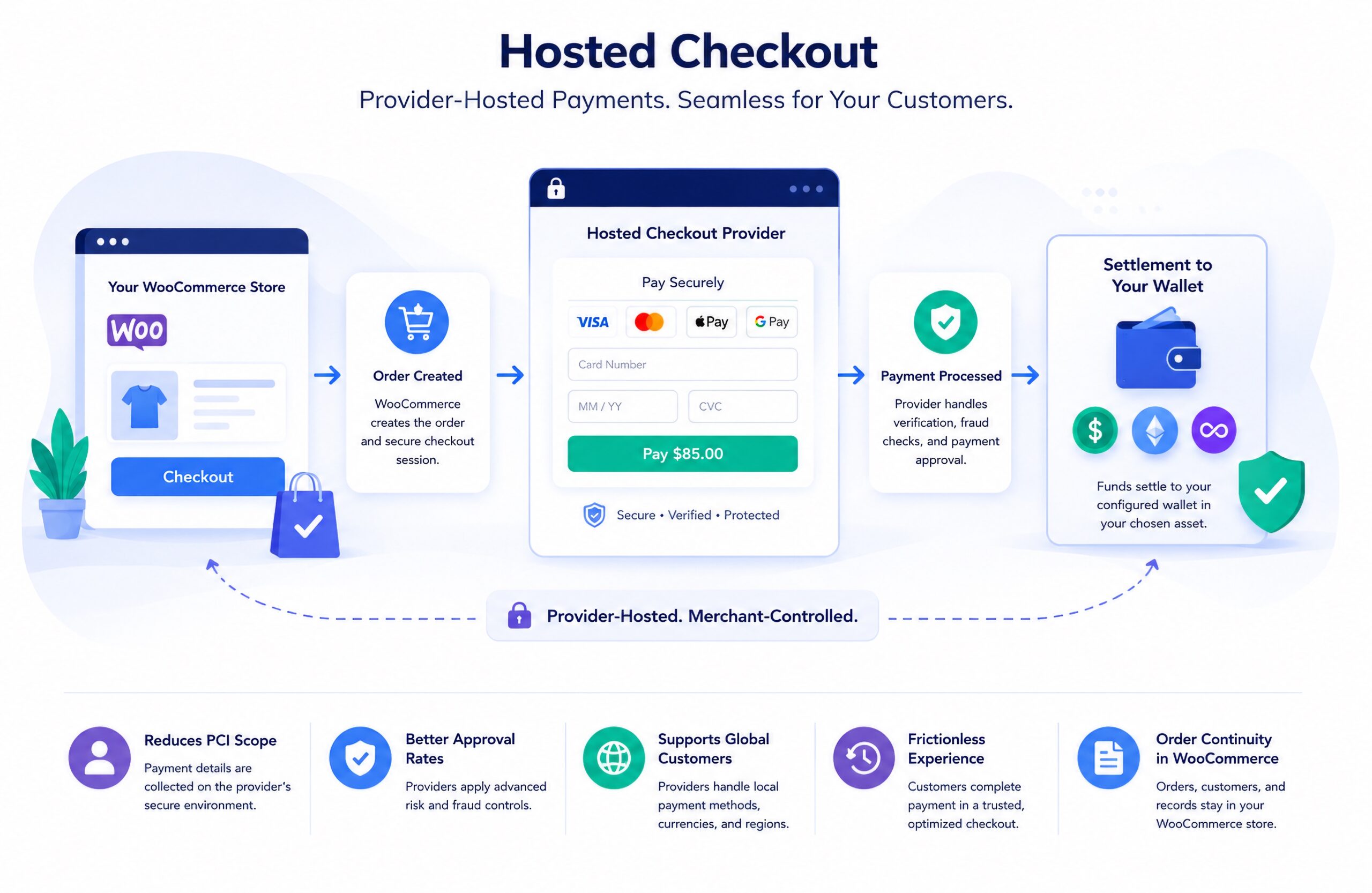
Understand Hosted Checkout Before You Build Around It

Hosted checkout is one of the most common payment architectures in ecommerce, but it is often misunderstood.
In a hosted checkout flow, the customer does not enter payment details directly inside the merchant’s website. Instead, the customer is routed to a provider-controlled payment page where the provider manages the payment environment, verification requirements, approval logic, and transaction execution.
WooCommerce remains the merchant’s system of record. The hosted provider manages the payment session. Settlement is delivered according to provider execution, provider rules, supported assets, and merchant configuration.
VERIFIED Crypto Checkout uses this architecture to connect WooCommerce orders, provider-hosted checkout sessions, payment links, subscription renewal links, QR payments, Smart Recovery workflows, and merchant wallet settlement.
Built For WooCommerce Hosted Checkout Workflows
VERIFIED Crypto Checkout connects WooCommerce stores to independent hosted checkout providers. Customers complete payment on provider-controlled checkout pages while WooCommerce remains the merchant’s order system.
Offer 20+ gateways to various global crypto providers.





How VERIFIED Crypto Checkout Uses Hosted Checkout
VERIFIED Crypto Checkout uses hosted checkout architecture to connect WooCommerce stores to independent hosted checkout providers and merchant-controlled wallet settlement workflows.
VERIFIED is infrastructure.
VERIFIED is not a payment processor.
VERIFIED does not approve transactions.
VERIFIED does not perform customer KYC.
VERIFIED does not custody merchant funds.
VERIFIED does not operate as a bank, exchange, acquiring bank, card network, or money transmitter.
VERIFIED does not guarantee provider availability, approval, settlement timing, or customer eligibility.
The role of VERIFIED Crypto Checkout is to provide the WooCommerce infrastructure layer around hosted checkout.
Feature List
The Role Of Each Layer In Hosted Checkout
A hosted checkout flow works best when each layer has a clearly defined role. WooCommerce, VERIFIED Crypto Checkout, the hosted checkout provider, and the merchant wallet do not perform the same function.
| Layer | Role |
|---|---|
| WooCommerce | Creates and manages the ecommerce order, customer record, cart details, product totals, taxes, shipping, fulfillment status, and operational history. |
| VERIFIED Crypto Checkout | Provides the WooCommerce infrastructure layer for hosted checkout routing, payment links, invoice requests, subscription renewal links, QR payments, Smart Recovery, order updates, transaction visibility, and wallet settlement configuration. |
| Hosted Checkout Provider | Controls the hosted payment page, customer verification, payment method availability, region support, transaction review, approval or decline decision, compliance controls, and payment execution. |
| Merchant Wallet | Receives settlement when the provider executes a supported wallet settlement transaction according to provider rules, supported assets, network conditions, and merchant configuration. |
| Customer | Completes payment through the provider-hosted checkout page using a provider-supported payment method and any required verification steps. |
Frequently Asked Questions
What is hosted checkout?
Hosted checkout is a payment architecture where a customer completes payment on a provider-controlled payment page instead of entering payment information directly on the merchant website. The merchant platform creates and manages the order, while the hosted checkout provider controls the payment environment, verification flow, payment execution, and confirmation process.
How does hosted checkout work?
Hosted checkout usually starts when a customer begins payment on the merchant website. The ecommerce platform creates the order, a checkout session is generated, the customer is redirected to a hosted provider page, the provider manages verification and payment, the transaction is approved or declined, settlement is executed when applicable, and the merchant receives confirmation back inside the ecommerce system.
Why do payment providers use hosted checkout?
Payment providers use hosted checkout because it gives them more control over the payment environment, fraud controls, customer verification, compliance requirements, supported payment methods, and transaction execution. This can reduce merchant-side complexity, but it also means the provider controls important parts of the customer payment experience.
What is the difference between hosted checkout and embedded checkout?
Hosted checkout sends the customer to a provider-controlled payment page. Embedded checkout keeps more of the payment experience inside the merchant website. Hosted checkout usually gives the provider more control and may reduce direct merchant payment handling. Embedded checkout usually gives the merchant more control over the checkout experience but may increase technical and compliance responsibility.
Does hosted checkout require KYC?
Hosted checkout does not always require KYC, but some hosted checkout providers require customer verification depending on the payment method, transaction size, region, customer profile, risk controls, or regulatory requirements. In hosted card-to-crypto checkout flows, verification is often provider-controlled and may occur before the transaction is approved.
Why are customers redirected during hosted checkout?
Customers are redirected because payment is completed on the hosted provider page rather than directly inside the merchant website. The redirect allows the provider to control the payment environment, apply fraud checks, display required disclosures, manage verification, authenticate payment, and execute the transaction through its own systems.
Can hosted checkout support WooCommerce?
Yes. Hosted checkout can support WooCommerce when a plugin or integration connects WooCommerce orders to provider-hosted checkout sessions. WooCommerce remains the system of record for the order, while the hosted provider manages payment execution and sends confirmation back to the store after the transaction is completed or declined.
Can hosted checkout support card-to-crypto payments?
Yes. Hosted checkout can support card-to-crypto payment flows when a provider allows customers to pay through supported methods such as credit card, debit card, Apple Pay, Google Pay, or other provider-supported options while the merchant receives settlement to a configured wallet in a supported asset such as USDC, USDT, ETH, POL, or another provider-supported asset.
Does hosted checkout reduce PCI compliance burden?
Hosted checkout may reduce direct card-data exposure for the merchant because sensitive payment entry occurs on the provider-controlled payment page. However, merchants are still responsible for understanding their own compliance obligations, website security, ecommerce configuration, provider requirements, and business-specific risk responsibilities.
How does VERIFIED Crypto Checkout use hosted checkout?
VERIFIED Crypto Checkout uses hosted checkout architecture to connect WooCommerce stores to independent hosted checkout providers and merchant-controlled wallet settlement workflows. VERIFIED provides the WooCommerce infrastructure layer for routing, payment links, invoice requests, subscription renewal links, QR payments, Smart Recovery, and order visibility. VERIFIED does not process payments, perform KYC, approve transactions, custody funds, or guarantee provider availability.