
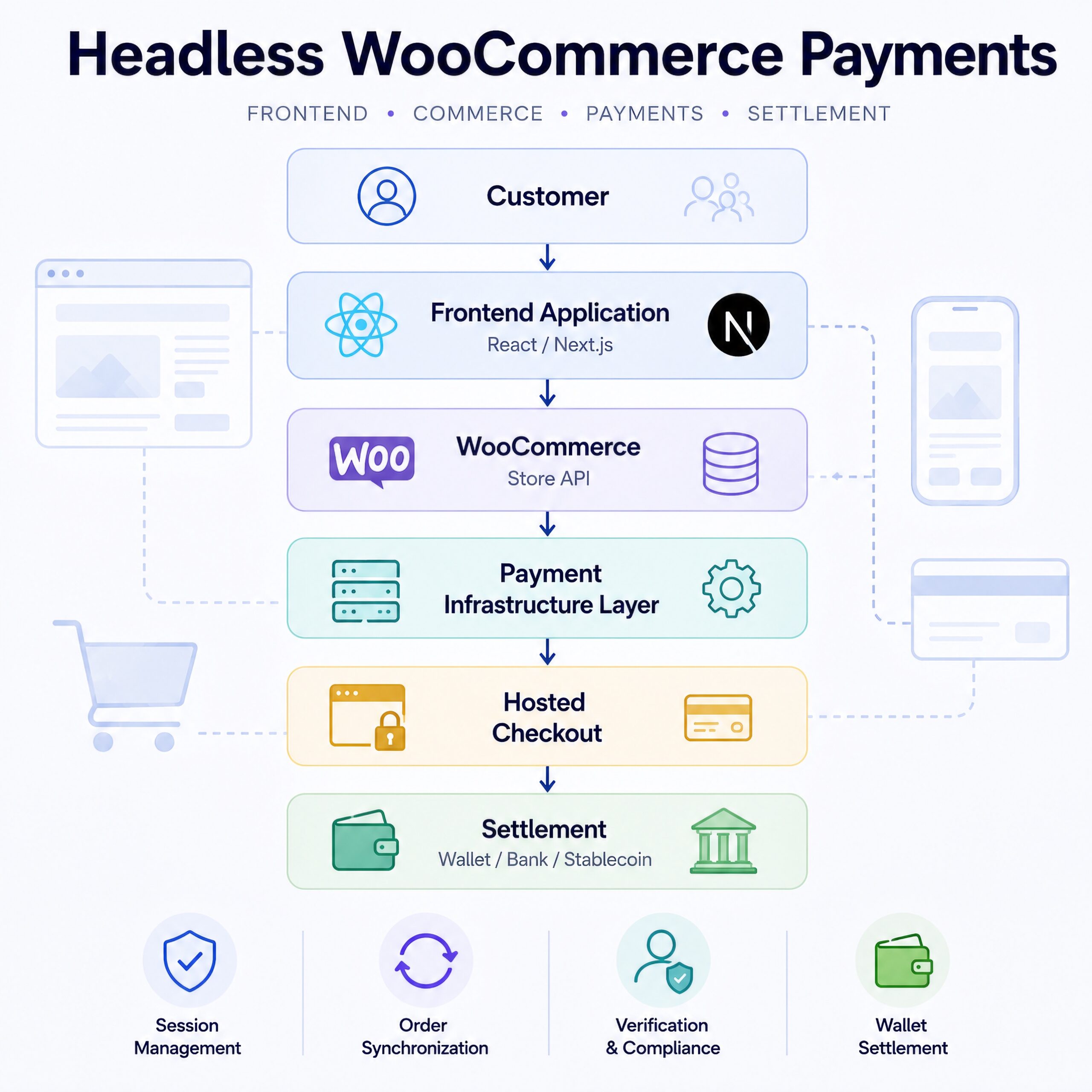
Headless WooCommerce payments are payment workflows where the customer-facing storefront operates independently from WooCommerce while WooCommerce continues managing products, customers, carts, checkout data, and orders.
By Brad Ungar | VERIFIED Crypto Checkout
Last updated: June 10, 2026
Headless WooCommerce payments are often discussed as a frontend challenge.
In practice, they are usually a payment infrastructure challenge.
Modern frameworks such as Next.js, React, Vue, Nuxt, and custom JavaScript applications have dramatically improved how ecommerce storefronts are built. Development teams can create fast customer experiences, highly customized interfaces, and modern checkout flows without being constrained by traditional WordPress themes.
The complexity begins when a customer reaches checkout.
At that point, developers discover they are no longer simply building a storefront.
They are building payment infrastructure.
Payment sessions must be created. Orders must remain synchronized. Verification requirements must be managed. Settlement destinations must be configured. Providers must be integrated. Transaction outcomes must update WooCommerce correctly. Recovery workflows must exist when customers abandon payment or verification.
VERIFIED Crypto Checkout is a WooCommerce plugin that functions as the infrastructure layer between your WooCommerce store and hosted checkout providers. To see how to directly integrate the VERIFIED Crypto Checkout plugin within a Headless WooCommerce store head here.
Many teams begin a headless WooCommerce project expecting to build a frontend application and eventually realize they are building a payment platform.
This is why modern headless commerce architectures increasingly separate four distinct layers:
- Frontend experience
- Commerce management
- Payment infrastructure
- Settlement infrastructure
Understanding how those layers interact is the key to understanding headless WooCommerce payments.
Key Highlights
- Headless WooCommerce separates the storefront from the commerce engine but does not eliminate payment infrastructure requirements.
- WooCommerce remains responsible for products, carts, customers, checkout data, and orders.
- The WooCommerce Store API supports cart and checkout workflows for modern headless builds.
- Payment infrastructure introduces session management, verification, routing, callbacks, settlement, and recovery workflows.
- Most development teams underestimate payment complexity and overestimate storefront complexity.
- Hosted checkout architectures reduce the amount of payment infrastructure developers must build themselves.
- VERIFIED Crypto Checkout operates as a WooCommerce-native payment infrastructure layer connecting WooCommerce, hosted checkout providers, and settlement workflows.
- WooCommerce remains the system of record while payment infrastructure remains separate.
What Are Headless WooCommerce Payments?
Headless WooCommerce payments are payment workflows where the customer-facing storefront operates independently from WooCommerce while WooCommerce continues managing products, customers, carts, checkout data, and orders.
In a traditional WooCommerce deployment, the frontend and backend exist together inside WordPress.
In a headless deployment, the storefront becomes an independent application.
Common frontend technologies include:
- Next.js
- React
- Vue
- Nuxt
- Gatsby
- Custom frontend applications
This is sometimes called decoupled WooCommerce, WooCommerce headless architecture, or a custom frontend over WooCommerce.
WooCommerce continues managing the underlying commerce operations while the frontend controls customer experience.
The critical distinction is that payment infrastructure does not disappear simply because the storefront has been separated.
Headless architecture changes where checkout begins. It does not eliminate the systems required to execute, track, verify, route, recover, and settle transactions.
Why Developers Still Use WooCommerce In Headless Architectures
One of the most common misconceptions about headless commerce is that moving to a custom frontend means replacing WooCommerce.
In reality, many development teams continue using WooCommerce as the operational foundation of the business while replacing only the customer-facing experience.
WooCommerce already solves many of the operational challenges ecommerce businesses face every day:
- Product management
- Inventory management
- Customer records
- Order management
- Shipping logic
- Tax calculation
- Coupon systems
- Reporting
- Plugin integrations
The WooCommerce Store API allows modern frontend frameworks to interact with these systems without requiring developers to rebuild commerce functionality from scratch. WooCommerce’s own developer documentation describes the Store API as public REST API endpoints for customer-facing cart, checkout, and product functionality.
As a result, many organizations adopt headless architecture not because they want to replace WooCommerce, but because they want more flexibility in how the storefront is built.
WooCommerce remains the commerce engine.
The frontend becomes the presentation layer.
Payment infrastructure becomes a separate specialized layer.
The Four-Layer Headless Commerce Model
A reliable headless WooCommerce payment architecture can be understood as four separate layers.
Frontend Layer
The frontend controls the customer experience.
- Product presentation
- Category navigation
- Search functionality
- Cart experience
- Checkout user interface
- Performance optimization
Commerce Layer
WooCommerce remains responsible for core commerce operations.
- Products
- Inventory
- Customers
- Orders
- Taxes
- Shipping rules
- Business logic
Payment Infrastructure Layer
This layer handles transaction execution.
- Payment sessions
- Checkout routing
- Provider integrations
- Transaction tracking
- Recovery workflows
- Order synchronization
- Callback handling
Settlement Layer
This layer determines where funds ultimately arrive.
- Bank settlement
- Wallet settlement
- Stablecoin settlement
- Alternative settlement destinations
Depending on the architecture being implemented, settlement may be directed to traditional payout accounts, merchant-controlled wallets, or other configured settlement destinations.
For merchants using VERIFIED Crypto Checkout, the settlement model is commonly centered around USDC wallet settlement through hosted checkout provider flows. USDC is a dollar-referenced stablecoin used to represent value on supported blockchain networks. Stablecoin settlement means the merchant receives settlement in a crypto asset designed to track a stable reference value rather than receiving a conventional processor payout to a bank account.
For a deeper explanation of that model, see our guide to the WooCommerce USDC payment gateway architecture.
Most implementation challenges occur within the payment and settlement layers rather than within the storefront itself.
WooCommerce Store API Payments In Headless Builds
The WooCommerce Store API is the primary API surface developers use for modern headless cart and checkout flows.
In a headless WooCommerce payment architecture, the frontend does not usually create orders by manually assembling order records from scratch. Instead, it communicates with WooCommerce through cart and checkout routes that preserve WooCommerce as the commerce system of record.
Two important Store API routes in a headless payment flow are:
/wc/store/v1/cart— used to retrieve or manage the active cart state./wc/store/v1/checkout— used to submit checkout and initiate the payment workflow.
These endpoints matter because they keep the headless frontend connected to WooCommerce’s cart, checkout, customer, tax, shipping, and order systems.
In a payment flow using VERIFIED Crypto Checkout, the storefront builds the cart through WooCommerce, submits checkout through the WooCommerce Store API, and WooCommerce then hands the payment workflow to the VERIFIED plugin infrastructure layer.
The full endpoint-level integration details belong in documentation rather than on an authority page. Developers evaluating the technical implementation can review the Headless WooCommerce Developer Integration Guide PDF.
WooCommerce Store API vs WooCommerce REST API

Developers often use “WooCommerce API” as a broad term, but the WooCommerce Store API and WooCommerce REST API serve different roles in headless architecture.
The WooCommerce REST API is commonly used for administrative and backend operations such as products, orders, customers, and store management.
The WooCommerce Store API is designed around frontend commerce experiences, including cart and checkout flows. This also connects to WooCommerce Blocks architecture, where cart and checkout state are designed around modern customer-facing flows rather than only legacy classic checkout patterns.
For headless WooCommerce checkout, this distinction matters. A decoupled frontend usually needs cart-aware checkout behavior, session continuity, and customer-facing checkout routes rather than only backend order-management access.
This is why headless WooCommerce payments are not only a matter of calling a payment provider API. The frontend, WooCommerce cart state, checkout submission, payment infrastructure, and order updates all need to work together.
A Minimal Store API Checkout Handoff Example
This example is not a full integration guide. It shows the shape of the payment handoff that makes headless WooCommerce payments different from a direct provider integration.
async function submitHeadlessWooCommerceCheckout() {
  const response = await fetch("https://yourstore.com/wp-json/wc/store/v1/checkout", {
    method: "POST",
    credentials: "include",
    headers: {
      "Content-Type": "application/json"
    },
    body: JSON.stringify({
      payment_method: "verified_crypto_checkout"
    })
  });

  const checkoutResult = await response.json();

  if (checkoutResult?.payment_result?.redirect_url) {
    window.location.href = checkoutResult.payment_result.redirect_url;
  }

  return checkoutResult;
}
The important point is not the syntax. The important point is the responsibility boundary.
The frontend submits checkout to WooCommerce. WooCommerce keeps control of the order. VERIFIED Crypto Checkout acts as the payment infrastructure layer. The customer is then handed off to the hosted checkout environment instead of forcing the frontend to manage provider SDKs, wallet settlement, verification, or transaction callbacks directly.
Why Payments Become More Complex In Headless Commerce
Building a storefront is primarily a user experience challenge.
Building payment infrastructure is an operational challenge.
That distinction explains why payment systems frequently become the most complicated part of a headless commerce deployment.
Payment Session Creation
Every transaction requires a secure session that can be created, validated, tracked, and completed.
Provider Integrations
Different payment providers introduce different workflows, verification requirements, operational rules, and maintenance requirements.
Verification Requirements
Some transactions require customer verification, identity checks, fraud screening, or provider-specific review processes.
Callback Infrastructure
Orders must update correctly even when customers never return to the storefront after payment.
Order Synchronization
The storefront, WooCommerce, payment infrastructure, and settlement systems must remain synchronized throughout the transaction lifecycle.
Settlement Infrastructure
Funds must ultimately arrive somewhere. Settlement architecture determines how that occurs.
Abandoned Verification Flows
One of the least discussed challenges in modern payment systems occurs when customers begin checkout but leave during verification or payment completion.
These abandoned transactions create operational gaps between customer intent and completed payment.
Recovery workflows become increasingly important when payment completion occurs outside the storefront experience. This is the reason VERIFIED includes Smart Recovery functionality as part of the broader payment infrastructure layer.
Why Crypto Payments Require Specialized Infrastructure In Headless WooCommerce
Crypto checkout adds another layer of complexity to headless WooCommerce payments.
A traditional card payment flow usually ends with processor authorization and bank settlement. A crypto-settlement architecture may involve hosted checkout, provider-side verification, transaction execution, wallet settlement, and on-chain confirmation workflows.
An on-chain confirmation is the process by which a blockchain network records and confirms that a transaction has occurred. In a checkout context, that confirmation may need to be reflected back into WooCommerce so the order status matches the actual payment outcome.
That matters because headless storefronts are not well suited to directly manage every part of that process.
Crypto payment infrastructure may need to account for:
- Hosted provider checkout sessions
- Customer verification outside the storefront
- Wallet settlement destinations
- Stablecoin settlement workflows
- Transaction confirmation visibility
- Order updates after payment completion
- Recovery when customers abandon verification or payment
In a headless WooCommerce crypto checkout model, the frontend should not be responsible for wallet logic, provider routing, settlement monitoring, or callback handling.
Those responsibilities belong in the payment infrastructure layer.
This is where VERIFIED Crypto Checkout becomes materially different from a generic WooCommerce payment plugin. It is designed to support WooCommerce-native checkout infrastructure while connecting the store to hosted checkout providers and wallet-settlement workflows.
For merchants, the crypto-specific benefit is not simply “accepting crypto.” The operational value is that a hosted card-to-crypto checkout flow can support wallet-direct USDC settlement, reduce dependence on traditional payout timing, and avoid the same post-settlement chargeback mechanics associated with conventional card acquiring.
The Hidden Complexity Behind Headless Payments
Many development teams begin by planning a storefront.
What they eventually discover is that they are building a payment platform.
Custom payment architectures often require:
- Payment session management
- Provider abstraction layers
- Routing logic
- Transaction monitoring
- Verification workflows
- Callback infrastructure
- Error handling systems
- Recovery workflows
- Settlement monitoring
- Order synchronization systems
Each individual component may seem manageable.
Together they create an entirely separate software system that must be maintained independently from the storefront.
This is why many organizations eventually adopt infrastructure layers rather than continuing to build payment functionality internally.
Why Developers Don’t Always Integrate Payment Providers Directly
At first glance, integrating directly with a payment provider appears to be the simplest approach.
In practice, direct integrations often create long-term operational complexity.
Each provider introduces its own:
- API architecture
- Authentication model
- Checkout flow
- Verification requirements
- Callback structure
- Maintenance cycle
Over time, payment infrastructure becomes tightly coupled to the provider itself.
Any provider change can require development resources, testing, and operational updates.
VERIFIED takes a different approach.
Rather than functioning as a payment processor, VERIFIED operates as an infrastructure layer between WooCommerce and hosted checkout providers.
A hosted checkout provider is a third-party payment environment that controls the customer payment screen, payment method availability, verification requirements, and transaction execution. VERIFIED connects WooCommerce to these provider-managed crypto checkout and payment environments while keeping WooCommerce as the operational system of record.
Hosted providers remain responsible for payment execution and verification.
VERIFIED coordinates the infrastructure layer connecting the two.
This separation allows development teams to focus on storefront development while reducing the amount of provider-specific payment infrastructure they must maintain.
Two Approaches To Headless Payments
Embedded Payments
Embedded payment architectures keep payment interactions inside the storefront experience.
Advantages
- Maximum checkout control
- Reduced redirects
- Highly customized user experiences
Limitations
- Greater implementation complexity
- More infrastructure ownership
- Higher maintenance burden
- Provider-specific integration requirements
Hosted Payments
Hosted payment architectures redirect customers to a dedicated payment environment.
Advantages
- Reduced infrastructure ownership
- Simplified provider management
- Less payment lifecycle complexity
- Faster deployment timelines
Limitations
- Redirect-based experiences
- Less control over payment screens
- Provider-defined verification flows
Neither model is universally better.
The appropriate architecture depends on technical requirements, operational goals, and business priorities.
For a deeper explanation of hosted payment architecture, see Hosted Checkout Explained.
Why Hosted Checkout Exists
Hosted checkout did not emerge because developers wanted redirects.
Hosted checkout emerged because payment infrastructure became increasingly difficult and expensive to build.
Most teams want:
Frontend → Checkout → Payment
What they do not want to build is:
- Session infrastructure
- Provider integrations
- Routing engines
- Verification workflows
- Settlement orchestration
- Callback management
- Transaction monitoring
Hosted checkout environments move much of that complexity into specialized infrastructure.
This allows developers to focus on customer experience while payment systems focus on transaction execution.
What Developers Build vs What VERIFIED Handles
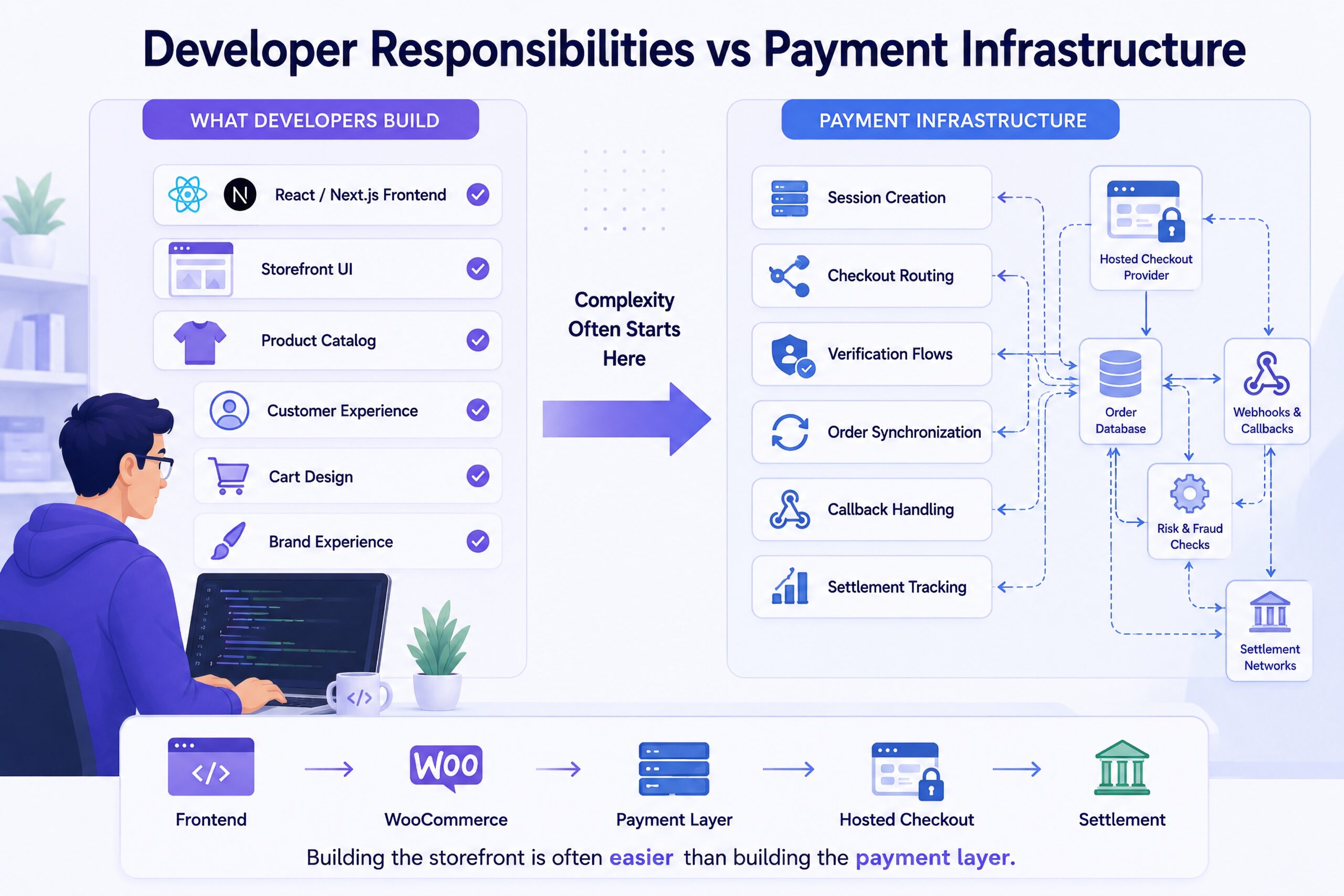
| You Build | VERIFIED Handles |
|---|---|
| Frontend experience | Payment session creation |
| Store API integration | Hosted checkout routing |
| Product catalog | Provider orchestration |
| Cart functionality | Transaction infrastructure |
| Store branding | Settlement preparation |
| Customer experience | Callback handling |
| Commerce workflows | Payment lifecycle management |
| Customer acquisition | Recovery workflows |
Developers integrating VERIFIED are not outsourcing checkout.
They are outsourcing payment infrastructure.
The storefront remains theirs.
The customer experience remains theirs.
WooCommerce remains theirs.
The infrastructure required to execute, track, route, recover, and synchronize transactions becomes a specialized layer.
Developer next step: If your team is evaluating whether to build payment infrastructure or use an existing WooCommerce-native infrastructure layer, review the Headless WooCommerce Developer Integration Guide PDF before writing custom payment orchestration code.
VERIFIED vs Building Your Own vs Generic Crypto Plugins
| Approach | How It Works | Best Fit |
|---|---|---|
| Build Your Own | Your team builds provider integrations, payment sessions, callbacks, routing logic, recovery workflows, and settlement monitoring. | Large technical teams that want full ownership of payment infrastructure. |
| Generic Crypto Plugin | A plugin may add a crypto payment option to WooCommerce, often focused on wallet-to-wallet payment acceptance or a single provider model. | Stores that only need a basic crypto payment option and do not require hosted card-to-crypto routing architecture. |
| VERIFIED Crypto Checkout | A WooCommerce plugin provides the infrastructure layer between WooCommerce, hosted checkout providers, recovery workflows, and wallet-settlement architecture. | Stores and developers that want WooCommerce-native payment infrastructure without building provider routing and settlement logic themselves. |
The strategic distinction is that VERIFIED is not trying to replace WooCommerce or become the hosted checkout provider. It exists as the infrastructure layer between the commerce system and the payment execution environment.
How VERIFIED Fits Into A Headless WooCommerce Architecture
Customer → Next.js / React Frontend → WooCommerce → VERIFIED Crypto Checkout → Hosted Checkout Provider → Merchant Settlement Destination
| Layer | Primary Responsibility |
|---|---|
| Frontend | Customer experience |
| WooCommerce | Products, carts, customers, orders |
| VERIFIED Crypto Checkout | Payment infrastructure and routing |
| Hosted Checkout Provider | Verification and payment execution |
| Settlement Destination | Final settlement location |
At each layer, responsibility passes from one system to the next.
The customer interacts with the headless frontend. The frontend communicates with WooCommerce for cart and checkout state. WooCommerce remains responsible for commerce data and order creation. VERIFIED Crypto Checkout provides the infrastructure layer that creates and routes the payment workflow. The hosted checkout provider controls payment execution and verification. Settlement then arrives at the configured destination, which may include merchant-controlled wallet settlement depending on the payment architecture.
WooCommerce remains the system of record.
VERIFIED becomes the infrastructure layer connecting commerce operations to payment execution and settlement workflows.
VERIFIED does not process payments, custody funds, perform KYC, or act as a payment processor. It provides the WooCommerce infrastructure layer that connects the commerce system to hosted checkout providers and settlement workflows.
How Integration Works At A High Level
This page is not a replacement for developer documentation, but it is useful to understand the integration model conceptually.
- The developer builds the frontend experience in Next.js, React, Vue, Nuxt, or another frontend framework.
- The frontend uses WooCommerce cart and checkout systems as the commerce layer.
- WooCommerce initiates the payment workflow through the VERIFIED Crypto Checkout plugin.
- VERIFIED creates the hosted checkout handoff, applies the configured merchant wallet destination, and coordinates payment routing while WooCommerce remains the order system of record.
This model keeps the headless frontend focused on customer experience instead of requiring it to manage provider-specific payment logic, wallet settlement workflows, or transaction callbacks.
Customer Verification And Hosted Checkout
Some transactions require verification.
Examples may include:
- Identity verification
- Fraud screening
- Risk review
- Provider-specific compliance requirements
An important distinction is that verification requirements belong to the payment provider.
Not WooCommerce.
Not the frontend.
Not VERIFIED Crypto Checkout.
This matters because a headless storefront cannot control every part of a provider-managed verification flow. The frontend should be designed to hand off the customer cleanly and rely on infrastructure to manage transaction routing, recovery workflows, and order synchronization.
Common Headless Payment Problems
Session Persistence Issues
Headless WooCommerce builds can break when cart and checkout state are not preserved correctly between frontend requests and WooCommerce. This often happens because the frontend behaves like a stateless checkout while WooCommerce still needs cart continuity across the customer session.
Cart Synchronization Problems
Commerce and payment systems must remain aligned throughout checkout. If the cart state, customer data, or order state falls out of sync, checkout failures and incorrect order records can follow.
Cross-Domain Cookie Handling
Many headless builds use a frontend domain that differs from the WooCommerce backend domain. When cookies, credentials, or allowed origins are not configured correctly, WooCommerce may treat requests as separate sessions instead of one continuous checkout journey.
Verification Abandonment
Customers may leave during payment or verification. This creates incomplete payment attempts that require recovery workflows rather than only frontend error handling.
Callback Failures
Payment updates must reliably reach WooCommerce. If callbacks are blocked by hosting, security tools, or misconfigured infrastructure, orders can remain pending even after payment activity occurs.
Settlement Visibility Challenges
Merchants need clarity regarding payment and settlement outcomes. This is especially important when the settlement model involves wallet destinations or stablecoin settlement rather than only traditional processor payouts.
Cross-System Complexity
The more systems involved, the more opportunities exist for synchronization issues. This is why headless payment architecture should be designed as infrastructure, not as an afterthought attached to the frontend.
Most of these problems are operational rather than frontend-related.
If these are the problems your team is trying to avoid, start with the headless integration guide before building a custom payment layer.
Why Developers Choose VERIFIED Instead Of Building Payment Infrastructure
Most development teams are hired to build storefronts, customer experiences, and commerce functionality—not payment infrastructure.
VERIFIED Crypto Checkout allows teams to focus on the customer experience while the payment infrastructure layer handles session creation, hosted checkout routing, provider coordination, settlement workflows, recovery tools, and transaction synchronization.
Instead of building:
- Payment sessions
- Provider SDK integrations
- Routing systems
- Settlement infrastructure
- Callback frameworks
- Recovery workflows
Teams can focus on:
- Frontend performance
- User experience
- Commerce functionality
- Customer acquisition
- Conversion optimization
That is the operational difference between building a storefront and building a payment platform.
When Hosted Checkout Makes Sense For Headless WooCommerce
- Next.js storefronts
- React storefronts
- Vue storefronts
- Custom frontend applications
- Hosted payment architectures
- Wallet settlement workflows
- Stablecoin settlement models
- Alternative settlement models
- Teams seeking reduced payment complexity
When Hosted Checkout Is Not Ideal
- Complete payment-page control requirements
- Embedded-only checkout requirements
- Zero-redirect payment requirements
- Custom processor development projects
- Organizations wanting full ownership of payment infrastructure
System Positioning Within The VERIFIED Ecosystem
VERIFIED Crypto Checkout is infrastructure.
It is not a payment processor, acquiring bank, or hosted checkout provider.
The platform operates as a WooCommerce-native infrastructure layer that connects commerce operations, hosted checkout providers, payment routing, recovery workflows, and settlement destinations.
For merchants evaluating broader payment strategy, underwriting options, and merchant account placement, VERIFIED Credit Card Processing explains the merchant account and underwriting side of the VERIFIED ecosystem.
Build Headless WooCommerce Payments Without Building Payment Infrastructure
The biggest misconception in headless commerce is that the storefront is the difficult part.
For many organizations, payment infrastructure becomes the greater challenge.
VERIFIED Crypto Checkout exists to separate those responsibilities.
Development teams can focus on storefront development, customer experience, and commerce functionality while payment infrastructure operates independently in the background.
Stop building payment infrastructure from scratch. Install VERIFIED Crypto Checkout and connect WooCommerce to hosted checkout infrastructure, payment routing, recovery workflows, and wallet-settlement architecture.
View VERIFIED Crypto Checkout on WordPress.org
Download The Headless WooCommerce Developer Integration Guide PDF
Headless WooCommerce Payments In One Sentence
Headless WooCommerce payments separate the storefront from payment infrastructure, allowing WooCommerce to manage commerce operations while specialized systems handle transaction execution, verification, routing, recovery, and settlement.
Developer Resources
- What Is VERIFIED Crypto Checkout?
- Hosted Checkout Explained
- WooCommerce USDC Payment Gateway
- Payment Links
- Subscription Payments Without Chargebacks
- Smart Recovery
- Documentation Hub
- Headless WooCommerce Developer Integration Guide PDF
- Fee Transparency Guide
Frequently Asked Questions
What are headless WooCommerce payments?
Headless WooCommerce payments are payment workflows where the storefront operates independently from WooCommerce while WooCommerce continues managing products, customers, carts, checkout data, and orders. The frontend may be built in Next.js, React, Vue, Nuxt, or another framework, while WooCommerce remains the commerce engine. Payment infrastructure still needs to handle session creation, routing, callbacks, verification, and settlement.
How does WooCommerce work in a headless architecture?
WooCommerce remains the system responsible for products, carts, customers, orders, taxes, shipping rules, and commerce logic. The headless frontend communicates with WooCommerce through APIs rather than rendering the store through a traditional WordPress theme. This allows developers to build a custom storefront while keeping WooCommerce as the operational backend.
What is the difference between headless WooCommerce and traditional WooCommerce?
Traditional WooCommerce combines the frontend and backend inside WordPress. Headless WooCommerce separates the customer-facing storefront into an independent frontend application while WooCommerce continues to manage commerce operations. The main benefit is frontend flexibility, but payment infrastructure still needs to be designed carefully.
What is the WooCommerce Store API?
The WooCommerce Store API provides frontend-facing endpoints for cart and checkout functionality. In headless commerce, routes such as /wc/store/v1/cart and /wc/store/v1/checkout help the frontend interact with WooCommerce cart and checkout state. This is different from using only the WooCommerce REST API for backend administrative operations.
Does headless WooCommerce require hosted checkout?
No. Headless WooCommerce can use embedded payment flows or hosted checkout flows depending on the business requirements. Hosted checkout is often used when teams want to reduce payment infrastructure ownership, provider SDK maintenance, callback complexity, and settlement workflow development.
Why do developers use hosted checkout?
Developers use hosted checkout because it moves much of the payment execution and provider-specific complexity into a dedicated payment environment. This can reduce the need to build payment session systems, provider integrations, verification workflows, routing engines, and settlement infrastructure directly into the storefront.
Can headless WooCommerce support wallet settlement?
Yes. Depending on the payment architecture, settlement can be directed to merchant-controlled wallets or other configured destinations. In crypto checkout architectures, this may include stablecoin settlement such as USDC, where the payment workflow is handled separately from the customer-facing storefront.
Can headless WooCommerce support crypto checkout?
Yes. Headless WooCommerce storefronts can support crypto checkout through WooCommerce-compatible payment infrastructure. The important requirement is that the payment system can coordinate hosted checkout, provider verification, wallet settlement, callbacks, and order synchronization without forcing the frontend to manage those responsibilities directly.
What does VERIFIED Crypto Checkout handle automatically?
VERIFIED Crypto Checkout handles payment session creation, hosted checkout routing, provider coordination, recovery workflows, settlement preparation, and transaction synchronization. It operates as a WooCommerce plugin and infrastructure layer between WooCommerce and hosted checkout providers. VERIFIED does not process payments, custody funds, perform KYC, or act as a payment processor.
Is VERIFIED Crypto Checkout a WooCommerce plugin?
Yes. VERIFIED Crypto Checkout is a WooCommerce plugin designed to act as the infrastructure layer between WooCommerce and hosted checkout providers. It allows WooCommerce to remain the commerce system of record while payment execution and verification occur through provider-controlled hosted checkout environments.
Can VERIFIED Crypto Checkout support Next.js storefronts?
Yes. VERIFIED Crypto Checkout can support Next.js storefronts that use WooCommerce as the commerce backend. The frontend remains responsible for the customer experience, while WooCommerce and the VERIFIED plugin coordinate the checkout and payment infrastructure layer.
Can VERIFIED Crypto Checkout support React storefronts?
Yes. React storefronts can use WooCommerce as the commerce backend while VERIFIED Crypto Checkout provides the payment infrastructure layer. This allows the React frontend to focus on customer experience instead of provider-specific payment orchestration.
Why do WooCommerce carts disappear in headless builds?
Cart issues in headless WooCommerce builds are often caused by session persistence problems, cross-domain cookie handling, stateless frontend assumptions, or checkout state not being preserved correctly. These are common implementation issues in decoupled WooCommerce architectures and are one reason payment infrastructure should be planned carefully.
Where should developers start with VERIFIED headless WooCommerce payments?
Developers evaluating VERIFIED for a headless WooCommerce build should start with the Headless WooCommerce Developer Integration Guide PDF and the documentation hub. The article explains the architecture, while the developer guide provides the implementation-specific details needed for a technical build.
About the Author: Brad Ungar
