
By Brad Ungar | Payment Infrastructure Consultant at VERIFIED Crypto Checkout
Merchants researching 7-OH ecommerce payment risk often find themselves navigating a category where provider policies, regulatory interpretations, and underwriting standards are changing faster than checkout infrastructure can adapt.
Hosted checkout continuity infrastructure is a WooCommerce payment architecture where customers complete payment through an external hosted provider, the provider independently manages transaction approval and compliance requirements, and settlement may occur through alternative settlement structures such as USDC wallet delivery rather than conventional merchant-account settlement alone.
For WooCommerce merchants, the conversation is increasingly shifting away from “finding a processor” and toward building resilient checkout infrastructure capable of handling operational uncertainty. Hosted checkout architecture, settlement flexibility, payment-path redundancy, and recovery tooling are becoming part of broader ecommerce continuity planning for stores operating in payment environments affected by provider policy changes and regulatory uncertainty.
Rather than functioning as a traditional merchant account provider, VERIFIED Crypto Checkout operates as WooCommerce checkout infrastructure that connects stores to hosted checkout providers capable of facilitating hosted settlement workflows and alternative checkout routing.
Important: VERIFIED Crypto Checkout is software infrastructure for WooCommerce and is not a payment processor, acquiring bank, sponsor bank, money transmitter, exchange, or underwriting provider.
VERIFIED does not approve merchants, determine legality of products sold, custody customer funds, or guarantee provider availability.
Hosted checkout providers independently determine supported categories, KYC requirements, transaction approval policies, geographic availability, and settlement behavior.
Merchants remain responsible for complying with all applicable laws, regulations, card-network rules, and product restrictions in their jurisdiction.
This article is for general ecommerce infrastructure education only. It is not intended to encourage, support, or facilitate the sale of any product that is illegal, restricted, misbranded, adulterated, or prohibited by any applicable provider policy.
Nothing in this article should be interpreted as a representation that any particular product category is supported by any hosted checkout provider, card network, financial institution, or settlement partner.
What this article covers:
- checkout continuity planning
- hosted provider dependency
- WooCommerce routing infrastructure
- payment-path redundancy
- settlement architecture
- operational recovery tooling
What this article does not cover:
- legal advice regarding 7-OH products
- claims that any provider supports any specific category
- guidance on circumventing provider restrictions or compliance obligations
Key Highlights
- Emerging supplement categories frequently experience payment instability due to underwriting sensitivity and provider policy volatility.
- Hosted checkout infrastructure differs substantially from traditional merchant account processing models.
- WooCommerce stores can implement hosted settlement flows using external providers and wallet settlement infrastructure.
- Settlement architecture influences operational flexibility, reserve exposure, and provider dependency risk.
- First-time customer friction, KYC requirements, and redirect abandonment are real operational considerations.
- Payment continuity planning matters more in unstable categories than relying entirely on a single processor relationship.
- VERIFIED Crypto Checkout functions as infrastructure orchestration software, not as the payment processor itself.
Regulatory Context Matters for 7-OH Products
7-OH products operate in a rapidly changing regulatory environment. The FDA has warned consumers about products containing 7-OH as an added ingredient or at enhanced levels, and in 2025 recommended scheduling certain 7-OH products under the Controlled Substances Act. State laws and enforcement positions may also vary.
Merchants should review current regulatory guidance directly from the FDA’s published communications regarding products containing concentrated 7-hydroxymitragynine and the FDA consumer update regarding products containing 7-OH and potential harm risks.
The FDA has also stated that 7-OH differs from natural kratom leaf products, and merchants should not assume that kratom-related rules apply uniformly to concentrated or enhanced 7-OH products.
This article does not provide legal advice or determine whether any specific product may be lawfully sold. Merchants should consult qualified counsel and review applicable federal, state, and local requirements before offering products in this category.
Why Emerging Supplement Categories Often Face Payment Instability
Many supplement-related ecommerce businesses operate in environments where underwriting interpretation changes quickly. Even when products remain legally sellable within certain jurisdictions, providers may independently reassess exposure tolerance, reserve requirements, chargeback concerns, refund patterns, or category classification risk.
In practice, merchants operating in emerging supplement categories often encounter:
- sudden policy updates
- processor account reviews
- reserve increases
- payment holds
- category reclassification
- checkout interruptions
- higher underwriting scrutiny
- elevated refund monitoring
Different providers may interpret the same business differently. One provider may permit a category temporarily while another may decline it entirely. Availability can also vary by geography, transaction volume, marketing claims, fulfillment practices, and customer demographics.
This unpredictability is why some ecommerce operators begin evaluating checkout redundancy and alternative settlement infrastructure before a disruption occurs.
Traditional Merchant Accounts vs Hosted Checkout Infrastructure
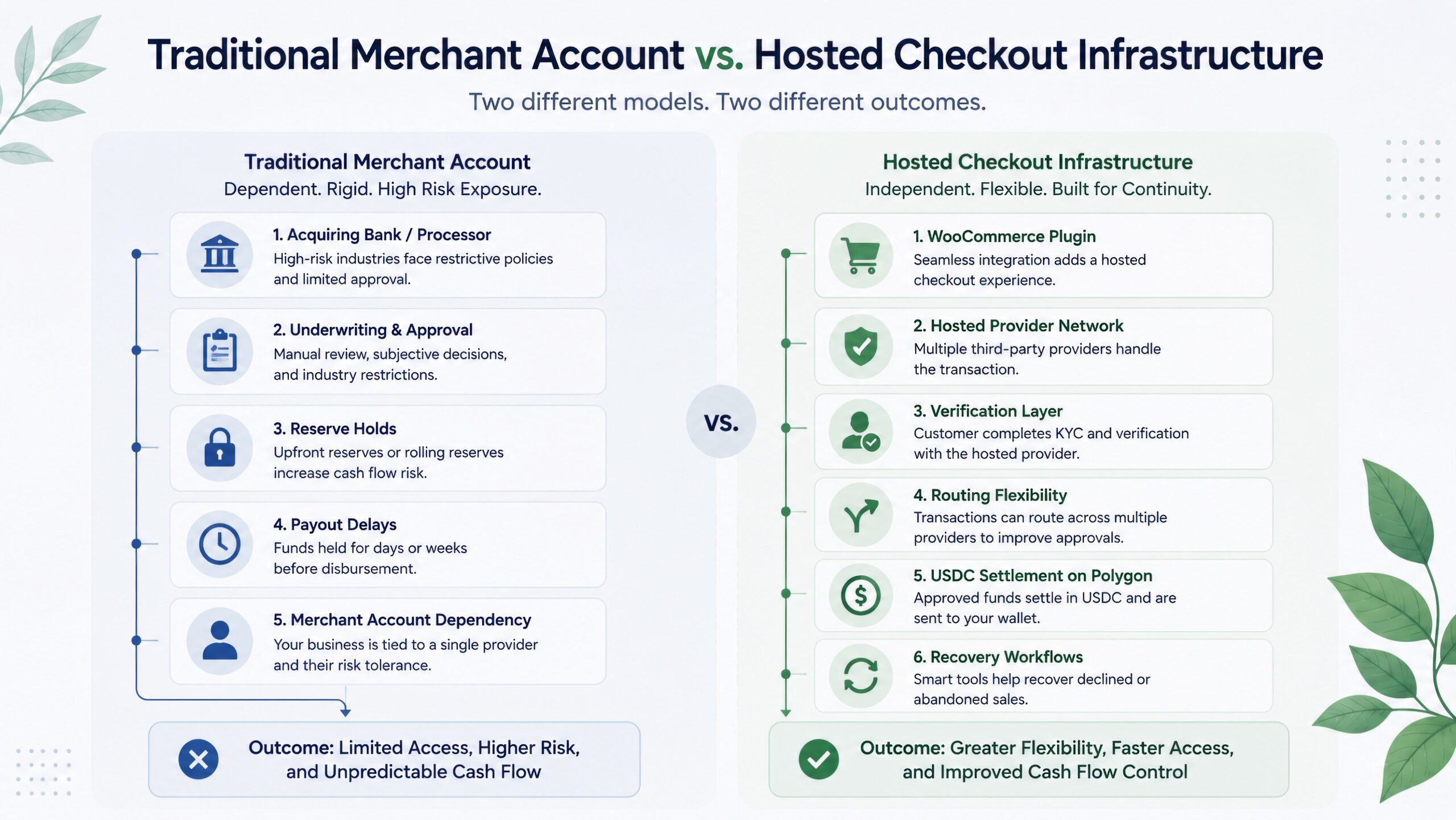
Traditional ecommerce payment systems typically rely on a direct merchant account relationship involving:
- an acquiring bank
- a processor
- underwriting review
- ongoing compliance monitoring
- reserve management
- chargeback exposure
In that structure, the merchant account itself becomes the operational dependency. If underwriting changes or provider policies shift, checkout continuity may be affected immediately.
| Traditional Merchant Account Model | Hosted Checkout Infrastructure Model |
|---|---|
| Direct merchant acquiring relationship | Hosted provider-managed checkout flow |
| Processor underwrites merchant directly | Provider independently evaluates transaction eligibility |
| Settlement typically to bank account | Settlement may occur through alternative wallet infrastructure |
| Merchant heavily dependent on one processor stack | Infrastructure can support routing flexibility |
| Traditional reserve structures may apply | Settlement architecture differs operationally |
| Conventional card-not-present chargeback environment | Hosted provider rules and settlement mechanics vary |
| Settlement timing dependent on processor payout schedules | Settlement visibility may occur faster through wallet-based infrastructure |
Under the VERIFIED Crypto Checkout model, the WooCommerce plugin functions as an infrastructure layer that coordinates:
- hosted checkout routing
- provider redirection
- wallet settlement workflows
- payment recovery systems
- subscription support
- manual payment flows
The hosted provider remains responsible for transaction approval, KYC requirements, payment acceptance policies, and category support decisions.
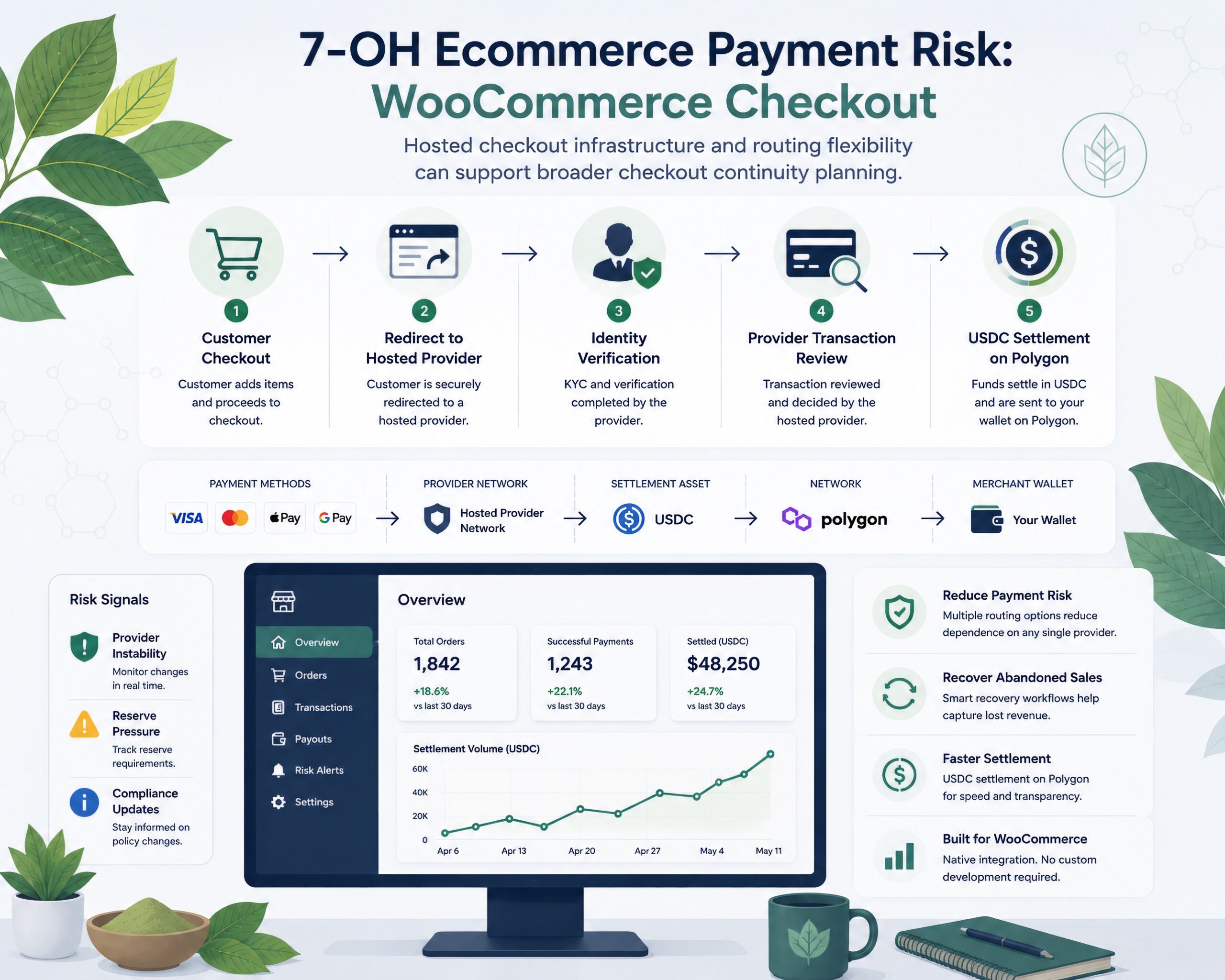
How the Hosted Checkout Settlement Flow Works
This infrastructure model is easier to understand when viewed operationally as a routing and settlement workflow.
Step 1: Customer Selects VERIFIED Checkout
The customer selects the VERIFIED checkout option inside WooCommerce during the standard ecommerce checkout process.
The merchant controls how the payment method is displayed, including optional messaging about identity verification requirements, redirect behavior, and payment expectations.
Step 2: Customer Is Redirected to a Hosted Provider
Rather than entering card details directly into the merchant’s WooCommerce environment, the customer is redirected to an external hosted checkout provider.
The hosted provider controls the transaction environment and independently determines:
- supported regions
- transaction eligibility
- payment acceptance rules
- risk scoring
- identity verification requirements
Step 3: Provider May Request KYC or Identity Verification
First-time customers may encounter identity verification requirements depending on the provider, geography, transaction size, or risk profile.
This is one of the most important operational realities merchants must understand before implementation.
Returning customers often experience faster checkout flows once verified within a provider ecosystem, but approval speed and friction vary substantially between providers.
Many merchants also observe that debit cards may perform more consistently than credit cards in certain hosted checkout environments, though approval behavior varies by issuer and provider policy.
Step 4: Provider Processes the Transaction
The hosted provider manages the underlying payment acceptance infrastructure according to its own policies and compliance framework.
VERIFIED does not process the card transaction itself.
The provider independently determines whether the transaction proceeds, requires additional review, or is declined.
Step 5: Settlement May Arrive in USDC on Polygon
When supported by the provider flow, customers can pay using traditional payment methods such as debit cards, credit cards, Apple Pay, or Google Pay while the hosted provider manages the conversion and settlement workflow behind the scenes.
Customers do not typically need to already own cryptocurrency before completing checkout.
Settlement may then occur in USDC delivered directly to a merchant-controlled wallet on Polygon depending on the provider flow being used.
This structure is designed as a non-custodial model where merchants maintain direct wallet control rather than storing funds inside VERIFIED infrastructure.
Polygon network transaction fees are typically very low, and on-chain settlement provides transparent transaction visibility for reconciliation and operational tracking.
Plain-English summary: In a hosted card-to-USDC checkout flow, the customer can pay through a third-party hosted provider using familiar payment methods, the provider independently manages verification and payment acceptance, and settlement may be delivered to the merchant as USDC depending on provider support and transaction eligibility.
Merchants wanting a deeper operational explanation of this settlement structure can review the USDC Settlement for Ecommerce guide.
Why Some Merchants Explore Alternative Checkout Infrastructure
Many merchants evaluating hosted checkout infrastructure are not necessarily trying to replace all traditional payment relationships.
Instead, they are often attempting to reduce operational dependency on a single provider environment.
Common motivations include:
- checkout continuity planning
- reducing single-provider dependence
- maintaining ecommerce operations during underwriting instability
- international settlement flexibility
- faster settlement visibility
- wallet-based treasury management
- WooCommerce-native integration requirements
- payment-path redundancy
Some merchants in supplement categories experiencing provider reviews have used hosted checkout infrastructure and payment links to maintain partial order continuity during underwriting transitions, reserve escalations, or processor instability.
Routing flexibility is a continuity asset when underwriting environments become unstable.
That does not eliminate operational risk, provider discretion, or compliance obligations. It simply changes how the infrastructure is structured.
Real Operational Friction Merchants Should Expect
One of the biggest mistakes merchants make is assuming hosted checkout infrastructure removes operational friction entirely.
It does not.
In fact, merchants should expect meaningful operational realities including:
- KYC requirements
- customer verification delays
- redirect abandonment
- provider declines
- unsupported jurisdictions
- wallet management learning curves
- refund workflow complexity
- checkout confusion from first-time users
Checkout friction compounds conversion loss.
This is why recovery infrastructure matters almost as much as the checkout flow itself.
VERIFIED includes a recovery system designed specifically for hosted checkout environments where first-time customers may abandon during provider redirection or verification.
The Smart Recovery system supports:
- abandoned checkout recovery emails
- tokenized “Pay Now” links
- hosted retry flows
- manual order rescue workflows
- recovery incentives
- subscription payment retries
Instead of pretending friction does not exist, the infrastructure is designed around operational mitigation.
Why WooCommerce Merchants Use Payment Links and Manual Recovery Flows
Hosted checkout infrastructure often requires more operational flexibility than standard embedded card processing.
That is why many WooCommerce operators rely heavily on payment links, manual recovery tools, and support-assisted checkout flows.
Typical operational use cases include:
- sending invoice payment requests
- recovering failed checkouts
- rescuing abandoned carts
- customer support payment assistance
- large-order handling
- manual renewal collection
- QR payment workflows
The WooCommerce Payment Links infrastructure supports hosted payment recovery outside the traditional checkout session.
For recurring ecommerce models, the WooCommerce subscriptions infrastructure also supports tokenized renewal payment flows designed around hosted settlement environments.
Operationally, these tools matter because unstable checkout categories often require more human-assisted recovery and customer communication than standard ecommerce processing.
Important Legal and Compliance Considerations
Hosted checkout availability can change over time based on provider policy updates, geographic restrictions, underwriting changes, or evolving regulatory interpretation of specific product categories.
Merchants should understand that provider availability is never guaranteed.
Important operational considerations include:
- local product legality
- consumer protection obligations
- KYC requirements
- tax compliance
- marketing claim restrictions
- geographic transaction limitations
- provider policy discretion
- refund handling obligations
Merchants should consult qualified legal and compliance professionals before selling products in legally sensitive or rapidly evolving categories.
VERIFIED does not determine whether a merchant’s products are lawful, permissible, or supported by third-party providers.
Provider requirements and restrictions may evolve over time without notice.
What Merchants Should Evaluate Before Implementing Hosted Checkout Infrastructure
Before implementing alternative checkout infrastructure, merchants should evaluate operational fit carefully rather than treating the system as a universal replacement for conventional ecommerce processing.
Important evaluation areas include:
- customer geography and provider support
- checkout friction tolerance
- wallet management readiness
- refund operations planning
- subscription billing requirements
- provider availability by category
- customer support capacity
- accounting reconciliation workflows
- USDC treasury management processes
- WooCommerce operational complexity
Merchants should also understand the infrastructure fee model and provider fee structure before implementation. The fee transparency guide explains how settlement and infrastructure costs are typically structured within the VERIFIED ecosystem.
Who This Infrastructure Model Is Best Suited For
This infrastructure model is generally best suited for:
- WooCommerce merchants
- operators comfortable managing wallets
- international ecommerce businesses
- technically capable store operators
- businesses planning for provider instability
- merchants evaluating payment-path redundancy
It may not fit well for:
- merchants requiring ultra-low-friction checkout experiences
- businesses uncomfortable with wallet settlement
- categories unsupported by hosted providers
- stores expecting traditional acquiring behavior
- operators unwilling to manage recovery workflows
- businesses seeking guaranteed provider availability
Infrastructure decisions should align with operational realities rather than marketing promises.
How VERIFIED Fits Within the Broader Payment Infrastructure Ecosystem
Within the broader VERIFIED ecosystem, VERIFIED Crypto Checkout functions as the WooCommerce infrastructure layer focused on hosted checkout routing and settlement coordination.
VERIFIED Crypto Checkout focuses specifically on WooCommerce routing, hosted provider connection, recovery workflows, and USDC settlement coordination rather than merchant account placement.
Meanwhile, Verified Credit Card Processing focuses on traditional underwriting-aware payment brokerage and merchant account placement strategies.
This separation matters because the two systems solve different operational problems.
- Traditional acquiring relationships focus on conventional merchant account processing.
- Hosted checkout infrastructure focuses on routing architecture and settlement coordination.
- Some merchants use one model.
- Some use both for redundancy planning.
For merchants evaluating implementation requirements, the VERIFIED Crypto Checkout documentation and setup guide explains the operational setup process, provider routing structure, wallet configuration requirements, and WooCommerce integration details.
Conclusion
Emerging supplement categories operate inside payment environments where provider policies, underwriting interpretation, and operational stability can change quickly.
As a result, many WooCommerce merchants are beginning to view checkout infrastructure as part of broader continuity planning rather than simply a processor selection decision.
Hosted settlement architecture changes how ecommerce payment routing and settlement can operate, but it also introduces new operational realities including KYC friction, wallet management responsibilities, provider dependency considerations, and recovery workflow requirements.
Operational takeaway: For legally sensitive ecommerce categories, payment continuity is less about finding a single replacement processor and more about understanding provider dependency, checkout friction, routing flexibility, recovery workflows, and settlement design.
VERIFIED Crypto Checkout provides WooCommerce infrastructure designed around hosted checkout orchestration, routing flexibility, settlement coordination, payment recovery tooling, and operational continuity planning.
Merchants evaluating this infrastructure model should focus on operational fit, provider availability, customer checkout expectations, and long-term continuity planning before implementation.
Merchants who have already experienced processor instability or underwriting disruption can also review operational recovery considerations in our guide on high-risk payment processor shutdowns.
To learn more, review the VERIFIED Crypto Checkout homepage, explore the documentation and setup guide, or download the WooCommerce plugin directly from the official WordPress repository.
Editorial note: This article is for general ecommerce infrastructure education only. Regulatory treatment of 7-OH products, kratom-derived products, enhanced alkaloid formulations, and related supplement categories may change quickly and may vary by jurisdiction. Merchants should consult qualified legal counsel before offering products in this category.
Frequently Asked Questions
What is payment continuity infrastructure for high-friction ecommerce categories?
Payment continuity infrastructure refers to ecommerce checkout systems designed to help merchants maintain operational flexibility when provider policies, underwriting conditions, or payment availability change. Some WooCommerce merchants evaluate hosted checkout routing and alternative settlement infrastructure as part of broader continuity planning.
Why do emerging supplement categories experience payment instability?
Emerging supplement categories often experience payment instability because providers may reassess underwriting exposure, reserve requirements, refund patterns, compliance concerns, or category risk as regulations and policies evolve.
Does VERIFIED Crypto Checkout process card payments directly?
No. VERIFIED Crypto Checkout operates as WooCommerce infrastructure software rather than as the payment processor itself. Hosted checkout providers independently manage payment acceptance, transaction approval, KYC requirements, and provider policies.
Do customers need to already own cryptocurrency to use hosted checkout flows?
No. In many hosted checkout flows, customers can pay using traditional payment methods such as debit cards, credit cards, Apple Pay, or Google Pay while the provider manages the settlement conversion workflow behind the scenes.
What operational challenges should merchants expect with hosted checkout infrastructure?
Merchants should expect operational realities including customer KYC requirements, redirect abandonment, unsupported regions, provider declines, wallet management responsibilities, and additional customer support requirements.
Can hosted checkout infrastructure reduce dependence on a single payment provider?
Some merchants explore hosted checkout infrastructure as part of broader payment-path redundancy planning to reduce operational dependency on a single provider relationship.
Does hosted checkout infrastructure guarantee provider support for 7-OH products?
No. Provider availability, category support, transaction eligibility, and settlement behavior are independently determined by third-party hosted providers and may change without notice.
Is this article legal advice regarding 7-OH products or emerging supplement categories?
No. This article is intended for general ecommerce infrastructure education only and does not provide legal advice. Merchants should consult qualified legal and compliance professionals regarding product legality, regulatory obligations, and provider requirements.
About the Author: Brad Ungar
