
Written by Brad Ungar | Payment Infrastructure Consultant at VERIFIED Crypto Checkout
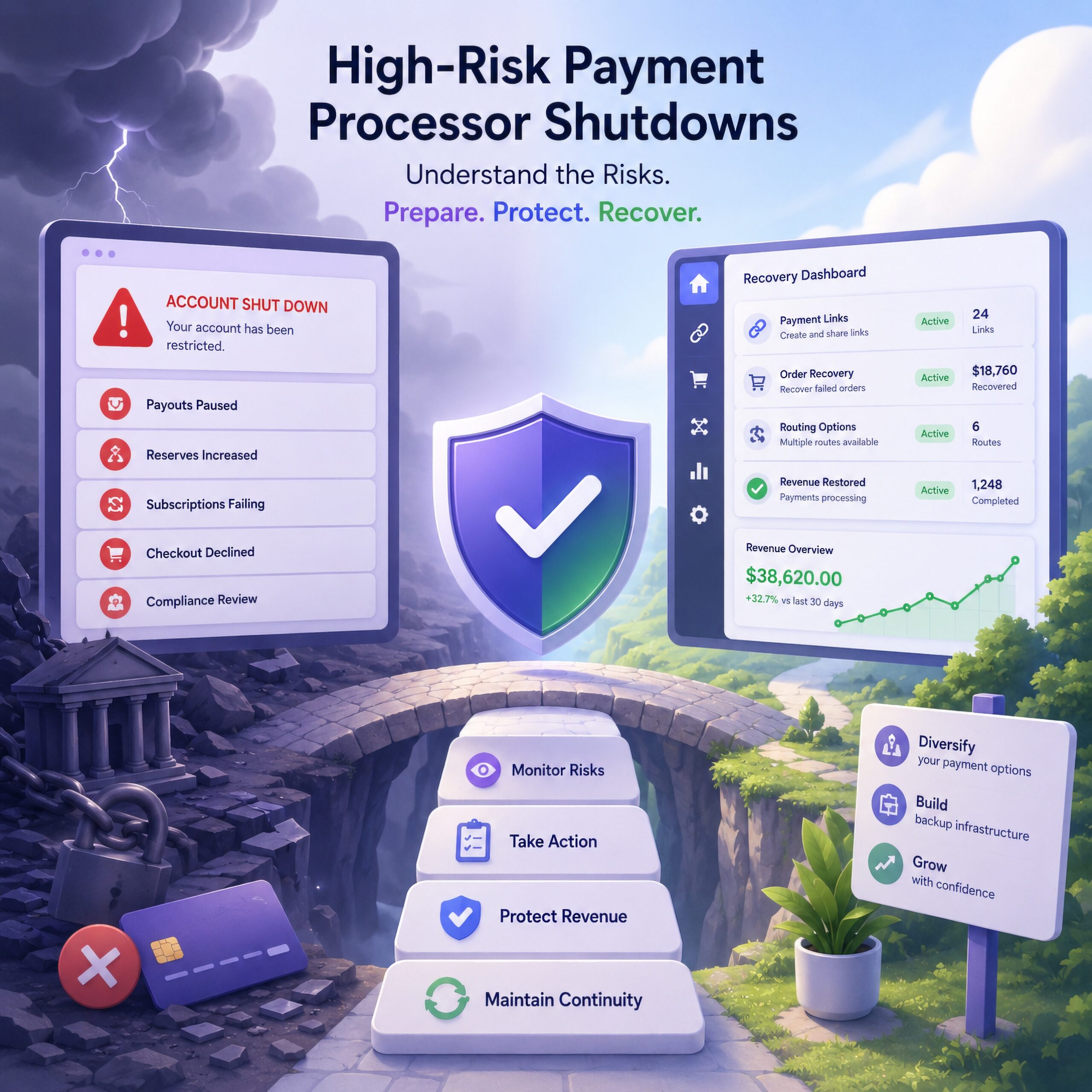
High-risk payment processor shutdowns are rarely random events. In most cases, they happen after a processor, acquiring bank, or underwriting team identifies cumulative risk signals tied to chargebacks, category exposure, compliance concerns, fulfillment instability, or sudden operational changes. For ecommerce merchants operating in supplements, peptides, CBD, adult products, restricted categories, or other underwriting-sensitive verticals, payment continuity becomes an operational discipline — not just a checkout feature.
As traditional processors continue tightening underwriting standards, more ecommerce businesses are building contingency plans before disruption occurs. That shift is changing how merchants think about payment infrastructure, hosted checkout systems, settlement flexibility, and backup collection flows.
Key Highlights
- Most high-risk payment processor shutdowns are driven by cumulative underwriting risk signals.
- Chargebacks, unsupported marketing claims, subscription disputes, and fulfillment issues are common triggers.
- High-risk ecommerce categories face greater scrutiny from processors and acquiring banks.
- Reserve increases and payout delays are often early warning signs before termination.
- Payment continuity planning matters long before a shutdown occurs.
- Hosted checkout infrastructure can provide operational continuity during processor instability.
- Alternative settlement rails still involve customer verification, provider compliance, and checkout friction.
What Is a High-Risk Payment Processor Shutdown?
A high-risk payment processor shutdown occurs when a processor, acquiring bank, or payment platform terminates or restricts a merchant’s ability to accept payments due to perceived risk exposure.
That exposure may involve financial risk, regulatory pressure, chargeback concerns, unsupported verticals, reputational risk, or underwriting instability.
In ecommerce, shutdowns typically affect:
- card processing access
- checkout functionality
- subscription billing continuity
- merchant payouts
- reserve availability
- customer payment acceptance rates
While merchants often view shutdowns as sudden events, processors usually view them as the final stage of escalating risk evaluation.
Why Payment Processors Shut Down High-Risk Ecommerce Stores
Processors and acquiring banks operate inside heavily regulated financial ecosystems. Their underwriting teams continuously evaluate merchant behavior, category exposure, dispute ratios, and operational stability.
When cumulative risk exceeds internal tolerance thresholds, restrictions often follow.
1. Excessive Chargebacks
Chargebacks remain one of the biggest drivers of processor instability.
High dispute ratios increase financial exposure for processors and acquiring banks. Subscription products, recurring billing, continuity programs, and aggressive rebill models tend to increase scrutiny quickly.
Visa and Mastercard both operate monitoring programs designed to identify merchants with elevated dispute activity, which can ultimately impact processor relationships and acquiring-bank exposure.
Useful references:
Common chargeback triggers include:
- unclear billing descriptors
- delayed shipping
- subscription confusion
- customer dissatisfaction
- unsupported product claims
- refund friction
Once a merchant approaches monitoring thresholds from card networks, processors may begin implementing reserves, rolling holds, or account reviews.
2. Unsupported Marketing Claims
Many supplement, peptide, CBD, and wellness merchants underestimate how closely underwriting teams review marketing language.
Claims involving:
- disease treatment
- medical outcomes
- weight-loss guarantees
- performance enhancement promises
- research-use ambiguity
can materially increase processor risk exposure.
Even when merchants are operationally stable, aggressive affiliate marketing or unsupported landing page claims can trigger compliance reviews.
3. MCC and Category Risk Exposure
Merchant Category Codes (MCCs) heavily influence underwriting decisions.
Certain categories inherently receive elevated scrutiny due to historical dispute ratios, regulatory complexity, or reputational pressure.
Examples include:
- supplements
- CBD
- peptides
- adult products
- nutraceuticals
- continuity billing models
- gray-market ecommerce
Even strong merchants inside these categories often face more fragile processing relationships than standard ecommerce stores.
Many mainstream processors also publish restricted business policies that affect how these categories are evaluated during underwriting.
4. Sudden Volume Spikes
Rapid increases in transaction volume frequently trigger underwriting concern.
From the processor perspective, unexpected spikes may indicate:
- fraud exposure
- viral traffic surges
- affiliate quality problems
- unapproved traffic sources
- inventory instability
- financial stress risk
Many merchants mistakenly assume higher sales automatically improve processor confidence. In reality, unmanaged growth can increase scrutiny if operational systems fail to scale alongside volume.
5. Fulfillment and Customer Support Problems
Processors closely monitor refund patterns, shipping complaints, and unresolved customer issues.
Operational instability often becomes visible through:
- late fulfillment
- tracking inconsistencies
- poor customer support responsiveness
- refund delays
- negative public reviews
When customer frustration rises, chargebacks typically follow.
Why High-Risk Merchants Are More Vulnerable
High-risk ecommerce merchants operate under narrower underwriting tolerance windows.
That does not necessarily mean the businesses are illegitimate. It means processors perceive greater financial or regulatory exposure associated with the category.
Merchants selling:
- supplements
- CBD products
- research compounds
- adult products
- regulated wellness products
- continuity subscriptions
often face:
- higher reserve probability
- stricter monitoring
- faster account reviews
- more aggressive compliance checks
- greater payout volatility
That operational reality is why payment continuity planning has become increasingly important across underwriting-sensitive ecommerce sectors.
Early Warning Signs Before a Processor Shutdown
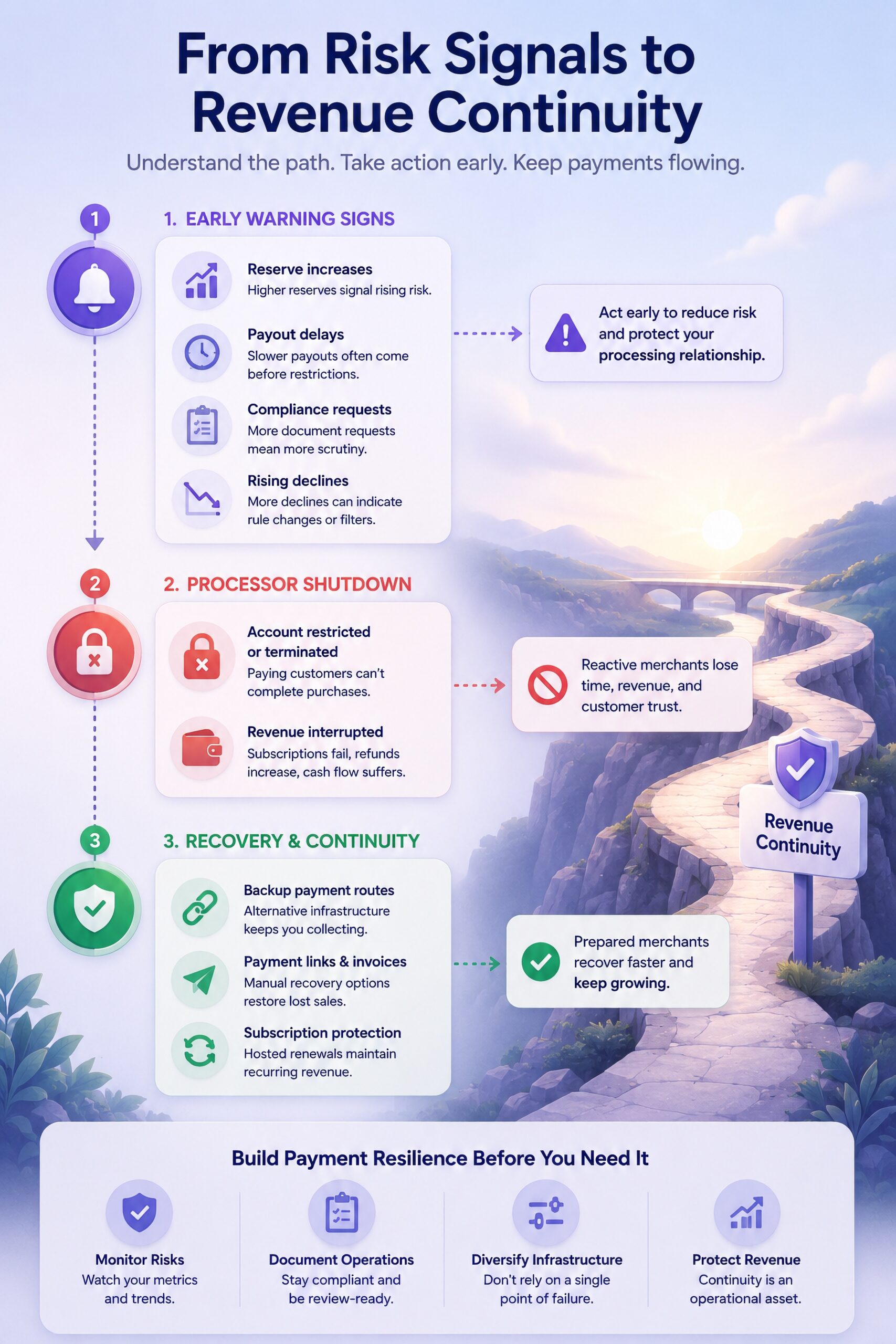
Most processor shutdowns are preceded by escalating operational signals.
Merchants who recognize these signs early usually have more time to stabilize payment infrastructure before major disruption occurs.
Reserve Increases
Rolling reserves, delayed reserves, or sudden hold increases often indicate rising processor concern.
Reserve adjustments are frequently used as a defensive risk-management mechanism before broader restrictions occur.
In one recent ecommerce scenario, a peptide merchant experienced reserve increases from 5% to 15% over a 7-week period before receiving a broader account review request. Because the merchant had already implemented backup payment collection flows, they were able to maintain partial revenue continuity during the underwriting review period instead of experiencing a complete checkout outage.
Payout Delays
Unexpected payout slowdowns may signal:
- manual underwriting reviews
- fraud investigations
- chargeback concerns
- banking partner pressure
Consistent payout timing changes should never be ignored.
Compliance Review Requests
Requests involving:
- supplier invoices
- marketing reviews
- fulfillment documentation
- lab testing
- updated policies
often indicate elevated underwriting scrutiny.
Increased Transaction Declines
Sudden authorization decline increases can occur before broader processing restrictions.
These shifts may reflect:
- bank-level filtering
- processor rule tightening
- fraud scoring changes
- issuer sensitivity toward the category
What Merchants Should Do When Warning Signs Appear
Merchants who wait until a full processor shutdown occurs often lose valuable time.
When underwriting pressure starts increasing, operational preparation becomes critical.
- Reduce preventable chargebacks. Improve billing clarity, customer support responsiveness, refund handling, and subscription transparency.
- Review compliance-sensitive marketing. Remove unsupported claims, aggressive affiliate copy, and misleading product language that may increase underwriting scrutiny.
- Document operational stability. Maintain updated supplier records, fulfillment systems, policies, and customer communication procedures.
- Evaluate payment continuity options. Merchants operating in unstable categories should understand what backup collection infrastructure may be available before disruption occurs.
- Avoid relying on a single payment dependency. Processor concentration risk becomes dangerous when an entire revenue system depends on one acquiring relationship.
Merchants already experiencing payout freezes, sudden account reviews, or processor restrictions should also review our guide on what to do if Stripe shuts down your account, which outlines operational recovery steps after a processor disruption occurs.
Why Payment Continuity Infrastructure Matters
For high-risk ecommerce merchants, payment infrastructure resilience matters as much as conversion optimization.
Merchants frequently invest heavily in:
- advertising
- inventory
- customer acquisition
- subscription growth
- brand development
but fail to build contingency planning around payment acceptance.
When a processor restriction occurs, the operational damage can extend beyond temporary checkout disruption.
Potential consequences include:
- revenue interruption
- subscription churn
- cash flow instability
- customer trust erosion
- inventory stress
- marketing inefficiency
This is why many ecommerce operators now view payment routing flexibility as a continuity asset rather than just a payment feature.
Hosted Checkout Infrastructure as a Continuity Rail
Hosted checkout infrastructure has increasingly become part of payment continuity planning for underwriting-sensitive ecommerce merchants.
Rather than relying entirely on direct merchant acquiring relationships, hosted checkout systems introduce alternative routing and settlement architectures.
These systems may help merchants maintain operational continuity during periods of processor instability, reserve escalation, or underwriting disruption.
However, merchants should understand the trade-offs clearly:
- hosted checkout introduces additional customer friction
- KYC verification may be required by providers
- conversion rates may differ from standard card processing
- not every customer will complete an on-ramp flow
- certain providers may restrict specific jurisdictions or card types
The goal is not to present hosted checkout as a universal replacement for traditional processing.
The goal is operational continuity when standard acquiring becomes unstable or unavailable.
Payment Links During Processor Instability
Payment links can become operationally important during periods of checkout disruption.
The ability to generate manual payment flows, invoice recovery links, or direct collection links gives merchants additional flexibility when primary payment infrastructure becomes unreliable.
VERIFIED Crypto Checkout payment links support:
- manual invoice recovery
- abandoned checkout recovery
- customer support-assisted collections
- direct payment requests
- temporary fallback collection flows
For some merchants, these systems function as operational redundancy during underwriting instability.
Subscription Revenue Protection During Processor Instability
Subscription merchants face unique risks during processor shutdown events.
Traditional recurring billing systems rely heavily on stored-card infrastructure. When acquiring relationships fail, recurring revenue can collapse quickly.
subscription payment continuity infrastructure introduces a different renewal model using hosted renewal flows rather than persistent stored-card rebilling.
That architecture changes how recurring payment continuity can function during underwriting disruption.
In another recent ecommerce scenario, a continuity subscription merchant temporarily lost access to stored-card rebilling during an account review process. By shifting renewal recovery into hosted payment links delivered through email reminders, the business recovered an estimated 70% of renewal revenue that previously would have churned during the disruption period.
Again, this model is not frictionless.
Customers may still encounter provider verification requirements or hosted payment steps.
But for some merchants operating in unstable categories, continuity matters more than perfect checkout simplicity.
Where VERIFIED Crypto Checkout Fits
VERIFIED Crypto Checkout is not positioned as a replacement for every payment processor.
It is infrastructure designed for merchants operating in environments where underwriting stability cannot always be assumed.
The WooCommerce-native hosted checkout system supports settlement infrastructure using supported on-ramp providers that can settle in USDC on Polygon while maintaining operational separation from traditional merchant acquiring models.
The broader VERIFIED ecosystem focuses on:
- payment continuity planning
- routing flexibility
- hosted checkout infrastructure
- USDC settlement architecture
- WooCommerce-native implementation
- high-risk ecommerce operational resilience
For merchants still pursuing traditional merchant accounts, Verified Credit Card Processing focuses on underwriting-aware payment placement strategies across higher-risk ecommerce categories.
Meanwhile, VERIFIED Crypto Checkout focuses on how alternative routing and settlement infrastructure can function operationally inside WooCommerce environments.
When This Infrastructure Makes Sense
- high-risk ecommerce merchants facing underwriting instability
- businesses with recurring processor reviews
- supplement and peptide brands with elevated compliance scrutiny
- merchants preparing contingency payment infrastructure
- WooCommerce stores needing backup collection flows
- subscription businesses seeking revenue continuity planning
When It May Not Make Sense
- low-risk merchants with highly stable acquiring relationships
- businesses prioritizing the absolute lowest-friction checkout possible
- stores unwilling to accept hosted checkout verification steps
- merchants operating in categories unsupported by providers
- businesses expecting traditional merchant account behavior
Final Thoughts
The ecommerce payment landscape is becoming increasingly sensitive to underwriting pressure, compliance scrutiny, and operational risk signals.
For high-risk merchants, processor instability is no longer a rare edge case. It is part of the operational environment.
That does not mean every merchant needs alternative settlement infrastructure immediately.
But it does mean merchants should understand:
- how payment shutdowns happen
- which operational signals increase risk
- what continuity planning actually involves
- how backup collection infrastructure can function during instability
Merchants who prepare before disruption typically maintain more operational flexibility than merchants forced to react after payment infrastructure fails.
If you want to explore how WooCommerce-native hosted checkout infrastructure works inside underwriting-sensitive ecommerce categories, you can learn more at VERIFIED Crypto Checkout or download the plugin directly from the WordPress plugin repository.
Frequently Asked Questions
Why do high-risk payment processors shut down ecommerce stores?
High-risk payment processors typically shut down ecommerce stores due to cumulative underwriting risk signals such as chargebacks, unsupported claims, subscription disputes, reserve exposure, fulfillment instability, or elevated compliance concerns. Shutdowns are usually the result of escalating risk evaluation rather than a single isolated event.
What are early warning signs before a payment processor shutdown?
Common warning signs include rolling reserve increases, payout delays, compliance review requests, sudden transaction decline increases, and heightened underwriting scrutiny. Merchants who identify these signals early often have more time to prepare contingency payment infrastructure.
What is a rolling reserve in payment processing?
A rolling reserve is a percentage of merchant revenue temporarily withheld by a processor to offset potential future chargebacks or financial risk. Reserve increases often signal rising underwriting concern.
Can a merchant get approved again after a processor shutdown?
Many merchants can still obtain payment processing after a shutdown, but approval often depends on the underlying reason for termination, operational improvements, chargeback history, compliance posture, and the merchant category involved.
What ecommerce categories are considered high risk for payment processing?
Categories commonly considered high risk include supplements, CBD, peptides, adult products, nutraceuticals, continuity billing programs, gambling-related services, and other underwriting-sensitive verticals with elevated dispute or regulatory exposure.
How do chargebacks lead to processor shutdowns?
Excessive chargebacks increase financial exposure for processors and acquiring banks. When merchants exceed acceptable dispute thresholds, processors may impose reserves, restrictions, or full account termination to reduce risk exposure.
What should merchants do if a processor requests compliance documentation?
Merchants should respond quickly with organized supplier records, policies, fulfillment documentation, and accurate operational information. Delayed or incomplete responses can increase underwriting concern.
Can hosted checkout infrastructure help during processor instability?
Hosted checkout infrastructure can help some merchants maintain payment continuity during processor instability by introducing alternative routing and settlement models. However, these systems still involve provider compliance rules, customer verification requirements, and additional checkout friction compared to traditional card processing.
What is a Merchant Category Code (MCC) and why does it matter for payment processing?
A Merchant Category Code (MCC) is a classification used by processors and card networks to identify a business type. Certain MCCs are considered higher risk due to elevated dispute rates, regulatory scrutiny, or historical fraud exposure, which can affect underwriting decisions, reserve requirements, and processor stability.
How long does it take to get approved for another processor after a shutdown?
Approval timelines vary depending on the merchant category, chargeback history, compliance posture, and underwriting complexity involved. Some merchants may secure replacement processing within days, while higher-risk categories undergoing enhanced review may require several weeks.
About the Author: Brad Ungar
