
Written by Brad Ungar | Payment Infrastructure Consultant at VERIFIED Crypto Checkout
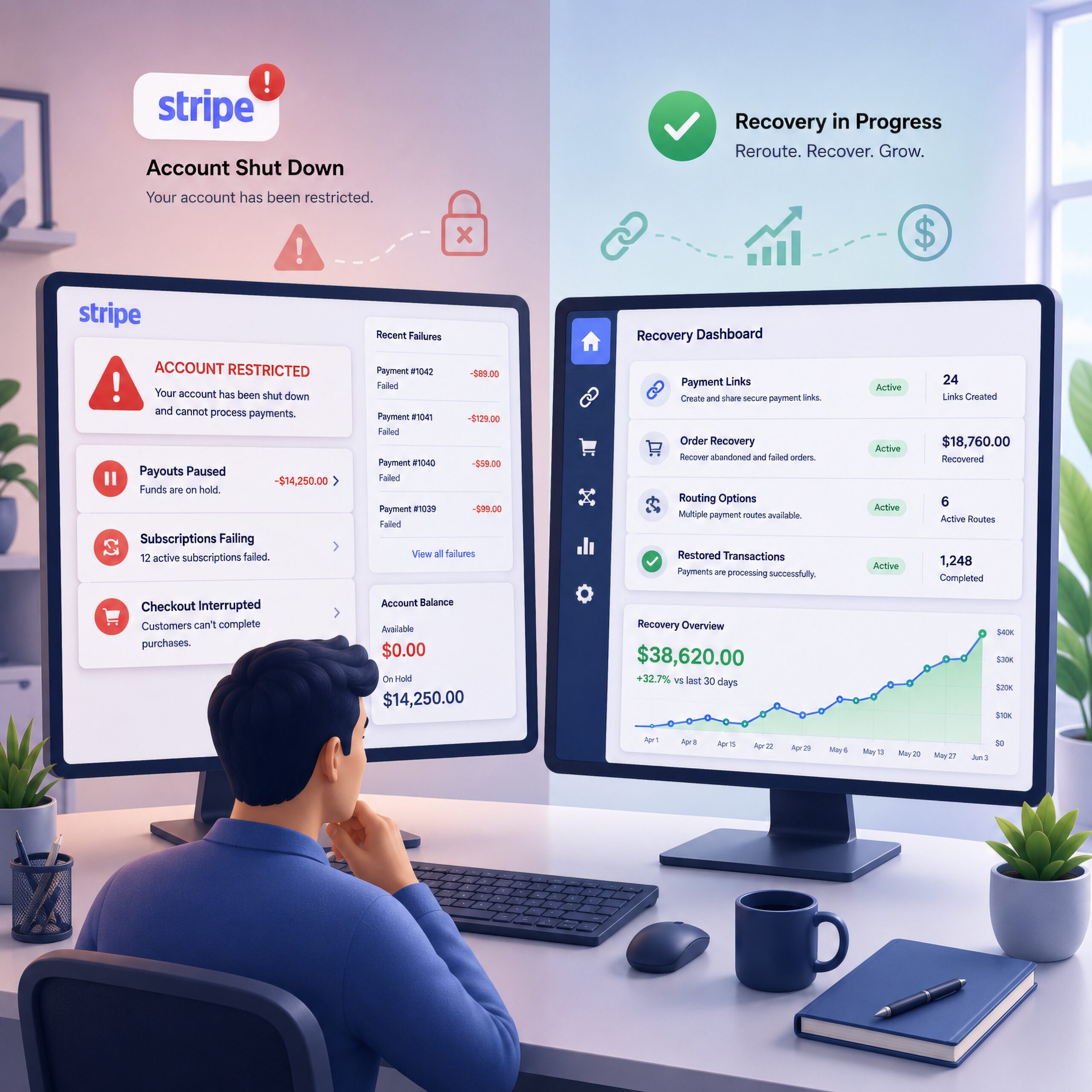
A Stripe account shutdown is a processor-initiated restriction or termination of a merchant’s ability to accept payments through Stripe’s acquiring infrastructure. For WooCommerce merchants, the impact can be immediate: checkout stops working, payouts may pause, subscriptions fail, customer trust drops, and revenue interruption begins before most businesses have a backup plan in place.
If Stripe shut down your account, the first priority is not panic. It is payment continuity. Losing access to one processor does not automatically mean losing the business, but it does mean the payment stack needs to be stabilized quickly, realistically, and without assuming that another processor will approve the same risk profile overnight.
Key Highlights
- Stripe shutdowns can stop WooCommerce checkout processing immediately.
- Account closures may involve payout delays, reserves, compliance review, or restricted processing capabilities.
- High-risk products, sudden volume changes, dispute exposure, and restricted-business policies are common causes.
- The biggest operational mistake is relying on one processor with no backup payment solution for ecommerce continuity.
- Traditional processors and high-risk merchant accounts may still be the best option when underwriting is available.
- Hosted checkout infrastructure can serve as a backup payment rail when standard processing becomes unstable.
- Alternative hosted checkout is not lower friction than Stripe and is not the right fit for every store.
What to Do If Stripe Shuts Down Your Account
If Stripe shut down your account, your first step is to separate the emergency into three categories: money already processed, orders that can no longer be paid, and future revenue that depends on a working checkout.
In practical order, merchants should:
- Review the Stripe notice and determine whether the account is restricted, terminated, or under review.
- Check whether pending payouts, reserves, or balances are being held.
- Export order, customer, subscription, refund, and dispute records.
- Disable failed checkout methods in WooCommerce so customers are not sent into a broken payment flow.
- Communicate clearly with affected customers if orders or renewals are delayed.
- Begin evaluating replacement processing, high-risk merchant placement, or alternative checkout infrastructure.
The goal is not simply to “find another Stripe.” The goal is to restore payment continuity in a way that matches the business category, risk profile, settlement needs, and customer experience realities.
Why Stripe Shuts Down Merchant Accounts
Stripe is not unusual in this respect. All large payment processors operate under acquiring-bank, card-network, fraud, dispute, and compliance obligations. Account closures usually happen because the processor believes the merchant creates risk outside its acceptable operating model.
Stripe publishes its own restricted businesses policy, which is the best starting point for understanding whether a product category, service model, or business practice may create policy risk.
High Chargeback Risk
Chargebacks are one of the clearest risk signals in card processing. Card-brand monitoring programs can impose thresholds, reviews, and penalties when dispute activity becomes excessive. For example, Mastercard excessive chargeback monitoring programs commonly focus on merchants exceeding both transaction-count and chargeback-ratio thresholds, while Visa dispute monitoring programs increasingly evaluate both dispute and fraud exposure for card-not-present merchants.
The exact enforcement path depends on processor, region, card brand, merchant history, and acquiring-bank tolerance, but the operational lesson is simple: dispute pressure can quickly become processor pressure.
Restricted or High-Risk Products
Some products are legal to sell but still difficult to underwrite. CBD, kratom, peptides, adult products, supplements, vape-adjacent products, coaching programs, continuity offers, and certain digital services may all create elevated review risk depending on claims, fulfillment, geography, and customer complaint patterns.
A merchant can be legitimate and still be outside a processor’s acceptable-use profile.
Sudden Volume Changes
A rapid sales spike may look positive to the merchant but risky to the processor. If a store moves from modest monthly volume to large daily volume, the processor may worry about future refunds, chargebacks, fulfillment delays, or marketing-driven complaint spikes.
Payment systems are designed to manage liability, not just approve revenue.
Compliance or Policy Triggers
Processors review more than payment data. Website claims, product descriptions, refund policies, fulfillment timelines, subscription disclosures, testimonials, regulatory language, and customer complaints can all influence risk decisions.
This is why some merchants are surprised by a shutdown even when their dispute rate appears manageable.
Risk Model Automation
Large processors use automated risk systems because manual review at platform scale is impossible. These systems evaluate transaction behavior, business category, dispute signals, fraud patterns, website content, customer complaints, and policy indicators together.
Automation can be efficient, but it can also feel abrupt when a merchant loses processing access without a long underwriting conversation.
What Happens After a Stripe Account Termination
A Stripe account terminated event affects more than the checkout button.
Common consequences include:
- WooCommerce checkout failures
- failed subscription renewals
- paused or delayed payouts
- reserve holds for future disputes and refunds
- customer support pressure
- advertising waste if paid traffic keeps running
- refund and fulfillment confusion
- lost customer trust
Stripe reserve policies explain that held funds may be used to cover potential refunds, disputes, and account exposure during elevated-risk periods.
From an operator’s perspective, the problem is not only the held money. The larger problem is the lost ability to keep accepting orders while the account is being reviewed, appealed, or replaced.
The Biggest Mistake Merchants Make
The biggest mistake is building the entire business around one payment processor with no fallback path.
This creates a single point of failure. When the processor works, the weakness is invisible. When the processor shuts down the account, the weakness becomes existential.
A backup payment solution for ecommerce does not have to be the primary checkout method. It can be a secondary rail, a payment link system, a manual invoice flow, a high-risk merchant account, or a Stripe shutdown alternative WooCommerce merchants may only activate when the primary processor becomes unstable.
Routing flexibility is a continuity asset. Merchants in underwriting-sensitive categories should treat payment infrastructure as part of business continuity planning, not just checkout design.
Your Real Options After Losing Stripe
Option 1 — Apply for Another Traditional Processor
A traditional processor replacement involves applying to a new acquiring relationship that supports standard embedded card checkout.
This may be the best path if the business is still underwritable through standard acquiring.
The advantage is familiarity. Customers can pay by card through a normal checkout experience, and the merchant can preserve a low-friction buying flow.
The challenge is that underwriting does not disappear. The next processor may ask for processing statements, chargeback history, product details, refund policies, supplier information, fulfillment evidence, and compliance documentation. If Stripe banned your business because of category risk or dispute exposure, that issue may follow the application.
Option 2 — Apply for a High-Risk Merchant Account
A high-risk merchant account is a traditional acquiring relationship designed for businesses operating in elevated-risk or restricted industries.
This may be a better fit for merchants in categories that standard processors are unlikely to support consistently.
Advantages can include:
- traditional card acceptance
- industry-aware underwriting
- more realistic risk review
- the possibility of long-term acquiring stability
Trade-offs can include:
- higher pricing
- rolling reserves
- monthly minimums
- longer approval timelines
- stricter compliance monitoring
This option is often worth pursuing, but merchants should not assume approval will be instant or guaranteed.
Option 3 — Use Hosted Checkout Infrastructure as an Alternative Model
Hosted checkout infrastructure is an alternative routing and settlement model that uses hosted providers instead of relying entirely on a direct merchant acquiring relationship.
Instead of depending only on standard card processing, the checkout can route customers through hosted payment providers that handle payment verification, card-to-crypto conversion, and settlement to a merchant wallet.
This is not “Stripe with crypto added.” It is a different routing and settlement architecture.
In a hosted card-to-crypto checkout process:
- The customer starts checkout inside WooCommerce.
- The merchant’s site sends the customer to a hosted provider flow.
- The provider handles payment and any required identity verification.
- The customer’s card payment is converted into a settlement asset such as USDC.
- Settlement is sent to the merchant’s wallet.
- The WooCommerce order updates after confirmation.
This model may help merchants exploring how to accept payments after Stripe shutdown scenarios where standard acquiring is unavailable, delayed, or unstable. But it also introduces trade-offs that must be understood before implementation.
Why Some Merchants Use Hosted Checkout as a Backup Rail
Hosted checkout is not always smoother than Stripe. In many cases, it is less smooth.
Customers may encounter:
- a hosted redirect
- provider-specific verification
- KYC requirements
- card approval variation by provider
- additional steps compared with standard embedded card checkout
That matters. Checkout friction can reduce conversion.
But when a merchant has no working processor, the comparison changes. The real comparison is not always “hosted checkout versus perfect Stripe checkout.” During a shutdown, the comparison may be “hosted checkout versus no checkout at all.”
That is where hosted checkout infrastructure can become useful: not as a universal replacement for standard processing, but as a continuity rail when traditional processing becomes unstable or unavailable.
How Payment Links Help Recover Revenue Quickly
Payment links are often one of the fastest recovery tools after an ecommerce payment processor shutdown because they let merchants collect payment outside the normal checkout path.
They can be used for:
- unpaid WooCommerce orders
- manual invoices
- customer support follow-ups
- abandoned checkout recovery
- failed payment recovery
- temporary payment collection during processor migration
For WooCommerce merchants, WooCommerce payment links are best understood as continuity tooling. They are not automatically better than a stable card processor, but they can help recover abandoned orders or unpaid orders when the primary checkout rail is disrupted.
How Subscription Businesses Protect Recurring Revenue
Subscription businesses are especially vulnerable after a Stripe shutdown because recurring billing depends on stored-card infrastructure. When the processor account disappears, future renewals may fail even if the customer still wants the product.
A continuity-focused subscription strategy may use renewal payment links instead of automatic stored-card rebilling.
This allows the merchant to send customers a secure payment link for each renewal cycle. The experience has more friction than automatic rebilling, but it may preserve revenue when stored-card processing is unavailable.
For merchants using WooCommerce subscriptions, renewal payment links can provide a backup collection path for recurring payment continuity.
Example Recovery Timeline After a Processor Shutdown
Every shutdown is different, but a realistic recovery timeline often looks like this:
- Day 1: Confirm account status, export records, disable broken checkout methods, review pending payouts and reserves.
- Days 1–3: Communicate with affected customers, pause paid traffic if checkout is broken, begin replacement processor review.
- Days 3–7: Submit high-risk merchant applications, prepare compliance documentation, evaluate backup checkout infrastructure.
- Days 5–14: Implement temporary payment links, hosted checkout, invoicing, or alternate payment collection for recoverable orders.
- Weeks 2–4: Complete underwriting, stabilize settlement, review refund exposure, and decide whether the backup rail remains secondary or becomes part of the long-term stack.
In one recent recovery scenario, a supplements merchant processing approximately $35,000 monthly lost embedded checkout access during a processor review. The business restored partial payment continuity within roughly 72 hours using temporary payment links while underwriting applications for a replacement processor were still pending.
The important lesson is that recovery is rarely just a plugin swap. It usually involves underwriting, communication, settlement planning, compliance cleanup, and customer experience management at the same time.
Important Trade-Offs and Limitations
Hosted card-to-crypto checkout is not the right fit for every WooCommerce merchant.
Compared with a stable Stripe checkout, merchants should expect more friction:
- hosted redirects instead of fully embedded checkout
- possible KYC requirements
- provider-specific card approval behavior
- some customer abandonment during verification
- more customer education than standard card processing
This is why the model should be framed as infrastructure, not a magic fix. It is most useful when payment continuity matters more than having the lowest-friction checkout flow.
When Hosted Checkout Infrastructure Makes Sense
This model may make sense for:
- high-risk WooCommerce merchants
- restricted ecommerce categories
- stores dealing with processor instability
- merchants that need backup payment rails
- businesses recovering after a payment processor shutdown
- subscription merchants trying to preserve renewal collection
- operators who understand that hosted checkout may convert lower but keep revenue moving
When Traditional Processing Is Still Better
For low-risk stores with stable Stripe access and strong approval history, traditional card processing often provides the smoothest checkout experience.
Standard processors and WooCommerce-native payment tools can offer lower friction, familiar card entry, faster customer completion, and less education at checkout. WooCommerce’s own payments documentation reflects the standard model most mainstream merchants should use when they can access it reliably.
If your business is low-risk, compliant, and stable with a traditional processor, there may be no reason to introduce a hosted card-to-crypto flow as the main checkout method.
Where VERIFIED Crypto Checkout Fits
VERIFIED Crypto Checkout is not a processor, not a bank, and not a universal replacement for normal card acquiring.
It is hosted checkout infrastructure for WooCommerce merchants that need an alternative routing and settlement model when traditional processing becomes unstable, restricted, or unavailable.
The system is designed around WooCommerce-native integration, hosted provider routing, card-to-crypto checkout flow, payment links, subscription renewal links, and wallet settlement infrastructure.
Merchants evaluating this model can review the core card-to-crypto checkout process, explore direct payment recovery links, or review recurring payment continuity for subscription businesses.
The right strategy depends on the merchant’s category, underwriting history, customer behavior, risk tolerance, and urgency. If standard processing is stable, that may remain the best option. If standard processing has become unavailable, alternative checkout infrastructure can help preserve payment continuity while the business rebuilds a more resilient payment stack.
Frequently Asked Questions
What should I do first if Stripe shut down my account?
Start by confirming whether the account is restricted, terminated, or under review. Then check payout status, export your order and customer records, disable broken checkout methods in WooCommerce, communicate with affected customers, and begin evaluating replacement processing or backup payment infrastructure.
Can I appeal a Stripe account termination?
In some cases, merchants can submit additional information to Stripe for review. The outcome depends on the reason for the restriction, the business category, the account history, and Stripe’s current risk decision. Merchants should not rely only on an appeal if checkout is already down.
Will Stripe release my reserves or held payouts?
Held funds and reserves are generally used to cover potential refunds, disputes, and account exposure. Release timing depends on the reserve terms, dispute risk, account balance, and Stripe’s review process. Merchants should review their Stripe notice and dashboard for account-specific details.
How long does Stripe hold reserves after an account shutdown?
Reserve periods vary based on account risk, dispute exposure, refund history, and processor policy. In many ecommerce shutdown scenarios, reserve periods commonly range from roughly 90 to 120 days, though some accounts may see shorter or longer timelines depending on ongoing disputes and underwriting review.
How can WooCommerce merchants accept payments after a Stripe shutdown?
WooCommerce merchants can pursue another traditional processor, apply for a high-risk merchant account, use manual invoicing or payment links, or implement hosted checkout infrastructure depending on their business category and underwriting risk.
Is hosted crypto checkout a direct replacement for Stripe?
No. Hosted card-to-crypto checkout is a different settlement model. It may help with payment continuity when traditional processing is unavailable, but it usually introduces more friction than a standard Stripe checkout flow.
Does hosted checkout require customer verification?
It can. Hosted providers may require identity verification or KYC depending on the customer, payment method, provider rules, transaction size, and jurisdiction. Merchants should expect some checkout friction and communicate clearly with customers.
What is the best backup payment solution for ecommerce after a processor shutdown?
The best backup depends on the business. Low-risk merchants may be best served by another traditional processor. High-risk or restricted merchants may need a high-risk merchant account, payment links, hosted checkout infrastructure, or a combination of backup rails.
When is traditional processing still better than alternative checkout infrastructure?
Traditional processing is usually better when the merchant is low-risk, underwriting is stable, approval history is strong, and customers expect a normal embedded card checkout experience. Alternative infrastructure is more relevant when traditional processing becomes unstable or unavailable.
About the Author: Brad Ungar
