
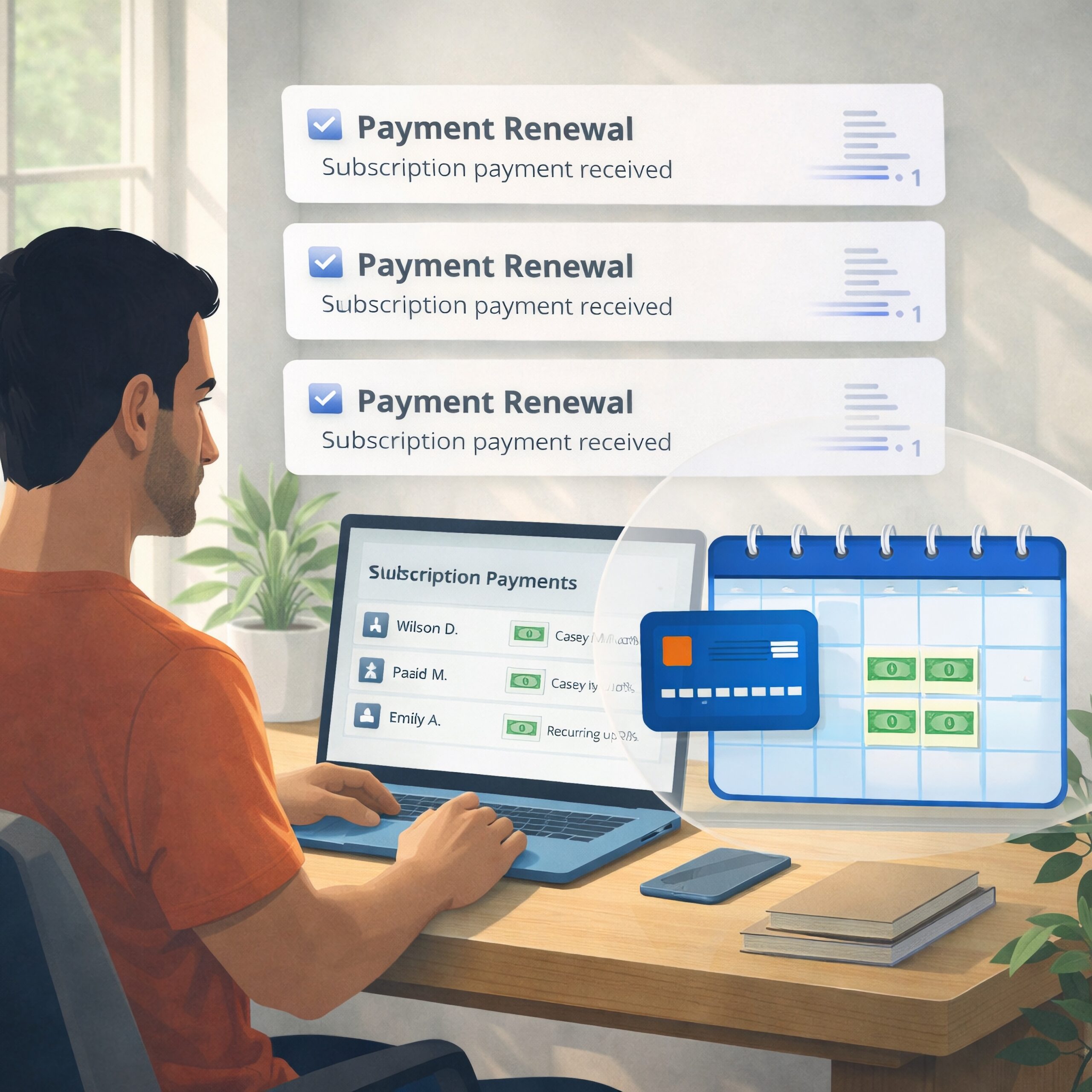
Crypto subscription payments replace stored-card recurring billing with event-driven renewal links, where customers manually complete each cycle and funds settle in stablecoins like USDC on blockchain networks.
Subscription billing has always depended on one fragile assumption: that a stored card can be charged again in the future without friction, disputes, or processor intervention. That assumption breaks quickly in high-risk environments, digital goods, and regulated verticals. Crypto subscription payments introduce a different model entirely — not automated billing, but event-driven renewal payments using hosted checkout routing and on-chain settlement.
Key Highlights
- No stored cards required — eliminates stored credential risk
- No chargebacks — settlement occurs on-chain in USDC
- Renewals triggered via email-based subscription payments
- Customers complete payment through hosted checkout providers
- Supports cross-border subscription payments without banking dependency
- Designed as payment infrastructure for continuity when underwriting is unavailable
What Are Crypto Subscription Payments?
Crypto subscription payments are a form of subscription payment infrastructure where recurring billing is handled through event-driven payment links rather than automated card charging.
Instead of storing a customer’s card and charging it at set intervals, each billing cycle is initiated through a renewal event. The customer completes a new payment using a hosted checkout that routes fiat card payments into cryptocurrency settlement — typically stablecoins like USDC issued by Circle and settled on networks such as Polygon — delivered directly to a merchant-controlled crypto wallet.
In simple terms, this is not automatic billing. It is a structured recurring payment process built on:
- Email-triggered renewal notifications
- One-click checkout links
- Card-to-crypto conversion via on-ramp providers
- Blockchain-based settlement into stablecoins
This model enables recurring crypto payments without relying on stored credentials, giving merchants a way to maintain subscription revenue without traditional billing risk.
The Problem With Traditional Subscription Billing
Traditional subscription payment systems rely on stored cards and automated rebilling. While effective in low-risk environments, this model introduces several structural weaknesses:
- Chargebacks: Customers can dispute recurring payments long after they are processed
- Stored card exposure: Tokenized card storage still carries compliance and fraud risk
- Processor dependency: If a merchant account is shut down, recurring revenue stops immediately
- High-risk instability: Certain industries face ongoing shutdowns, reserves, or restrictions
Settlement architecture determines risk exposure. In traditional systems, risk compounds over time because every future charge depends on continued approval from banks and card networks.
Why Merchants Search for Recurring Billing Without Stripe
Many merchants arrive at this model after searching for recurring billing without Stripe or alternatives to traditional subscription processors. This usually happens when:
- Accounts are declined or terminated due to vertical risk
- Chargebacks exceed acceptable thresholds
- Reserves or payout delays impact cash flow
- Cross-border billing creates additional friction
In these cases, the problem is not just pricing or features — it is infrastructure dependency. Crypto subscription payments shift the billing model away from stored card authorization into a system that does not rely on continued processor approval to function.
How Crypto Subscription Payments Work
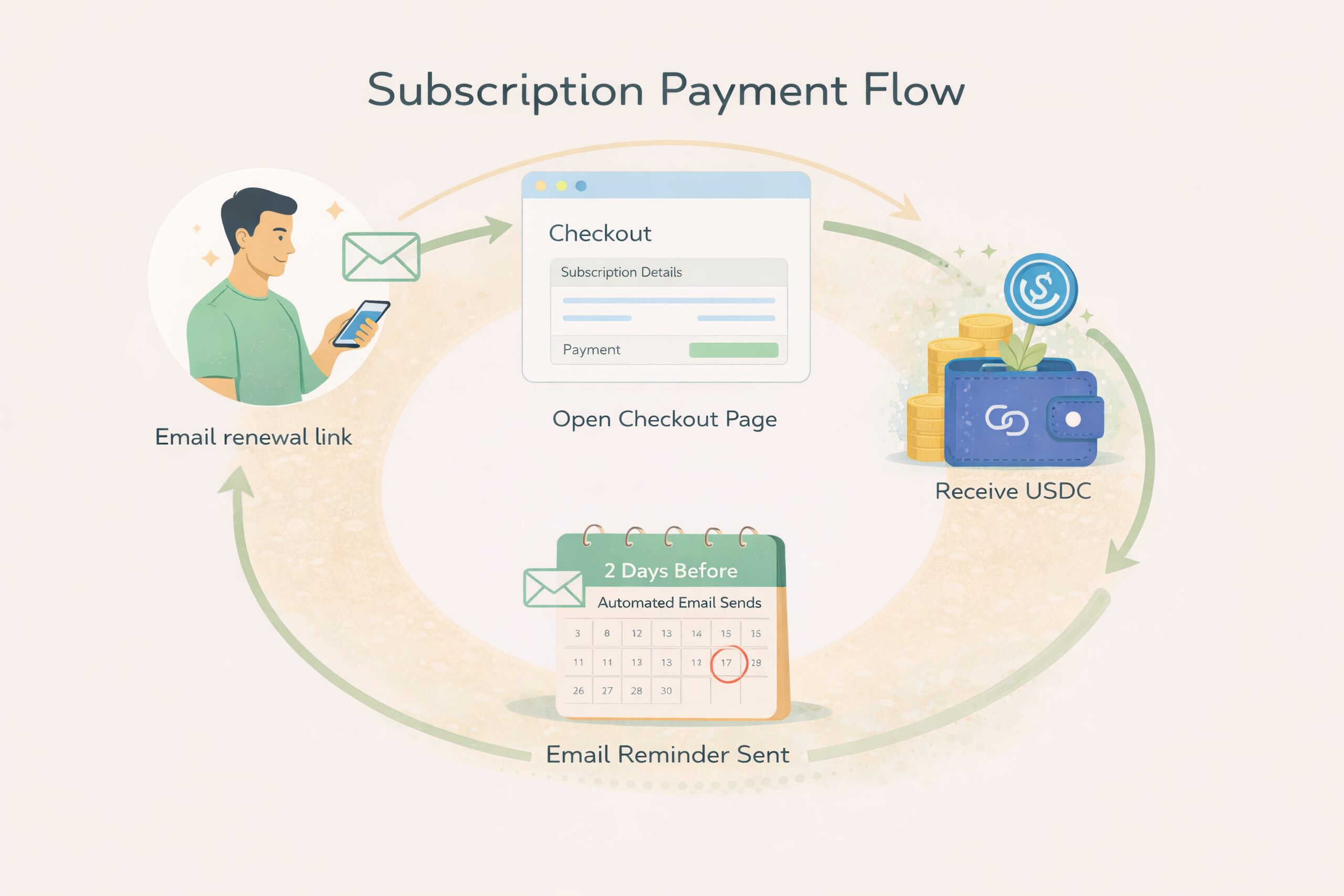
Instead of relying on automated billing, this model uses a structured renewal payment flow:
- Initial Subscription Purchase: The customer completes their first subscription payment through a hosted crypto payment checkout.
- KYC Completion: The on-ramp provider may require identity verification on the first transaction.
- Subscription Created: The billing cycle is established without storing any card data.
- Renewal Trigger: Before the next billing date, the customer receives a reminder email with a payment link.
- One-Click Payment: The customer clicks “Pay Now” — no login required.
- Provider Routing: The system routes the payment to a suitable on-ramp provider.
- Fast Checkout: Returning users typically experience a streamlined checkout with reduced friction. Since KYC was completed in first purchase.
- Settlement: The transaction is converted from fiat into a stablecoin (usually USDC) and sent to the merchant’s crypto wallet on Polygon.
Each renewal behaves similarly to a recurring invoice — the customer receives a notification and completes the payment through a hosted checkout rather than being automatically charged.
Why There Are No Chargebacks
The defining advantage of this system is settlement finality. Unlike traditional payment systems where issuing banks retain control over dispute resolution, blockchain-based settlement removes that reversal layer entirely.
- Funds are converted into cryptocurrency
- The transaction is recorded on blockchain networks
- Settlement occurs directly to the merchant’s wallet
Because there is no issuing bank involved in reversing the payment, this model enables true no chargeback subscription payments. This removes one of the largest operational risks in subscription businesses, particularly in high-risk verticals where dispute rates can quickly lead to account shutdowns.
However, this also means refunds must be handled manually by the merchant if required.
UX Reality: What Merchants Need to Understand
This model improves risk and payment stability, but it changes how subscription payments are experienced by customers. This email-based subscription payments model relies on user action rather than passive billing, which changes both behavior and expectations.
- No automatic billing — customers must actively complete each recurring payment
- Email delivery and reminder timing become critical to recurring revenue
- First-time users may complete KYC depending on provider requirements
- Some card issuers may restrict crypto-related transactions
While this system does not support full automation, it creates a predictable recurring billing process without exposing the business to chargebacks or stored payment risk.
When This Model Makes Sense
Crypto subscription payments are particularly effective in scenarios where traditional subscription payment systems are unreliable or unavailable:
- High-risk or restricted product categories (see kratom merchant account requirements)
- Supplement and wellness businesses with underwriting constraints (see supplement merchant account options)
- Digital subscriptions and membership platforms
- Coaching, education, and service-based billing models
- Cross-border subscription businesses serving global customers
- Merchants seeking subscription payments no merchant account dependency
When It Doesn’t
This model is not a replacement for all subscription systems. It works best when stability and control outweigh the need for fully automated billing, and it introduces tradeoffs that merchants must consider carefully.
- Businesses that require fully automated recurring payments with no customer interaction
- Low-friction consumer SaaS platforms expecting seamless auto-renewal
- Very low-ticket subscriptions where repeated manual payments reduce conversion
Routing flexibility is a continuity asset — but only when aligned with how customers expect to pay and interact with recurring billing.
WooCommerce Implementation
This subscription payment model can be implemented directly within WooCommerce environments using existing subscription plugins:
- Compatible with WooCommerce Subscriptions (paid)
- Compatible with Subscriptions for WooCommerce (free)
- No stored card data required
- Renewals handled through payment links for recurring billing
For merchants using VERIFIED Crypto Checkout, this system operates as a checkout-layer payment infrastructure rather than a processor.
We built VERIFIED Crypto Checkout specifically to enable this routing model — allowing merchants to accept card payments that convert into USDC and settle directly to a wallet without relying on traditional merchant account infrastructure.
In addition to WooCommerce, API-based integration allows this model to be deployed in custom checkout environments and headless ecommerce builds, extending the payment system beyond standard plugin implementations.
Cost and Conversion Considerations
One of the most common questions around crypto subscription payments is how they compare in cost and conversion.
From a cost perspective:
- On-ramp providers typically charge between 2–5% per transaction, depending on region, card type, and provider
- Infrastructure fees may apply depending on the routing setup
- No chargeback costs or reserve requirements exist
From a conversion perspective:
- Initial conversion may be slightly lower due to KYC or unfamiliar checkout flow
- Returning customers often convert quickly once verified with a provider
- Renewal rates depend heavily on email timing, reminder strategy, and customer intent
In practice, many merchants trade slightly lower frictionless conversion for significantly higher payment stability and reduced operational risk.
Comparison: Traditional vs Crypto Subscription Model
| Feature | Traditional Subscriptions | Crypto Subscription Model |
|---|---|---|
| Auto-charge | Yes | No |
| Chargebacks | Yes | No |
| Stored cards | Required | Not required |
| Merchant account | Required | Not required |
| Settlement | Bank account | Stablecoin (USDC on Polygon) |
| Chargeback Costs | Present (fees, disputes, reserves) | None |
| Processing Fees | Processor + gateway + dispute risk | Provider + infrastructure (no dispute layer) |
| Risk of shutdown | High in certain verticals | Lower due to routing-based infrastructure |
System Positioning
VERIFIED Crypto Checkout functions as a payment infrastructure layer that enables crypto subscription payments through card-to-crypto routing and hosted checkout flows.
It does not act as a payment processor or merchant account provider. Instead, it:
- Routes transactions to external on-ramp providers
- Facilitates checkout within WooCommerce and custom environments
- Enables settlement directly into merchant-controlled crypto wallets
Within the VERIFIED ecosystem, this infrastructure complements underwriting solutions provided by VERIFIED Credit Card Processing, which focuses on traditional merchant account placement.
For deeper technical understanding of stablecoin settlement, see USDC by Circle and Polygon network documentation.
Why This Matters
As the subscription economy expands globally, businesses are increasingly dependent on recurring revenue models. At the same time, traditional payment systems introduce growing friction through chargebacks, compliance requirements, and processor instability.
Crypto subscription payments — including recurring crypto payments structured through renewal links — provide an alternative payment system that supports cross-border transactions, reduces reliance on banking infrastructure, and enables more resilient recurring revenue models.
This is not a universal replacement for traditional subscription billing — but it is a critical option when stability, control, and settlement certainty matter more than full automation.
Getting Started
If your subscription business is experiencing limitations with traditional recurring payments, understanding this payment model is the first step toward building a more resilient billing system.
You can explore how this infrastructure works in practice through VERIFIED Crypto Checkout, including WooCommerce integration and API-based implementations for custom environments.
Frequently Asked Questions
Are crypto subscription payments automatic?
No. Crypto subscription payments are not automatic. Each billing cycle is triggered through a renewal event, typically via email, and requires the customer to complete payment manually through a hosted checkout.
Why are there no chargebacks with crypto subscription payments?
Chargebacks are not possible because settlement occurs on blockchain networks using cryptocurrency. Once funds are transferred to the merchant’s wallet, there is no issuing bank or card network that can reverse the transaction.
Can you run subscription payments without a merchant account?
Yes. This model allows subscription payments without a merchant account by routing card payments through on-ramp providers and settling funds in cryptocurrency directly to a wallet, eliminating reliance on traditional acquiring banks.
About the Author: Brad Ungar
