
By Brad Ungar | Ecommerce Payments & Checkout Infrastructure
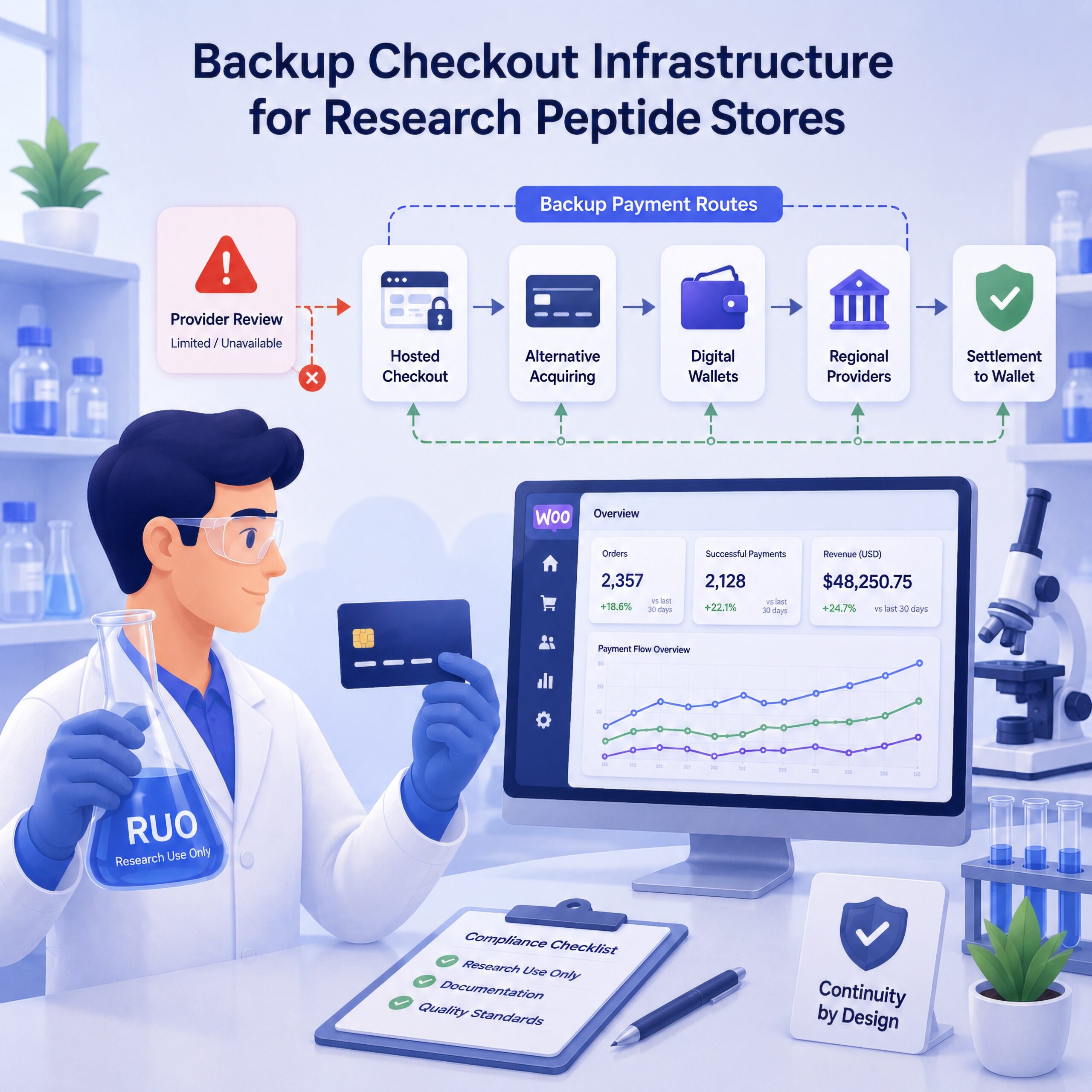
Research peptide WooCommerce merchants often face payment uncertainty because standard processors may review, restrict, or decline research-compound categories based on internal policy, underwriting tolerance, category classification, and evolving risk procedures. When that happens, merchants may evaluate checkout infrastructure that reduces dependence on a single payment relationship and introduces greater routing flexibility.
VERIFIED Crypto Checkout is WooCommerce checkout infrastructure that allows customers to complete payments through hosted provider flows while settlement can be delivered to the merchant in USDC — a dollar-pegged stablecoin — rather than through a traditional acquiring bank settlement path.
That distinction matters. This is not a merchant account. It is a different routing architecture and settlement model for merchants evaluating payment continuity when changing provider requirements or operational concentration risk create uncertainty around traditional payment relationships.
Key Highlights
- Customers may pay through hosted provider flows using familiar payment methods.
- Card payments can route through on-ramp infrastructure and settle to the merchant in USDC.
- This checkout architecture may allow merchants to operate without relying entirely on a traditional merchant-account relationship, depending on provider requirements and implementation.
- Research-compound categories often face elevated payment scrutiny from conventional processors.
- Infrastructure can reduce concentration risk but does not guarantee uninterrupted availability.
- Merchants remain responsible for compliance obligations and operational requirements.
Direct Answer
Research peptide WooCommerce merchants sometimes evaluate additional checkout infrastructure because dependence on a single payment relationship can create operational vulnerability. Additional infrastructure does not replace merchant accounts, legal obligations, or provider requirements. Instead, it functions as a routing layer intended to improve checkout flexibility and reduce concentration risk.
How Card-to-USDC Checkout Actually Works
The customer experience can still feel familiar. Customers may see payment options such as cards, Apple Pay, or Google Pay depending on provider availability. The difference is what happens behind the scenes.
Rather than routing a transaction exclusively through a traditional acquiring bank and merchant account relationship, the payment can flow through hosted on-ramp infrastructure. The hosted provider manages onboarding, verification procedures, and payment processing requirements. If completed, settlement can be delivered through USDC rather than standard acquiring settlement methods.
In practical terms, the customer completes a familiar payment action while the underlying routing and settlement model differs from conventional card acquiring.
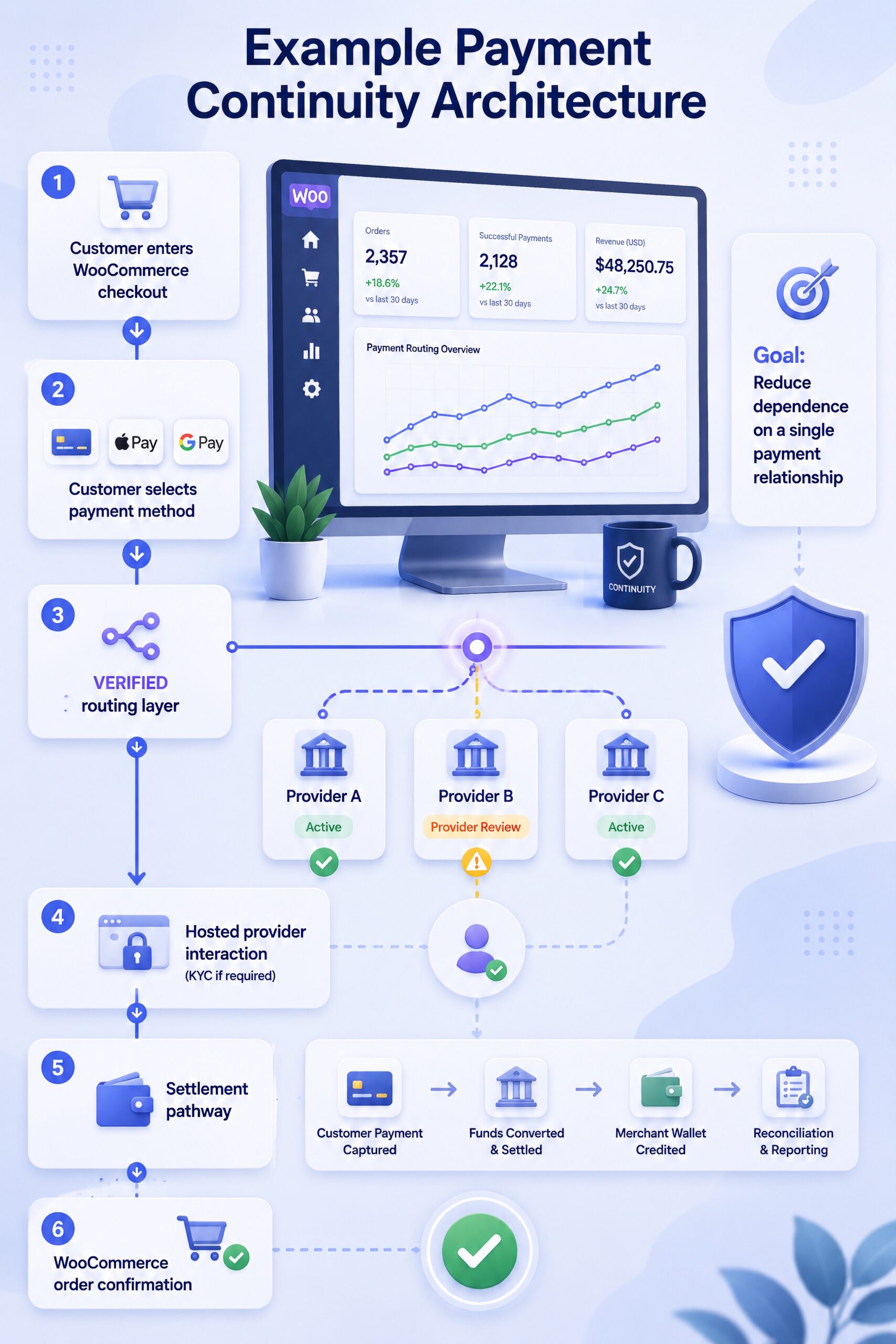
The step-by-step flow generally works as follows:
- Customer selects a payment option in WooCommerce checkout
- VERIFIED routes the transaction into a hosted provider environment
- The provider manages onboarding and KYC procedures if required
- Payment processing occurs through hosted infrastructure
- Settlement may be converted and delivered through USDC
- WooCommerce receives order confirmation and updates the order
Because settlement occurs through on-ramp infrastructure rather than a traditional merchant-account relationship, certain reserve structures and dispute workflows may differ from conventional acquiring. Provider-specific policies, verification requirements, transaction limits, refunds, and dispute processes can still affect merchant and customer experiences.
Why Research Peptide Merchants Experience Payment Friction
Many larger processors treat research-compound categories as elevated risk. This does not necessarily represent a legal determination. More commonly, it reflects internal underwriting decisions based on category classification, documentation standards, and risk tolerance.
Common factors influencing provider decisions include:
- marketing language sensitivity and claim review
- category classification differences
- jurisdiction-specific requirements
- documentation expectations
- provider-specific risk models
- restricted-business policies
None of these variables automatically determine whether a business is legitimate or compliant. They influence whether a specific provider is willing to support the category under its own internal requirements.
That is why merchants operating research peptide ecommerce and broader research-compound ecommerce categories may evaluate backup checkout infrastructure and payment redundancy strategies even while pursuing traditional merchant-account options.
Relevant references merchants should review directly:
What Merchants Are Often Looking For
Research peptide merchants frequently search for terms such as:
- research peptides credit card processing
- research peptide payment processing
- RUO payment processing
- research use only payment processing
- research peptide merchant account alternatives
- backup checkout for research peptide stores
- payment continuity for research peptide ecommerce
In many cases, the underlying need is broader than simply finding a processor.
Merchants are often trying to improve WooCommerce payment continuity and create alternate payment pathways that reduce dependence on a single relationship.
It is WooCommerce payment continuity — a way to continue accepting orders through alternate payment pathways when a primary payment relationship creates operational concentration risk or changing payment requirements.
Card-to-USDC infrastructure addresses this differently from a replacement merchant account. A merchant account attempts to preserve conventional acquiring. Checkout infrastructure introduces an alternate routing architecture and settlement model.
What Merchants Should Know About Checkout Friction
This infrastructure should not be viewed as a frictionless replacement for conventional processors.
Customers may encounter hosted checkout environments rather than embedded card forms. Some providers may require verification during initial transactions. Not every customer profile, geography, or payment method behaves identically.
Some customers may abandon the process during onboarding or verification requirements.
That friction is real. Merchants evaluating backup infrastructure are usually weighing that friction against the operational risk of complete dependence on a single payment relationship.
The model often works best for merchants who understand those trade-offs and communicate checkout expectations clearly to customers.
Reducing Concentration Risk Before Disruption Occurs
Merchants who navigate processor disruptions most effectively often prepare before disruption occurs.
Running VERIFIED Crypto Checkout alongside existing payment infrastructure — or maintaining alternate payment pathways — may help reduce operational dependence on a single payment relationship.
Think of this similarly to redundant hosting, secondary email systems, or backup fulfillment processes. Businesses usually implement those systems before a primary system experiences difficulty.
Merchants who have already experienced a disruption can also review operational recovery strategies after a payment processor shutdown for additional continuity planning considerations.
Merchant Responsibilities
Checkout infrastructure operates within a broader operational framework that merchants remain responsible for maintaining.
Legal compliance, customer communication, marketing practices, provider requirements, tax obligations, and product presentation remain merchant responsibilities regardless of which routing architecture is used.
VERIFIED routes and orchestrates checkout activity only. It does not provide legal, underwriting, regulatory, or compliance determinations.
Where VERIFIED Fits and Where It Doesn’t
VERIFIED Crypto Checkout may make sense for merchants that require payment redundancy, operate in categories with changing payment requirements, or want alternate routing architecture available as part of a broader continuity strategy.
It may not make sense for merchants seeking the lowest possible friction, merchants whose customers may not complete hosted onboarding steps, or businesses that specifically require conventional acquiring relationships.
Merchants evaluating traditional acquiring pathways for research peptide businesses — including LegitScript considerations for clinic or telehealth models — can review the Research Peptides Guide at Verified Credit Card Processing, which covers merchant-account approval considerations, compliance positioning, and acquiring options for this category.
To understand the broader routing architecture, review What Is Crypto Checkout? and USDC for Ecommerce: How Merchants Accept Card Payments and Settle in Stablecoins.
Calm Continuity Planning Beats Emergency Recovery
Backup checkout infrastructure is generally most useful when it exists before it becomes urgently necessary.
Merchants that understand their routing options, provider limitations, customer communication requirements, and settlement architecture are often better positioned to adapt when payment relationships change.
VERIFIED Crypto Checkout should be evaluated as infrastructure: a routing and settlement layer intended to reduce payment concentration risk, not a guarantee of approval, legality, or uninterrupted availability.
Frequently Asked Questions for Research Peptide WooCommerce Merchants
How does card-to-USDC checkout work for research peptide stores?
Customers complete payment through hosted provider checkout flows. The provider manages verification and onboarding procedures if required. Settlement may be delivered through USDC while WooCommerce receives confirmation and updates the order.
Why do research peptide stores sometimes lose payment processors?
Research-compound categories may receive elevated review due to underwriting policies, documentation standards, category classification differences, marketing language sensitivity, and provider-specific risk models.
What is checkout infrastructure versus a merchant account?
A merchant account is a conventional acquiring relationship. Checkout infrastructure functions as a routing and settlement layer that can operate differently from traditional merchant-account models.
Do customers need cryptocurrency to complete checkout?
No. Customers may use familiar payment methods supported by hosted providers such as cards or mobile-wallet options.
Can this architecture eliminate payment risk?
No. Additional infrastructure may reduce concentration risk and dependence on a single relationship, but provider requirements and operational risks still exist.
Does VERIFIED approve research peptide merchants?
No. VERIFIED Crypto Checkout is routing infrastructure only and does not provide approvals, underwriting decisions, or legal compliance determinations.
Editorial note: Payment-provider policies, underwriting requirements, and regulatory interpretations can change over time. Information in this article is for general informational purposes only and may not reflect current requirements in all jurisdictions.
About the Author: Brad Ungar
