
Last updated: June 24, 2026 Having your merchant account denied, does not mean you don’t have options. Many businesses that receive a decline from one processor can still obtain approval through a specialist payment provider. Others may be better served by an alternative checkout architecture that does not rely on a traditional merchant account model. The right solution depends on why the application was denied, what products you sell, your chargeback profile, your business model, and your long-term payment goals. This guide explains why merchant accounts are denied, what options remain available, and how WooCommerce businesses can evaluate both traditional payment processing and hosted checkout alternatives.
Key Highlights
- A merchant account denial does not automatically mean your business cannot accept payments.
- Different processors have different underwriting standards and risk tolerances.
- Many high-risk industries can still obtain traditional payment processing.
- Some businesses may be better suited to hosted checkout architectures.
- WooCommerce merchants should evaluate both processing availability and checkout infrastructure requirements.
- VERIFIED Credit Card Processing helps merchants evaluate traditional processing options.
- VERIFIED Crypto Checkout provides WooCommerce checkout infrastructure for hosted checkout workflows.
Direct Answer: What Should You Do If Your Merchant Account Was Denied?
If your merchant account application was denied, your first step should be understanding why the denial occurred. Many merchants assume a merchant account rejection means payment processing is no longer available. In reality, many businesses that receive a decline from one processor later obtain approval through a different provider that better understands the industry, business model, or risk profile. Some businesses may also benefit from evaluating merchant account alternatives, including hosted checkout architectures that separate ecommerce operations from payment execution. In one sentence: Most merchants who receive a merchant account denial should first seek a specialist underwriting review, while businesses facing repeated processing restrictions may also benefit from evaluating hosted checkout infrastructure.
Why Merchant Accounts Get Denied
Many merchants assume a denial means there is something fundamentally wrong with their business. That is often not the case. Payment processors evaluate risk differently and may decline applications for reasons unrelated to business quality or legitimacy.
Common Reasons For Merchant Account Denials
- Industry risk classification
- New business with limited processing history
- High chargeback exposure
- Regulatory concerns
- International ownership structures
- Prior processor shutdowns
- MATCH or TMF listings
- Excessive refund activity
- Unclear website disclosures
- Insufficient business documentation
A payment processor declined application may reflect internal risk policies rather than a judgment about the legitimacy of the business itself.
What Type Of Denial Did You Receive?
Not all merchant account denials mean the same thing. The next step depends heavily on the specific reason for the decline.
- Application declined during underwriting: Another processor may still approve the business.
- Reserve requirements too high: Alternative providers may offer different structures.
- Existing account terminated: Specialist underwriting review becomes important.
- Stripe, Square, or PayPal restrictions: Many merchants still qualify for traditional merchant accounts.
- MATCH listing: Available options become more limited but may not disappear entirely.
Understanding the cause of the merchant account rejection is often more important than the denial itself.
What Is A MATCH Or TMF Listing?
A MATCH listing, formally known as Member Alert To Control High-Risk Merchants, is a Mastercard-maintained database used by acquiring banks and payment processors to identify merchants whose prior processing relationships ended for specific risk-related reasons. TMF, or Terminated Merchant File, is the older industry term many merchants still use when referring to the same general terminated-merchant screening issue. Being placed on MATCH can make obtaining a traditional merchant account significantly more difficult because future processors may see the listing during underwriting. Common causes include:
- Excessive chargebacks
- Fraud concerns
- Knowingly violating processor policies
- Excessive risk exposure
- Certain compliance violations
A MATCH listing does not automatically mean payment processing is impossible, but it typically requires specialist underwriting review and may limit available options. MATCH records are commonly associated with a five-year retention period, although removal questions should be reviewed based on the specific listing reason and the processor involved.
What Are Reserve Requirements?
Reserve requirements are funds temporarily withheld by a processor to help offset potential future chargebacks, refunds, or losses. In higher-risk merchant account programs, reserves may be structured as rolling reserves, capped reserves, upfront reserves, or a combination of reserve controls. A rolling reserve commonly withholds a percentage of each processed transaction for a defined period before funds are released. Reserve terms vary by provider, industry, processing history, chargeback profile, fulfillment timing, and underwriting risk. Some high-risk merchants may see reserve structures in the 5% to 15% range, but that is not a guarantee. Certain businesses may see lower, higher, shorter, longer, or no reserve depending on the underwriting decision.
How Long Does Approval Take After A Merchant Account Denial?
Approval timing depends on the provider, industry, documentation quality, website readiness, processing history, and underwriting complexity. Prepared merchants with complete documentation may receive decisions within several business days. More complex high-risk applications can take longer, especially if the processor needs additional documentation, compliance review, prior processing statements, chargeback explanations, or website updates. The fastest way to improve approval odds is to submit a complete, accurate application with clear website disclosures, current business documentation, fulfillment details, refund policies, and prior processing history where available.
How Payment Options Work After A Merchant Account Denial
When a merchant account is denied, businesses generally have several potential paths forward.
- Identify the specific reason for the denial.
- Determine whether specialist underwriting may still approve the account.
- Evaluate alternative processors with different risk tolerances.
- Assess reserve requirements and operational impact.
- Consider merchant account alternatives where appropriate.
- Select a payment infrastructure model that aligns with business objectives.
First: Don’t Assume Traditional Processing Is Off The Table
This is the most common mistake merchants make after receiving a denial. Many businesses receive a decline from one processor and immediately assume payment processing is unavailable everywhere. In reality, underwriting standards vary considerably across providers. A business declined by one processor may still qualify through another provider that better understands the underlying business model. For many ecommerce businesses, every day without payment acceptance represents lost revenue. The goal is not simply finding a processor. The goal is restoring payment continuity with an infrastructure model that fits the business long term.
Industries That Often Still Obtain Approval
- Supplements
- Nutraceuticals
- CBD
- Coaching
- Membership programs
- Telehealth
- Digital products
- Subscription businesses
Need A Second Opinion?
Before abandoning traditional processing, many merchants benefit from a second underwriting review. VERIFIED Credit Card Processing helps merchants evaluate traditional payment processing options across a wide range of industries, including standard ecommerce, high-risk ecommerce, WooCommerce stores, subscription businesses, supplement merchants, CBD merchants, coaching businesses, telehealth companies, and other underwriting-sensitive categories.
- Merchant accounts
- High-risk payment processing
- Payment gateways
- WooCommerce integrations
- Subscription billing support
- Chargeback mitigation tools
Businesses frequently seek a second review after:
- Stripe shutdowns
- PayPal restrictions
- Square account closures
- Reserve demands
- Underwriting declines
- Merchant account rejections
VERIFIED Credit Card Processing focuses on underwriting-sensitive businesses and helps merchants prepare applications for providers that understand difficult ecommerce categories, including supplements, CBD, telehealth, subscriptions, coaching, and other high-risk or policy-sensitive models. Request A Processing Review
Understanding Your Available Payment Options
Option 1: Traditional Merchant Accounts
Traditional merchant accounts remain the preferred option for many ecommerce businesses. Customer → Card Processor → Merchant Account → Bank Settlement Best For:
- Established businesses
- Lower-risk industries
- Merchants seeking traditional card processing
Advantages:
- Familiar checkout experience
- Direct bank settlement
- Broad customer acceptance
Limitations:
- Underwriting requirements
- Reserve requirements
- Industry restrictions
Option 2: High-Risk Merchant Accounts
High-risk payment processing refers to merchant account programs designed for industries that traditional processors may consider higher risk due to chargebacks, regulatory complexity, fulfillment timing, or business-model characteristics. Specialist processors evaluate industries that traditional providers often avoid. Best For:
- Supplements
- CBD
- Telehealth
- Membership programs
- Subscription businesses
Advantages:
- Traditional checkout experience
- Higher approval potential for difficult industries
- Industry-specific underwriting review
Limitations:
- Higher costs than low-risk processing
- Possible reserve requirements
- Enhanced underwriting review
Option 3: ACH And Bank Transfer Models
ACH, or Automated Clearing House, payments move funds directly between bank accounts rather than through card networks. Advantages:
- Lower processing costs
- Reduced card chargeback exposure
- Direct account-to-account fund movement
Limitations:
- Different customer experience than card checkout
- Slower adoption for some ecommerce buyers
- Not suitable for every business model
Option 4: Hosted Checkout Architectures
A hosted checkout architecture is a payment model where payment execution occurs within a dedicated hosted checkout environment while WooCommerce continues managing products, customers, orders, taxes, shipping, and fulfillment operations.
How Hosted Checkout Architecture Works
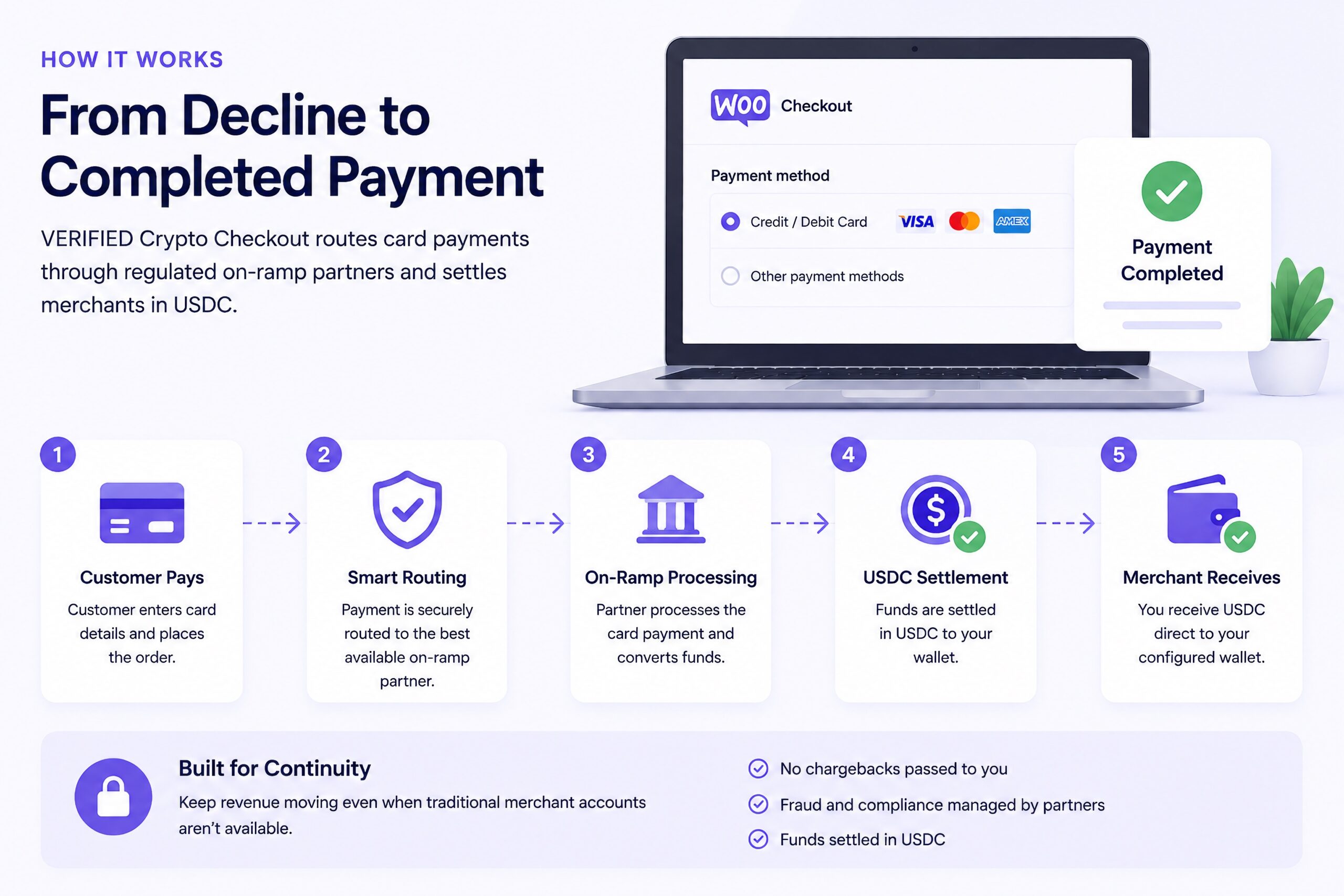
- The customer places an order in WooCommerce.
- WooCommerce creates and stores the order.
- The customer is redirected to a hosted checkout provider.
- The provider manages payment execution and verification requirements.
- The provider completes settlement according to its supported settlement model.
- WooCommerce receives order updates and maintains the operational record.
This separates ecommerce operations from payment execution while preserving WooCommerce as the system of record.
Why This Matters For WooCommerce Merchants
Settlement architecture determines risk exposure. Routing flexibility is a continuity asset. Merchants evaluating payment options for denied merchants should understand not only who can process payments but also how the underlying payment infrastructure operates. For WooCommerce businesses, the payment decision is not only about approval. It is also about how orders are created, how customers are routed, how payment status returns to the store, how fulfillment is triggered, and how settlement is handled.
Where VERIFIED Crypto Checkout Fits
VERIFIED Credit Card Processing and VERIFIED Crypto Checkout are complementary solutions within the VERIFIED ecosystem. VERIFIED Credit Card Processing helps merchants evaluate traditional payment processing options, while VERIFIED Crypto Checkout provides WooCommerce checkout infrastructure for hosted checkout workflows. VERIFIED Crypto Checkout is not a payment processor. It is WooCommerce checkout infrastructure. The platform connects WooCommerce stores to independent hosted checkout providers while allowing WooCommerce to remain the operational system of record. VERIFIED provides:
- Hosted checkout routing
- Payment links
- Invoice requests
- QR payments
- Subscription renewal workflows
- Smart Recovery
- Transaction visibility
- Wallet settlement configuration
Providers remain responsible for:
- Payment execution
- Customer verification
- Compliance controls
- Payment method availability
- Settlement execution
Evaluating Hosted Checkout Infrastructure
If traditional processing remains unavailable or your business is evaluating alternative checkout architectures, it is worth understanding how hosted checkout systems operate before making a long-term decision. Learn About VERIFIED Crypto Checkout Review Documentation View The VERIFIED Crypto Checkout Plugin On WordPress.org
Which Solution Is Right For Your Business?
| Business Situation | Recommended First Step |
|---|---|
| Standard ecommerce store | Traditional processing review |
| Supplements | High-risk processor review |
| CBD | CBD specialist processing review |
| Subscription business | Recurring billing processor review |
| Telehealth | Specialist underwriting review |
| Stripe shutdown | Traditional processor evaluation |
| Multiple processor shutdowns | Traditional review plus hosted checkout evaluation |
| Research products | Hosted checkout evaluation |
| International ownership | Specialist review and hosted checkout evaluation |
Important Compliance Clarification
Whichever path fits your business, a few things remain true of every payment provider and hosted checkout provider. Neither VERIFIED Credit Card Processing nor VERIFIED Crypto Checkout guarantees approval. Payment providers maintain their own underwriting standards, risk policies, verification requirements, compliance obligations, and geographic restrictions. Businesses must continue complying with all applicable laws, regulations, and provider requirements.
Related Resources
- What Is VERIFIED Crypto Checkout?
- Hosted Checkout Explained
- WooCommerce USDC Payment Gateway
- Subscription Payments Without Chargebacks
- VERIFIED Crypto Checkout Fees Transparency Guide
- Stripe Shut Down My Account
- High-Risk Payment Processor Shutdowns
Final Recommendation
If your merchant account was denied, start by determining whether traditional processing remains available through a specialist provider. Many businesses discover they have more options than they initially believed. If traditional processing remains viable, VERIFIED Credit Card Processing can help evaluate merchant account options across a wide range of industries. If a hosted checkout architecture appears to be a better fit, VERIFIED Crypto Checkout provides WooCommerce infrastructure that connects merchants to independent hosted checkout providers while keeping WooCommerce as the operational system of record. The best payment solution is not determined by a single underwriting decision. It is determined by selecting the payment infrastructure that aligns with your business model, risk profile, operational requirements, and long-term goals.
Frequently Asked Questions
Does a merchant account denial mean my business cannot accept payments?
No. Many businesses receive approvals through different processors, specialist underwriting programs, or alternative payment architectures depending on their industry and risk profile.
What is a MATCH listing?
A MATCH listing is a Mastercard-maintained database used by acquiring banks and processors to identify merchants whose previous processing relationships ended for specific risk-related reasons. It can make obtaining future merchant accounts more difficult.
How long does a MATCH listing last?
MATCH records are commonly associated with a five-year retention period. Removal questions depend on the specific listing reason and should be reviewed with the processor involved.
Can I get a merchant account after Stripe shut down my account?
Often yes. Many businesses that are restricted by Stripe, PayPal, or Square later obtain approval through specialist payment providers that better understand their industry and business model.
What are reserve requirements?
Reserve requirements are funds temporarily withheld by a processor to help offset potential future chargebacks, refunds, or losses. Reserve structures vary by provider, industry, transaction history, and underwriting profile.
How long does high-risk merchant account approval take?
Prepared merchants may receive decisions within several business days, while complex high-risk applications can take longer if additional underwriting, compliance review, or documentation is required.
Can WooCommerce operate without a traditional merchant account?
WooCommerce supports multiple payment architectures, including hosted checkout models that separate ecommerce operations from payment execution while maintaining WooCommerce as the system of record.
Is VERIFIED Crypto Checkout a payment processor?
No. VERIFIED Crypto Checkout is WooCommerce checkout infrastructure that connects stores to independent hosted checkout providers. Providers remain responsible for payment execution, verification, compliance, and settlement.
Should I stop looking for traditional processing after being denied?
Not necessarily. Many businesses that are declined by one provider are later approved by another processor with different underwriting standards and industry expertise.
About the Author: Brad Ungar
