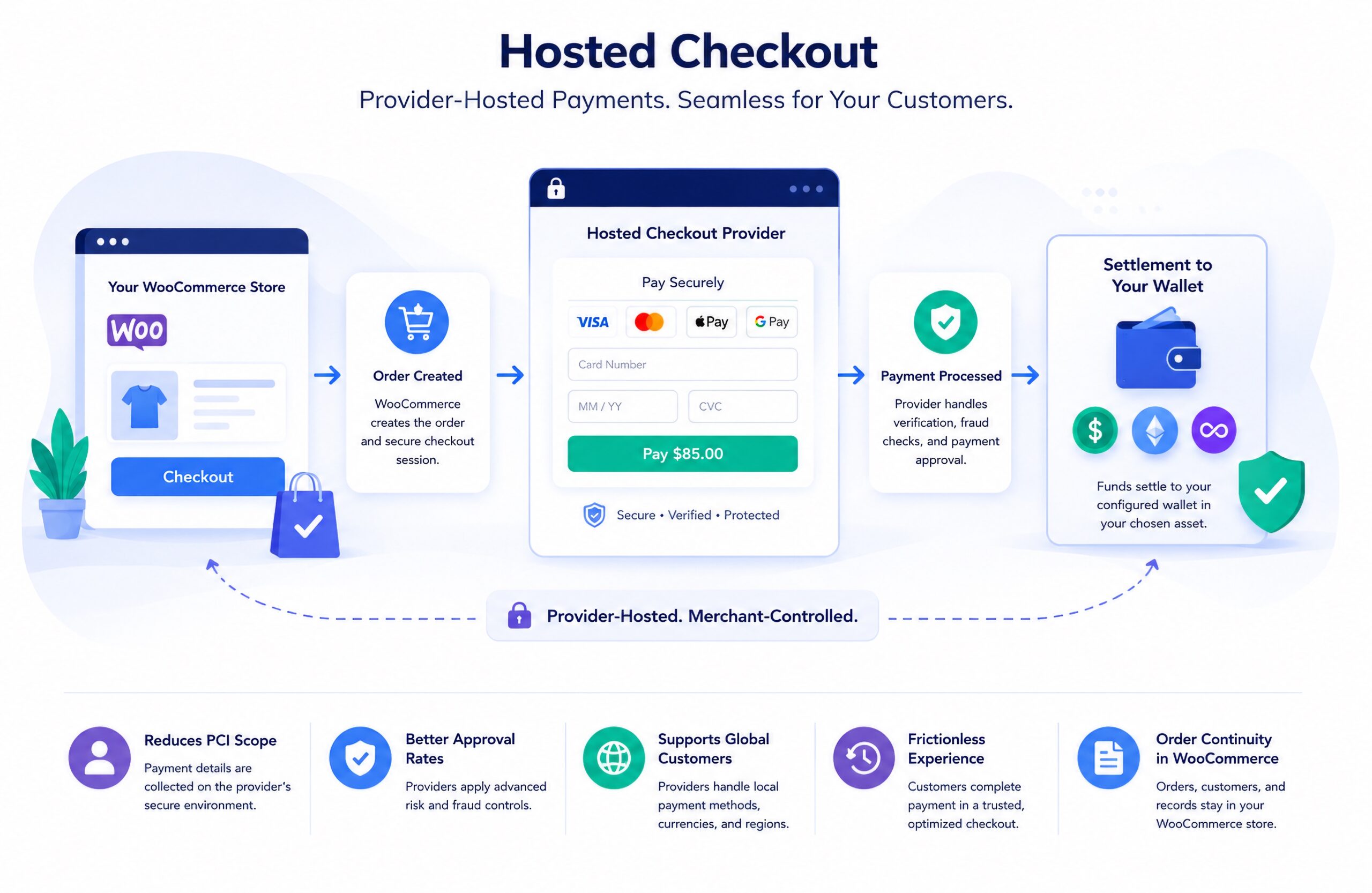
Hosted-Checkout-Explained-Verified-Crypto-Checkout

Understand Hosted Checkout Before You Build Around It

Hosted checkout is one of the most common payment architectures in ecommerce, but it is often misunderstood.

In a hosted checkout flow, the customer does not enter payment details directly inside the merchant’s website. Instead, the customer is routed to a provider-controlled payment page where the provider manages the payment environment, verification requirements, approval logic, and transaction execution.

WooCommerce remains the merchant’s system of record. The hosted provider manages the payment session. Settlement is delivered according to provider execution, provider rules, supported assets, and merchant configuration.

VERIFIED Crypto Checkout uses this architecture to connect WooCommerce orders, provider-hosted checkout sessions, payment links, subscription renewal links, QR payments, Smart Recovery workflows, and merchant wallet settlement.

  • Hosted checkout is a payment architecture, not a payment method.

  • WooCommerce creates and manages the order record.

  • The hosted provider controls payment execution and verification.

  • Customer payment method and merchant settlement asset are separate concepts.

  • Hosted checkout can reduce merchant-side payment complexity, but it does not eliminate provider rules or customer verification.

Built For WooCommerce Hosted Checkout Workflows

VERIFIED Crypto Checkout connects WooCommerce stores to independent hosted checkout providers. Customers complete payment on provider-controlled checkout pages while WooCommerce remains the merchant’s order system.

Offer 20+ gateways to various global crypto providers.

Woocommerce Logo
Stripe-Logo
Moonpay-Logo
Binance Logo.svg

Hosted Checkout Moves Payment Execution Out Of The Merchant Website

The Problem

Merchant-Controlled Checkout Can Become Hard To Manage

Many WooCommerce merchants need payment workflows that are difficult to manage inside a standard embedded checkout.

That can include provider verification, payment links, invoice requests, subscription renewal payments, QR payments, card-to-crypto checkout, recovery flows, and wallet settlement.

When the merchant tries to control every part of the payment flow directly, the technical burden increases quickly. Payment-page security, fraud controls, customer verification, provider rules, transaction status, settlement tracking, and reconciliation all become harder to manage inside the merchant website.

Hosted checkout exists because many payment providers need to control the payment environment before they approve, execute, or settle a transaction.

The Solution

Provider-Hosted Payment Execution Connected To WooCommerce

Hosted checkout separates the ecommerce order from the payment execution environment.

WooCommerce creates and manages the order. The hosted checkout provider manages the payment page, verification flow, risk checks, transaction approval, and payment execution.

VERIFIED Crypto Checkout provides the infrastructure layer between those systems. It connects WooCommerce orders to provider-hosted checkout sessions, payment links, invoice requests, subscription renewal links, QR payment flows, Smart Recovery, and wallet settlement configuration.

The result is a cleaner payment architecture: WooCommerce remains the merchant’s system of record, while the hosted provider controls the payment environment required to complete the transaction.

How Hosted Checkout Works

A hosted checkout flow is not just a redirect. It is a structured payment sequence that connects the merchant’s ecommerce platform to a provider-controlled payment environment.

  • The customer begins payment from WooCommerce, a payment link, an invoice request, a subscription renewal link, or a QR code.

  • WooCommerce creates the order record, including products, customer details, totals, taxes, shipping, and fulfillment status.

  • A checkout session connects the WooCommerce order to the hosted provider payment flow.

  • The customer is redirected to a provider-controlled payment page where payment can be completed.

  • The hosted provider may require identity verification, card authentication, payment confirmation, or other provider-controlled risk checks.

  • The provider decides whether the transaction can proceed based on its own rules, risk controls, payment method support, customer eligibility, and region availability.

  • If approved, settlement occurs according to provider execution, supported assets, wallet configuration, and network conditions.

  • WooCommerce receives the payment result and updates the order status so the merchant can fulfill, reconcile, or follow up.

Why WooCommerce Merchants Use Hosted Checkout

WooCommerce merchants use hosted checkout when they need provider-controlled payment execution without giving up WooCommerce as the order system.

This is especially useful when payment does not always happen through a standard cart checkout. A merchant may need to collect payment after a quote, send an invoice request, recover an abandoned payment, renew a subscription, accept an in-person QR payment, or route a customer through a provider-hosted card-to-crypto flow.

Hosted checkout infrastructure allows those workflows to exist around WooCommerce without forcing the merchant to rebuild payment routing, provider sessions, settlement tracking, and recovery logic from scratch.

  • WooCommerce Order Continuity — WooCommerce remains the system of record for orders, customer details, product totals, fulfillment status, and reconciliation.

  • Payment Links And Invoices — Merchants can request payment outside the standard cart flow using secure provider-hosted payment sessions.

  • QR Code Payments — Merchants can generate QR-based payment sessions for in-person, assisted, or counter-service payment flows.

  • Provider-Controlled Payment Flow — The hosted provider manages the payment page, verification, approval logic, and transaction execution.

  • Subscription Renewal Links — Merchants can support renewal-style payment workflows without relying on traditional stored-card rebilling.

  • Smart RecoveryMerchants can follow up on abandoned or incomplete hosted checkout sessions using controlled recovery paths.

Hosted Checkout For Card-To-Crypto Payments

Card-to-crypto checkout is one of the clearest examples of why hosted checkout matters.

In this model, the customer payment method and merchant settlement asset are different concepts.

A customer may pay with a credit card, debit card, Apple Pay, Google Pay, bank transfer, or another provider-supported payment method. The merchant may receive settlement to a configured wallet in USDC, USDT, ETH, POL, or another supported asset.

That does not mean the merchant is directly collecting card details or operating a crypto exchange. The hosted provider controls the payment environment, verification requirements, transaction approval, and execution. VERIFIED Crypto Checkout provides the WooCommerce infrastructure layer that connects the order to the hosted provider flow and merchant wallet settlement configuration.

Get Paid Easily,

Enjoy Hosted Checkout

Install VERIFIED Crypto Checkout, don’t worry about PCI compliance or holding customer card data. No merchant account required.

Banner 1544X500 1

How VERIFIED Crypto Checkout Uses Hosted Checkout

VERIFIED Crypto Checkout uses hosted checkout architecture to connect WooCommerce stores to independent hosted checkout providers and merchant-controlled wallet settlement workflows.

VERIFIED is infrastructure.

VERIFIED is not a payment processor.

VERIFIED does not approve transactions.

VERIFIED does not perform customer KYC.

VERIFIED does not custody merchant funds.

VERIFIED does not operate as a bank, exchange, acquiring bank, card network, or money transmitter.

VERIFIED does not guarantee provider availability, approval, settlement timing, or customer eligibility.

The role of VERIFIED Crypto Checkout is to provide the WooCommerce infrastructure layer around hosted checkout.

Feature List
  • WooCommerce checkout session creation

  • Hosted provider routing

  • Wallet settlement configuration

  • Payment links

  • Invoice-style payment requests

  • Subscription renewal workflows

  • QR code payment sessions

  • Smart Recovery

  • Order status updates

Hosted checkout is a payment architecture where a customer completes payment on a provider-controlled payment page instead of entering payment information directly on the merchant website.

The merchant website creates the order. The hosted checkout provider controls the payment environment, verification flow, payment method availability, approval logic, and transaction execution.

In WooCommerce, this means the store can remain the system of record while the payment session happens through a provider-hosted checkout page.

Hosted checkout is not a payment method. It is the structure used to route the customer from the merchant’s ecommerce system to a provider-controlled payment flow.

A hosted checkout flow usually starts when the customer begins payment from a WooCommerce checkout page, payment link, invoice request, subscription renewal link, QR code, or recovery flow.

WooCommerce creates the order record first. A checkout session is then generated and connected to a hosted provider payment page. The customer is routed to the provider, completes any required payment or verification steps, and the provider approves or declines the transaction.

If the transaction is completed, WooCommerce receives confirmation and updates the order status so the merchant can fulfill, reconcile, or follow up.

WooCommerce manages the commerce record. The hosted provider manages payment execution.

Payment providers use hosted checkout because it gives them more control over the payment environment.

That control can include fraud screening, customer verification, card authentication, transaction limits, region restrictions, supported payment methods, required disclosures, and compliance review.

For merchants, hosted checkout can reduce the need to build and maintain every part of the payment flow directly inside their own website. But it also means the provider controls important parts of the customer experience, including verification, approval, and payment execution.

This is why hosted checkout should be understood as payment architecture, not just a redirect page.

Card-to-crypto checkout is one of the clearest examples of why hosted checkout matters.

In this model, the customer payment method and merchant settlement asset are different concepts.

A customer may pay with a credit card, debit card, Apple Pay, Google Pay, bank transfer, or another provider-supported payment method. The merchant may receive settlement to a configured wallet in USDC, USDT, ETH, POL, or another supported asset.

The merchant is not necessarily collecting crypto directly from the customer. The hosted provider controls the payment environment, verification requirements, transaction approval, and execution.

VERIFIED Crypto Checkout provides the WooCommerce infrastructure layer that connects the order to the hosted provider flow and merchant wallet settlement configuration.

Some hosted checkout providers require customer verification before a transaction can proceed.

Verification may occur during a first transaction, higher-value transaction, unsupported-region check, identity mismatch, failed authentication attempt, or provider risk review.

Verification is controlled by the hosted checkout provider. It is not controlled by the merchant, and it is not controlled by VERIFIED Crypto Checkout.

Merchants can explain the checkout flow, provide better customer instructions, and use payment recovery workflows when customers abandon payment. But merchants cannot force a provider to skip KYC, approve a customer, support a region, or settle an unsupported transaction.

Hosted checkout sends the customer to a provider-controlled payment page. Embedded checkout keeps more of the payment experience inside the merchant’s website.

Hosted checkout usually gives the provider more control over the payment environment, verification, fraud screening, and transaction execution. It may reduce merchant-side payment-page complexity, but it can also introduce redirect friction and provider-controlled verification.

Embedded checkout usually gives the merchant more control over the customer experience, but it may require deeper payment integration, more technical maintenance, and more direct responsibility for checkout security and compliance planning.

Neither model is automatically better. The right choice depends on the merchant’s payment requirements, customer expectations, provider rules, compliance exposure, and operational workflow.

Hosted checkout can make sense when a WooCommerce merchant wants provider-controlled payment execution while keeping WooCommerce as the order system.

It is often useful for merchants that need payment links, invoice-style payment requests, subscription renewal links, QR payment sessions, checkout recovery workflows, provider-managed verification, card-to-crypto checkout, or wallet settlement configuration.

Hosted checkout is also useful when payment does not always happen through a standard cart checkout. A merchant may need to collect payment after a support conversation, quote, renewal reminder, abandoned checkout, manual invoice, or in-person interaction.

The value is separation: WooCommerce manages the order, while the hosted provider manages payment execution.

Hosted checkout is not ideal for every merchant.

It may not be a fit for merchants that require complete control over every checkout screen, no customer redirect, zero verification friction, guaranteed transaction approval, guaranteed settlement, guaranteed provider availability, or traditional stored-card rebilling.

It is also not a fit for merchants expecting VERIFIED Crypto Checkout to process payments, approve transactions, perform KYC, hold funds, custody crypto, or operate as a bank, payment processor, exchange, acquiring bank, card network, or money transmitter.

Hosted checkout is infrastructure. It can improve routing flexibility and reduce merchant-side payment complexity, but hosted providers still control their own verification requirements, supported regions, transaction limits, approval decisions, and settlement execution.

VERIFIED Crypto Checkout uses hosted checkout architecture to connect WooCommerce stores to independent hosted checkout providers and merchant-controlled wallet settlement workflows.

VERIFIED provides the WooCommerce infrastructure layer for checkout session creation, hosted provider routing, payment links, invoice requests, subscription renewal links, QR code payment sessions, Smart Recovery, order status updates, transaction visibility, and wallet settlement configuration.

VERIFIED does not process payments, approve transactions, perform customer KYC, custody merchant funds, or guarantee provider availability.

WooCommerce remains the merchant’s system of record. The hosted checkout provider controls payment execution. The merchant wallet receives settlement when the provider completes a supported settlement transaction.

Hosted checkout can simplify payment architecture, but merchants should understand the tradeoffs.

Customers may abandon when redirected to a provider page. Some providers may require identity verification. Payments may be declined based on issuer response, provider risk rules, region restrictions, customer eligibility, payment method limits, or failed authentication.

Provider support can also vary by country, transaction type, payment method, asset, wallet configuration, and risk controls.

These are not reasons to avoid hosted checkout. They are operational realities to plan around. Clear checkout instructions, payment links, invoice requests, QR payments, Smart Recovery, and alternate provider paths can help reduce lost payments where available.

The Role Of Each Layer In Hosted Checkout

A hosted checkout flow works best when each layer has a clearly defined role. WooCommerce, VERIFIED Crypto Checkout, the hosted checkout provider, and the merchant wallet do not perform the same function.

Layer Role
WooCommerce Creates and manages the ecommerce order, customer record, cart details, product totals, taxes, shipping, fulfillment status, and operational history.
VERIFIED Crypto Checkout Provides the WooCommerce infrastructure layer for hosted checkout routing, payment links, invoice requests, subscription renewal links, QR payments, Smart Recovery, order updates, transaction visibility, and wallet settlement configuration.
Hosted Checkout Provider Controls the hosted payment page, customer verification, payment method availability, region support, transaction review, approval or decline decision, compliance controls, and payment execution.
Merchant Wallet Receives settlement when the provider executes a supported wallet settlement transaction according to provider rules, supported assets, network conditions, and merchant configuration.
Customer Completes payment through the provider-hosted checkout page using a provider-supported payment method and any required verification steps.

Frequently Asked Questions

What is hosted checkout?

Hosted checkout is a payment architecture where a customer completes payment on a provider-controlled payment page instead of entering payment information directly on the merchant website. The merchant platform creates and manages the order, while the hosted checkout provider controls the payment environment, verification flow, payment execution, and confirmation process.

How does hosted checkout work?

Hosted checkout usually starts when a customer begins payment on the merchant website. The ecommerce platform creates the order, a checkout session is generated, the customer is redirected to a hosted provider page, the provider manages verification and payment, the transaction is approved or declined, settlement is executed when applicable, and the merchant receives confirmation back inside the ecommerce system.

Why do payment providers use hosted checkout?

Payment providers use hosted checkout because it gives them more control over the payment environment, fraud controls, customer verification, compliance requirements, supported payment methods, and transaction execution. This can reduce merchant-side complexity, but it also means the provider controls important parts of the customer payment experience.

What is the difference between hosted checkout and embedded checkout?

Hosted checkout sends the customer to a provider-controlled payment page. Embedded checkout keeps more of the payment experience inside the merchant website. Hosted checkout usually gives the provider more control and may reduce direct merchant payment handling. Embedded checkout usually gives the merchant more control over the checkout experience but may increase technical and compliance responsibility.

Does hosted checkout require KYC?

Hosted checkout does not always require KYC, but some hosted checkout providers require customer verification depending on the payment method, transaction size, region, customer profile, risk controls, or regulatory requirements. In hosted card-to-crypto checkout flows, verification is often provider-controlled and may occur before the transaction is approved.

Why are customers redirected during hosted checkout?

Customers are redirected because payment is completed on the hosted provider page rather than directly inside the merchant website. The redirect allows the provider to control the payment environment, apply fraud checks, display required disclosures, manage verification, authenticate payment, and execute the transaction through its own systems.

Can hosted checkout support WooCommerce?

Yes. Hosted checkout can support WooCommerce when a plugin or integration connects WooCommerce orders to provider-hosted checkout sessions. WooCommerce remains the system of record for the order, while the hosted provider manages payment execution and sends confirmation back to the store after the transaction is completed or declined.

Can hosted checkout support card-to-crypto payments?

Yes. Hosted checkout can support card-to-crypto payment flows when a provider allows customers to pay through supported methods such as credit card, debit card, Apple Pay, Google Pay, or other provider-supported options while the merchant receives settlement to a configured wallet in a supported asset such as USDC, USDT, ETH, POL, or another provider-supported asset.

Does hosted checkout reduce PCI compliance burden?

Hosted checkout may reduce direct card-data exposure for the merchant because sensitive payment entry occurs on the provider-controlled payment page. However, merchants are still responsible for understanding their own compliance obligations, website security, ecommerce configuration, provider requirements, and business-specific risk responsibilities.

How does VERIFIED Crypto Checkout use hosted checkout?

VERIFIED Crypto Checkout uses hosted checkout architecture to connect WooCommerce stores to independent hosted checkout providers and merchant-controlled wallet settlement workflows. VERIFIED provides the WooCommerce infrastructure layer for routing, payment links, invoice requests, subscription renewal links, QR payments, Smart Recovery, and order visibility. VERIFIED does not process payments, perform KYC, approve transactions, custody funds, or guarantee provider availability.